


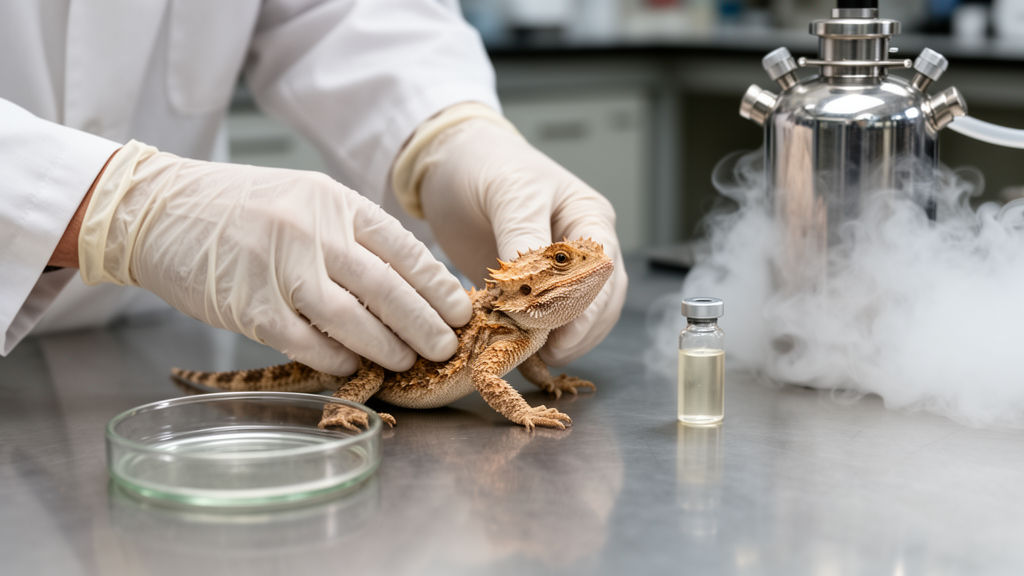
As global reptile populations continue to decline, improving reproductive success in managed populations of listed species, such as Phrynosoma cornutum (the Texas horned lizard) has become increasingly critical for species survival. One understudied area of reproductive research in reptile species is gamete collection and storage, a crucial component for maintaining genetic diversity. Semen was collected from wild P. cornutum (n = 20) collected from Cottle County, Texas, in June 2025. Semen collection was performed via electroejaculation (EEJ) under alfaxalone anesthesia. Prior to semen collection, snout-vent-lengths (SVLs) and weights were recorded and testes measurements were taken using a portable ultrasound. Semen samples were extended in a commercial equine preservation medium (INRA96) and divided for use in cold-storage longevity or cryopreservation trials. Samples under cold-storage conditions were assessed for motility daily for 10 days. For cryopreservation, samples were diluted 1:1 in INRAFreeze cryopreservation media and frozen in liquid nitrogen, then immediately thawed. Average fresh sperm motility and concentration across all lizards was 83.7% and 85.7 x 10⁶ sperm/mL, respectively. While lizards with longer SVLs had higher sperm motility, weight and testis size did not affect sperm parameters. During cold storage, sperm motility was not significantly reduced until 48 hours post-collection and maintained 19% motility until day 10. Following cryopreservation trials, the average post-thaw sperm motility was 13.9%, with the highest post-thaw motility recorded at 38.2%. This is the first report of semen storage and cryopreservation in Phrynosoma and provides valuable insight into semen storage potential in reptile species.
The significance of this work becomes clearer when placed against the broader backdrop of reptile conservation biology. With more than a fifth of the world’s reptile species currently threatened with extinction, zoological facilities have increasingly turned to assurance colonies as a hedge against wild population collapse. For the Texas horned lizard, a species once ubiquitous across the south-central United States and northern Mexico but now listed as threatened in Texas, such colonies have been established at multiple institutions with the explicit goal of producing offspring for release. Yet breeding success and hatch rates in these programs have remained stubbornly low, and without diagnostic tools to identify whether reproductive failure stems from the male or female side, managers have had little ability to intervene. This study addresses that gap by establishing, for the first time in this genus, a non-terminal pathway for obtaining and preserving viable semen.
The choice of electroejaculation as the collection method deserves particular attention. Historically, much of what researchers knew about reptile semen came from post-mortem collection from the vas deferens, an approach obviously incompatible with endangered species management. Manual massage techniques have been refined in some lizards and are the standard for snakes, but success rates vary considerably across species. Electroejaculation, which uses a rectal probe to deliver mild electrical stimulation to the nerves surrounding the vas deferens, had previously been validated mainly in larger-bodied reptiles such as turtles, crocodilians, and green iguanas. Concerns about probe size and animal welfare had long limited its use in smaller lizards. Beginning in 2018, however, studies in the spiny lava lizard, the crevice swift, and veiled and panther chameleons demonstrated that the technique could be both safe and repeatable in medium- and small-bodied species, including repeated collections over extended periods. The present work extends that lineage to Phrynosoma, a genus with distinctive body morphology and no prior record of semen storage or cryopreservation.
The anesthesia protocol also reflects a careful welfare consideration. Alfaxalone, administered at 15 to 18 milligrams per kilogram of body weight, is a neuroactive steroid anesthetic that has become increasingly favored in herpetological medicine because of its relatively rapid induction and recovery profile compared with older agents. Its use here allowed each wild-caught male to undergo ultrasound examination of the testes, morphometric recording, and semen collection within a single handling event, minimizing stress and the duration of captivity before the animals could be returned.
The fresh semen parameters reported are notable in their own right. An average motility of 83.7 percent and a concentration of 85.7 million sperm per milliliter indicate that the wild males sampled in June were in robust reproductive condition, consistent with capture during the height of the breeding season. The finding that longer snout-vent length correlated with higher motility, while body mass and testis dimensions measured by portable ultrasound did not, offers a practical if imperfect cue for field biologists selecting candidate males for genetic rescue efforts. Body length is simple to measure and may serve as a proxy for sexual maturity or overall condition in ways that single-organ dimensions do not capture reliably across individuals.
The cold-storage results carry perhaps the most immediate operational value. Sperm motility showed no significant decline for the first 48 hours after collection, a window long enough to transport samples between field sites and regional zoological facilities, or to coordinate insemination timing within a single institution. Even more striking, samples retained roughly 19 percent motility at day ten, suggesting that refrigerated semen extended in INRA96, a medium originally formulated for equine breeding, can bridge multi-day gaps between collection and use. That a commercial mammalian extender performed adequately in a lizard species underscores a recurring theme in comparative reproductive science: the fundamental requirements for sperm survival, namely osmotic balance, energy substrate, and buffering against metabolic acidification, are conserved widely enough that cross-taxa borrowing of media is often a productive starting point, even before species-specific optimization.
The cryopreservation outcomes, while more modest, establish a critical baseline. Average post-thaw motility of 13.9 percent, with the best individual sample reaching 38.2 percent, falls short of what would be needed for high-efficiency artificial insemination, but it demonstrates that Phrynosoma sperm can survive the freeze-thaw process at all. Post-thaw motility is a conservative proxy for fertilizing ability; some sperm that appear immotile after thawing may still retain intact membranes and genomes, and cryopreservation protocols typically improve substantially through iterative refinement of cryoprotectant concentration, cooling rate, and thawing temperature. The 1:1 dilution in INRAFreeze followed by plunging into liquid nitrogen represents a starting formulation rather than an endpoint, and the wide individual variation in post-thaw survival, from near zero to nearly 40 percent, suggests that male-specific factors, possibly related to seminal plasma composition or membrane lipid profiles, may be exploitable targets for improvement.
It is worth emphasizing why these tools matter for population genetics specifically. Small, closed colonies inevitably lose genetic diversity through drift and inbreeding over generations, and the standard remedy, moving animals between institutions for breeding, carries costs in stress, disease risk, and logistics. Semen storage decouples genetics from geography: a sample collected from a wild male in Cottle County can, in principle, fertilize eggs at a zoo hundreds of kilometers away, or be banked indefinitely in liquid nitrogen for use decades later when genetic refreshment is needed. For a species with declining wild populations, every genetically valuable male that can contribute without being removed from the wild, or whose gametes can outlive him, represents a meaningful conservation asset.
The study also contributes to a broader rebalancing of reptile reproductive research. Historically, attention has concentrated on female endocrinology, follicular dynamics, and the management of dystocia and follicular stasis, problems documented since the 1970s. Male-side investigation, encompassing semen collection, analysis, and preservation, has lagged far behind, and the resulting absence of standardized sperm parameters has made it difficult to assess male fecundity when pairings fail. By generating baseline motility and concentration data for a threatened lizard, this work gives managers a reference against which the semen of captive males can be judged, potentially distinguishing true infertility from husbandry-related suppression of sperm production.
Several avenues naturally follow from these findings. Refining the cryopreservation medium and freezing protocol for horned lizard sperm is the most obvious, given the gap between average and best-case post-thaw motility. Extending cold-storage trials beyond ten days would clarify the practical shelf life of refrigerated samples. Repeated sampling of the same individuals across a season, as has been done in chameleons, could reveal how semen quality varies with hormonal cycles and environmental conditions. And ultimately, the decisive test of any semen preservation protocol is whether stored sperm can achieve fertilization, whether through natural pairing supplemented with insemination or through fully artificial routes. Demonstrating that live sperm can be delivered on demand is the necessary first step toward that end, and this study provides it for a genus in which it had never before been shown.
Finally, the methodological framework itself, combining field capture under permit, alfaxalone anesthesia, point-of-care ultrasound, and immediate semen processing in the field or at a nearby facility, offers a template that can be adapted to other small-bodied threatened lizards. As reptile declines accelerate globally, the bottleneck is often not the desire to apply assisted reproductive technologies but the absence of validated, welfare-conscious protocols for the species at hand. Each successful validation, such as the one reported here for Phrynosoma cornutum, lowers the barrier for the next species and gradually assembles the toolkit that modern genetic management of captive and wild reptile populations will require.
Subject of Research: Reproductive biology and conservation of the Texas horned lizard
Article Title: Semen collection, short term storage, and cryopreservation in the Texas horned lizard (Phrynosoma cornutum)
Article References: Julien, A. R., Griffioen, J. A., Perry, S. M., Doege, R., Burger, I., & Barber, D. (2026). Semen collection, short term storage, and cryopreservation in the Texas horned lizard (Phrynosoma cornutum). Frontiers in Amphibian and Reptile Science, 4, Article 1845399. https://doi.org/10.3389/famrs.2026.1845399
Image Credits: AI Generated
DOI: 10.3389/famrs.2026.1845399
Keywords: reptile conservation, semen collection, cryopreservation, Phrynosoma cornutum, assisted reproductive technologies, sperm motility, Semen, collection, short, term, storage, Texas
Cite Scienmag News
Juliet Wilcox. (October 16, 2026). Semen collection, short term storage, and cryopreservation in the Texas horned lizard (Phrynosoma cornutum). Scienmag. https://scienmag.com/semen-collection-short-term-storage-and-cryopreservation-in-the-texas-horned-lizard-phrynosoma-cornutum/
Juliet Wilcox. "Semen collection, short term storage, and cryopreservation in the Texas horned lizard (Phrynosoma cornutum)." Scienmag, 16 October 2026, https://scienmag.com/semen-collection-short-term-storage-and-cryopreservation-in-the-texas-horned-lizard-phrynosoma-cornutum/. Accessed 16 October 2026.
Juliet Wilcox. "Semen collection, short term storage, and cryopreservation in the Texas horned lizard (Phrynosoma cornutum)." Scienmag. October 16, 2026. https://scienmag.com/semen-collection-short-term-storage-and-cryopreservation-in-the-texas-horned-lizard-phrynosoma-cornutum/


