


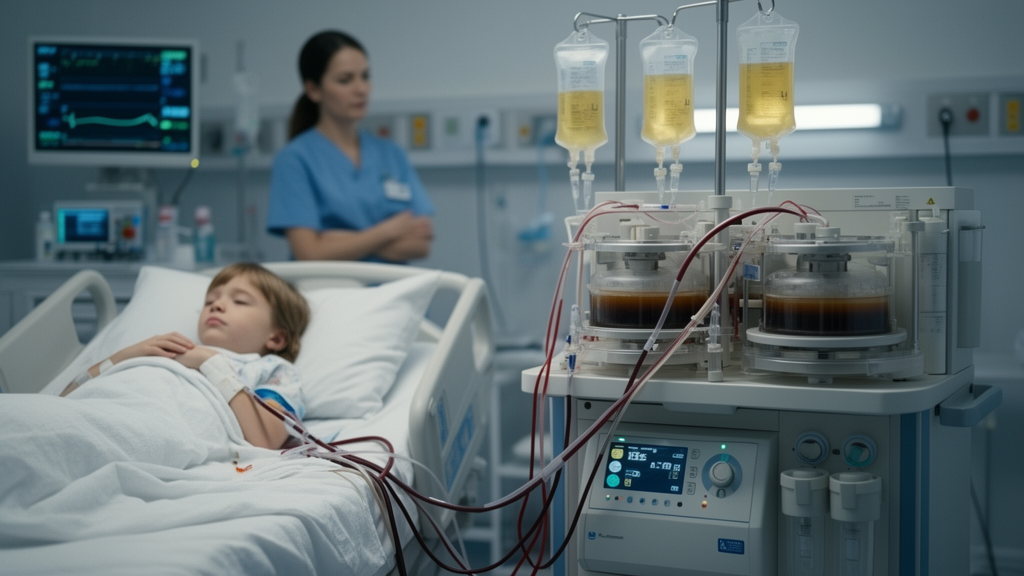
Therapeutic plasma exchange, a procedure that filters a patient’s blood to remove harmful substances circulating in the plasma, has become an increasingly common tool in pediatric intensive care units around the world. Yet despite its growing use, robust data on how critically ill children actually fare when they undergo the treatment have remained surprisingly scarce. A new retrospective study from a Chinese pediatric intensive care unit now offers one of the most detailed pictures to date, drawing on five years of clinical experience and 144 young patients to map out who receives the therapy, how safe it is, and which factors are most closely tied to survival.
The research, conducted at the pediatric intensive care unit of Zhujiang Hospital, Southern Medical University, examined every child who underwent therapeutic plasma exchange between January 2017 and December 2021. The investigators combed through medical records to collect demographic information, underlying diagnoses, the specific reasons the treatment was initiated, complications that arose during the procedures, and the ultimate outcomes for each patient. They also classified the indications for treatment according to the 2019 guidelines issued by the American Society for Apheresis, the professional body that categorizes which diseases merit plasma exchange and how strongly the evidence supports its use in each case.
The study population consisted of 144 children with a median age of 66 months, roughly five and a half years old. These were among the sickest patients in the hospital: the median Pediatric Risk of Mortality III score, a widely used measure of illness severity in intensive care, stood at 18, signaling a high baseline risk of death. Over the study period, these children collectively received 414 sessions of therapeutic plasma exchange, meaning the average patient underwent nearly three separate procedures during their intensive care stay.
One of the most striking findings concerned the range of conditions for which the treatment was deployed. Neurological disorders topped the list, accounting for 29.2 percent of the indications, followed by liver diseases at 19.4 percent and hematologic disorders at 16.7 percent. The remainder was spread across other categories, including immune-mediated and metabolic conditions. Notably, 57.6 percent of the children were treated for indications classified as category III under the American Society for Apheresis guidelines, a designation that reflects disorders for which the evidence base supporting plasma exchange is still developing rather than firmly established.
Safety emerged as a clear strength of the program. Across all 414 sessions, complications occurred at a rate of 16.9 percent per session, with clotting of the filter or circuit being the most frequent event at 7.2 percent. Such clotting is a well-known technical challenge in apheresis, arising when blood components interact with the artificial surfaces of the exchange circuit. Critically, the researchers reported that every complication resolved after prompt management, and no death could be attributed to the treatment itself. For a procedure performed on some of the most fragile patients in the hospital, that safety profile carries significant weight.
Survival, however, told a more sobering story. Overall mortality in the pediatric intensive care unit reached 36.8 percent among the children who received plasma exchange. The figures varied dramatically by underlying diagnosis: children treated for liver disease fared worst, with a mortality rate of 60.7 percent, while those treated for neurological disorders had the best outcomes, with mortality of just 16.7 percent. The difference was statistically significant, with a P value of 0.012, underscoring that the disease driving the need for plasma exchange matters enormously in determining prognosis.
To dig deeper into what separated survivors from non-survivors, the team compared the two groups across a range of clinical variables. The differences were stark. Children who died had substantially higher rates of multiple organ dysfunction syndrome, required mechanical ventilation more often, and needed vasopressor medications, drugs that raise blood pressure in patients with circulatory collapse, far more frequently than those who survived. All three comparisons were highly significant, with P values below 0.001, reflecting the severity gradient between the groups.
The investigators then turned to multivariate logistic regression, a statistical technique that can isolate the independent effect of each factor while accounting for the influence of the others. Two variables emerged as independent predictors of death. Multiple organ dysfunction syndrome carried an odds ratio of 5.609, with a 95 percent confidence interval spanning 1.189 to 26.453, meaning that children with the syndrome had more than five times the odds of dying compared with those without it. Vasopressor use carried an even stronger signal, with an odds ratio of 6.551 and a confidence interval of 1.310 to 32.768. In practical terms, a child whose circulation already depended on blood pressure support at the time of plasma exchange faced a markedly elevated risk, a finding that aligns with the broader critical care literature linking vasopressor dependence to poor outcomes.
The authors are careful about what their study can and cannot show. Because the design was retrospective and included no control group of comparable critically ill children who did not receive plasma exchange, the treatment’s efficacy could not be evaluated. The conclusions, as the researchers note, are limited to the safety profile and clinical characteristics of the therapy in this population. That caveat matters: without a comparison group, it is impossible to determine whether plasma exchange itself improved survival, merely that it was delivered safely to a very sick cohort whose mortality reflected the severity of their underlying illnesses.
Even with those limitations, the study adds valuable real-world data to a field where pediatric evidence has long lagged behind adult practice. It suggests that in an experienced pediatric intensive care unit, therapeutic plasma exchange can be delivered with a low rate of serious complications and no treatment-related deaths, even in children with profound multi-organ illness. It also offers clinicians a clearer sense of prognosis: children treated primarily for neurological conditions appear to tolerate the therapy well and survive at far higher rates than those with liver failure or established multi-organ dysfunction. As the use of apheresis continues to expand in pediatric medicine, the findings point toward the need for prospective, controlled studies that can finally answer the question this retrospective analysis could not, whether plasma exchange genuinely changes outcomes for critically ill children, and if so, for which patients and at what point in their illness it should be deployed.
Subject of Research: Safety, indications, and mortality risk factors of therapeutic plasma exchange in critically ill children
Article Title: Clinical characteristics and outcomes of 144 critically ill children receiving therapeutic plasma exchange in a pediatric intensive care unit: a single-center retrospective study
Article References: Chen, Z., Wei, Q., Liu, J., Zeng, C., & Zhao, W. (2026). Clinical characteristics and outcomes of 144 critically ill children receiving therapeutic plasma exchange in a pediatric intensive care unit: a single-center retrospective study. Frontiers in Pediatrics, 14, Article 1955886. https://doi.org/10.3389/fped.2026.1955886
Image Credits: AI Generated
DOI: 10.3389/fped.2026.1955886
Keywords: therapeutic plasma exchange, pediatric intensive care, critically ill children, multiple organ dysfunction syndrome, vasopressors, American Society for Apheresis, liver disease, neurological disorders, mortality risk factors, apheresis, retrospective study, pediatric critical care
Cite Scienmag News
Ophelia Keating. (October 16, 2026). Therapeutic Plasma Exchange Shows Strong Safety Record in Critically Ill Children, Single-Center Study Finds. Scienmag. https://scienmag.com/therapeutic-plasma-exchange-shows-strong-safety-record-in-critically-ill-children-single-center-study-finds/
Ophelia Keating. "Therapeutic Plasma Exchange Shows Strong Safety Record in Critically Ill Children, Single-Center Study Finds." Scienmag, 16 October 2026, https://scienmag.com/therapeutic-plasma-exchange-shows-strong-safety-record-in-critically-ill-children-single-center-study-finds/. Accessed 16 October 2026.
Ophelia Keating. "Therapeutic Plasma Exchange Shows Strong Safety Record in Critically Ill Children, Single-Center Study Finds." Scienmag. October 16, 2026. https://scienmag.com/therapeutic-plasma-exchange-shows-strong-safety-record-in-critically-ill-children-single-center-study-finds/


