


Cucurbits—squash, melons, cucumbers, pumpkins, watermelons and gourds—contribute more than 200 million tonnes to global food production each year, and a family of tiny, whitefly-carried DNA viruses is increasingly undermining that output. A new review published in Frontiers in Virology synthesizes what is known about begomoviruses infecting cucurbit crops worldwide, arguing that the drivers of their emergence and the tools available to manage them have developed along separate tracks that now need to be integrated. With 464 recognized species, the genus Begomovirus is the largest in the family Geminiviridae, and its members owe their evolutionary success to high mutation rates, frequent recombination, pseudorecombination and partnerships with satellite molecules that modulate disease.
The review, led by M. S. Gambo of Aliko Dangote University of Science and Technology in Nigeria together with colleagues in India and Nigeria, contrasts two very different epidemiological stories. In the Old World, Tomato leaf curl New Delhi virus (ToLCNDV) has undergone a remarkable intercontinental expansion from its origin in the Indian subcontinent, reaching Southeast Asia, the Middle East, North Africa and, since its first detection in Spain in 2013, the Mediterranean Basin. In the New World, persistent complexes such as Squash leaf curl virus (SLCV) and Cucurbit leaf crumple virus (CuLCrV) remain endemic threats to squash, melon and pumpkin production. Both scenarios are amplified by the spread of the whitefly vector Bemisia tabaci, climate-driven shifts in vector distribution and changing agricultural practices.
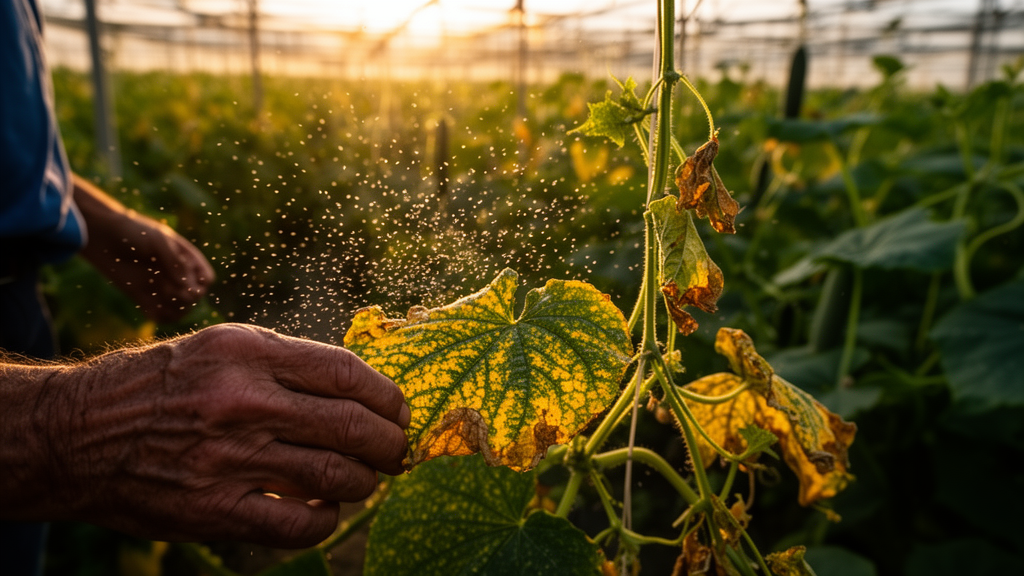
Symptom expression in the field is highly variable, which complicates diagnosis. CuLCrV typically induces downward leaf curling in watermelon and squash, whereas SLCV more often causes upward leaf cupping and severe distortion. ToLCNDV infection in zucchini, melon and cucumber is characterized by vein hypertrophy on young leaves, although severity varies with cultivar and environment. Mixed infections add further complexity: in Lebanon, co-infection of Watermelon chlorotic stunt virus (WmCSV) and SLCV produced more intense yellowing, leaf deformation and dwarfing than either virus alone, and similar multivirus disease complexes have recently been described in Saudi Arabia. The authors stress that visual symptoms should be treated only as a first filter, to be confirmed by molecular assays before any epidemiological or management decision is made.
At the molecular level, begomoviruses carry circular single-stranded DNA genomes of roughly 2.5 to 2.8 kilobases, either as a single component (monopartite) or as two components, DNA-A and DNA-B (bipartite). Bipartite genomes predominate among New World viruses, while both arrangements occur in the Old World. DNA-A encodes the replication-associated protein Rep, the transcriptional activator TrAP, the replication enhancer REn, the multifunctional C4 protein that contributes to symptom development and host defense suppression, the coat protein that mediates encapsidation and vector transmission, and, in many Old World viruses, the V2 pre-coat protein involved in movement and silencing suppression. DNA-B encodes the nuclear shuttle protein and the movement protein, whose coordinated action is essential for systemic infection.
This architecture is a platform for evolution. Multiple recombination breakpoints have been identified in the Rep and coat protein genes of ToLCNDV and linked to host-range expansion and intercontinental dissemination, allowing the virus to infect more than 11 cucurbit species as well as tomato, potato and numerous weed hosts. Pseudorecombination—the exchange of DNA-A and DNA-B components between compatible bipartite viruses—has generated novel lineages with altered symptom severity and host range, and the frequent co-infection of multiple begomoviruses in fields with high whitefly pressure provides abundant raw material for such reshuffling. Satellite molecules deepen this complexity. Betasatellites, circular DNAs of about 1.3 kilobases, encode the βC1 protein, a potent suppressor of host RNA silencing that drives severe leaf curling, enations and stunting; they have been found associated with ToLCNDV and WmCSV in cucurbits and correlated with increased symptom severity and higher viral DNA accumulation. Alphasatellites, by contrast, generally do not intensify symptoms but may modulate transmission or replication, while deltasatellites—non-coding defective derivatives of the helper genome—have so far not been definitively characterized in association with any major cucurbit-infecting begomovirus, a gap the authors say warrants systematic surveys.
Tissue-level biology reinforces the epidemiological picture. Cucurbit-infecting begomoviruses are strongly phloem-limited: classical ultrastructural work on SLCV in zucchini revealed abundant virions and large nuclear inclusion bodies in vascular parenchyma and maturing sieve elements, with sieve element necrosis appearing within days of infection. Immunolocalization and in situ hybridization confirm that CuLCrV is strictly phloem-limited and not sap-transmissible, in contrast to many mechanically transmissible cucurbit RNA viruses such as the potyvirus-like Squash yellow leaf curl virus, which produces cytoplasmic pinwheel inclusions. This phloem restriction explains why begomoviruses are acquired and inoculated by phloem-feeding whiteflies and supports management tactics that target vascular feeding stages, including systemic insecticides, rather than contact approaches alone.
On the diagnostic front, the review offers a comparative framework spanning conventional and quantitative PCR, isothermal amplification, rolling-circle amplification, serology, portable sequencing and emerging CRISPR-based assays. Laboratory PCR and qPCR remain the benchmark for high-confidence diagnosis, with qPCR detecting as little as 10 to 100 femtograms per microliter, but they require thermocyclers, reliable power and trained personnel. Isothermal methods such as loop-mediated isothermal amplification (LAMP) and recombinase polymerase amplification (RPA) approach PCR-level sensitivity with simpler equipment: LAMP assays for ToLCNDV in pumpkin return results in 30 to 45 minutes, and RPA for Squash leaf curl Philippines virus in pumpkin in 15 to 30 minutes, making both suitable for field-adjacent testing. Portable nanopore sequencing platforms such as MinION can resolve whole genomes and mixed infections within one to three days but remain constrained by cost, infrastructure and bioinformatics demands. No single method is optimal in all contexts, and the authors argue that the choice should match the surveillance purpose, from seed-health certification to outbreak investigation.
Management remains anchored in host resistance, which is the most sustainable strategy but is complicated by the genetics of the resistance sources identified so far. In cucumber, the Cy-1 locus on chromosome 1 encodes CsRDR3, a DFDGD-class RNA-dependent RNA polymerase that functions in transcriptional gene silencing and is orthologous to known antiviral genes in tomato and pepper; map-based cloning narrowed the locus to a 209-kilobase interval, and virus-induced gene silencing of CsRDR3 abolished resistance, confirming its causal role. In pumpkin, the cultivar Punjab Nawab carries digenic recessive resistance to mixed infections of Squash leaf curl China virus and ToLCNDV, controlled by loci on chromosomes 7 and 17, with the major locus fine-mapped to a 103-kilobase interval and captured by nine KASP markers suitable for marker-assisted selection. In melon, a major quantitative trait locus on chromosome 11 reduces ToLCNDV accumulation. Because resistance in these crops is largely recessive and quantitative, the authors advocate gene pyramiding—stacking Cy-1 with additional cucumber QTLs on chromosomes 2, 6 and 7, or combining the two pumpkin loci—to reduce the probability of resistance breakdown.
Complementary tactics are maturing at different speeds. Biological control with the parasitoid Encarsia formosa and reflective aluminum mulches that disorient whiteflies are already commercial, while exogenous double-stranded RNA sprays targeting ToLCNDV genes remain experimental, and CRISPR/Cas9 editing of host susceptibility factors such as eIF4E in cucumber is still at the laboratory stage. Seed certification based on PCR or rolling-circle amplification testing is under development, a notable gap given documented seed transmission of CuLCrV in squash. Vector management is further complicated by rapid insecticide resistance in whitefly populations and by the lack of region-specific strategies that account for local virus–vector complexes, including differences between B. tabaci biotypes such as MEAM1 and MED in transmission efficiency and insecticide susceptibility.
Looking forward, the review sets out a research agenda that couples genomics with artificial intelligence and climate science. The authors call for multiplex LAMP and RPA assays capable of simultaneously detecting ToLCNDV, SLCV, CuLCrV, WmCSV, SLCCNV and associated betasatellites, validated across multiple cucurbit-producing regions and embedded in standardized international seed-health protocols. AI-driven predictive models should link viral genomic changes to epidemiological outcomes, providing early warning of high-risk variants, while machine-learning forecasts trained on whitefly population dynamics, weather and cropping patterns could generate short-term risk alerts delivered through simple channels such as SMS. Modeling future disease hotspots under climate-change scenarios would guide targeted deployment of resistant cultivars and vector management. The unifying message is that begomoviruses will keep evolving faster than any single control measure; only sustained, multidisciplinary investment spanning virology, vector biology, host genetics and climate science can turn today’s fragmented knowledge into durable protection for the world’s cucurbit fields.
Subject of Research: Begomovirus diversity, epidemiology and management in cucurbit crops
Article Title: Global emergence of begomoviruses in cucurbits: diversity, epidemiology, and management strategies
Article References: Gambo, M. S., Hurakadli, M. S., Baghel, M. M., Suleiman, S. A., Jangra, N., & Dagar, A. (2026). Global emergence of begomoviruses in cucurbits: diversity, epidemiology, and management strategies. Frontiers in Virology, 6, Article 1890227. https://doi.org/10.3389/fviro.2026.1890227
Image Credits: AI Generated
DOI: 10.3389/fviro.2026.1890227
Keywords: begomovirus, cucurbits, Bemisia tabaci, ToLCNDV, plant virology, recombination, betasatellite, diagnostics, host resistance, RNA interference, CRISPR, integrated disease management
Cite Scienmag News
Phoebe Ingram. (October 16, 2026). Whitefly-borne begomoviruses are reshaping the global threat to cucurbit crops. Scienmag. https://scienmag.com/whitefly-borne-begomoviruses-are-reshaping-the-global-threat-to-cucurbit-crops/
Phoebe Ingram. "Whitefly-borne begomoviruses are reshaping the global threat to cucurbit crops." Scienmag, 16 October 2026, https://scienmag.com/whitefly-borne-begomoviruses-are-reshaping-the-global-threat-to-cucurbit-crops/. Accessed 16 October 2026.
Phoebe Ingram. "Whitefly-borne begomoviruses are reshaping the global threat to cucurbit crops." Scienmag. October 16, 2026. https://scienmag.com/whitefly-borne-begomoviruses-are-reshaping-the-global-threat-to-cucurbit-crops/


