


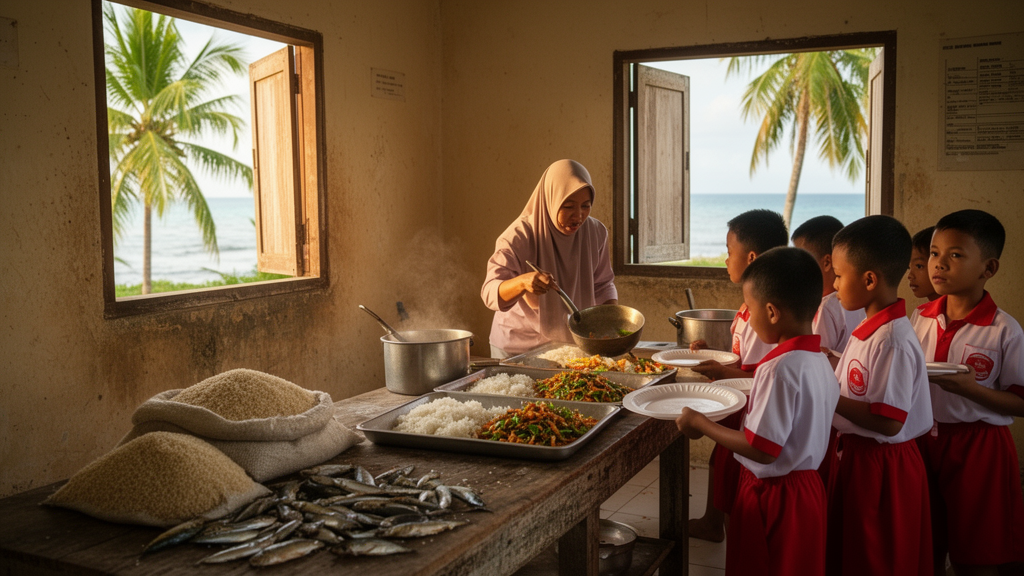
Indonesia’s Free Nutritious Meal Program, known locally as Program Makan Bergizi Gratis or MBG, was designed as a promise to every schoolchild in the archipelago: a hot, nutritious meal delivered regardless of where they live, aimed squarely at the country’s stubborn burden of malnutrition and stunting. On paper, it is the kind of universal welfare policy that governments across the Global South have embraced over the past two decades, from India’s Midday Meal Scheme to Brazil’s vast social assistance apparatus. But new research from North Sulawesi Province suggests that the journey from national promise to a child’s lunch plate is far more treacherous than policymakers imagined, and that the very act of implementing a universal program can quietly manufacture new forms of exclusion.
The study, published in Frontiers in Political Science, was conducted by a team from Sam Ratulangi University in Manado and collaborators in Jakarta and Yogyakarta. Led by Joyce Jacinta Rares of the Department of Public Administration, the researchers set out to answer a deceptively simple question: how does the interaction between national policy content and local implementation context shape what actually happens on the ground? Their answer, drawn from months of fieldwork across one of Indonesia’s most geographically fragmented provinces, is a cautionary tale for any government betting on uniform policy designs to deliver distributive justice.
North Sulawesi was a deliberate choice of case study. The province stretches across mainland districts and remote island chains, including the Sangihe and Talaud archipelagos that lie closer to the Philippines than to the provincial capital. Infrastructure quality, transport access, and administrative capacity vary dramatically from one regency to the next. This heterogeneity makes the province an ideal laboratory for observing what happens when a nationally standardized program collides with local realities that no central guideline anticipated.
Between June and August 2025, the researchers conducted in-depth interviews with eight key informants, including representatives of two central ministries, managers of the Nutrition Fulfillment Service Units known as SPPG, the local kitchens that prepare and distribute meals, and school principals from Manado City, Minahasa Regency, the Sangihe Islands, and the Talaud Islands. They supplemented these interviews with direct field observations at kitchen facilities, including the SPPG at Soataloara II in Sangihe and the SPPG at Melonguane in the Talaud Islands, and with an analysis of policy documents and official reports. The team applied qualitative thematic analysis, triangulating evidence across sources and drawing on Grindle’s policy implementation framework alongside Michael Lipsky’s theory of street-level bureaucracy, which holds that frontline officials exercise substantial discretion as they reconcile standardized rules with messy local conditions.
The first major finding concerns targeting. Although MBG is nominally universal, the researchers found that the selection of beneficiary schools was driven overwhelmingly by administrative readiness rather than by social vulnerability. Schools with strong documentation, adequate facilities, and robust bureaucratic reporting were far more likely to be enrolled in the program than schools in remote, low-income areas, even though the latter often faced the greatest nutritional need. The authors describe this as a shift from substantive rationality, which would prioritize students’ actual nutritional deficits, to procedural rationality, which rewards administrative order and auditability. In the language of public management, this is a classic case of goal displacement: the means of the bureaucracy, its procedures and compliance mechanisms, gradually replace the original ends of the policy.
The consequences are starkly visible in the island regencies. A principal at Ebenhaezar Christian Elementary School in Melonguane, Talaud Islands, told the researchers that food deliveries do not always arrive on schedule because transportation to the island depends heavily on sea conditions, and that when weather deteriorates, meal distribution is delayed and maintaining food quality and freshness becomes increasingly difficult. Another principal, at Apengsembeka Inpres State Elementary School in the Sangihe Islands, noted that implementation procedures are identical to those applied in mainland areas even though logistical realities differ profoundly, with higher transport costs and longer delivery times that current arrangements fail to reflect. Urban schools in Manado, by contrast, tended to receive services more consistently.
The second finding concerns power. MBG is formally designed as a cross-sectoral program, but the researchers documented deeply asymmetrical relations among implementing actors. Strategic decisions about program design, operational standards, and implementation mechanisms are concentrated at the national level, while local governments and schools function largely as technical executors. A manager of the SPPG in PAAL Dua, Manado, explained that their responsibility is to implement the technical guidelines issued by the central government, with very limited authority to modify operational procedures because major decisions, including menu standards and implementation mechanisms, must comply with national guidelines. The result is a structural squeeze: frontline managers bear direct responsibility for kitchen operations, menu planning, and distribution, yet lack the authority to adapt these operations to conditions the national standards never envisioned.
Caught between rigid rules and unforgiving geography, implementers resort to informal adaptations. The SPPG manager in Manado described occasions when meal portions had to be reduced because of budget limitations and the rising cost of transporting supplies, adjustments made solely to keep the program running. Elsewhere, managers substituted unavailable ingredients with locally obtainable alternatives, despite rules prohibiting menu changes without prior approval. The researchers characterize these practices not as acts of resistance but as survival strategies, what they call forced deviations produced by the policy design itself. Because these adaptations are individual and non-institutionalized, they generate inconsistencies in service quality across regions while leaving the underlying design flaws unaddressed.
The deeper problem, the authors argue, is a spatial disconnection at the heart of the policy. MBG’s operational guidelines assume relatively uniform infrastructure, continuous market access, and manageable price fluctuations, assumptions that may hold in densely connected mainland regions but collapse in archipelagic terrain. The program relies on standardized per-portion cost frameworks set at national or overly broad regional levels, which fail to capture the vastly higher logistics costs of delivering a single meal to the outer islands of Sangihe or Talaud compared with Manado. When these cost differentials are not accommodated in budget design, food quality in remote areas is effectively sacrificed to subsidize transportation expenses. Rigid menu standardization compounds the problem, ignoring local dietary preferences and local food availability, and forgoing the potential multiplier effects that procurement from local farmers, fishers, and small businesses could provide.
Perhaps the most provocative conclusion is what the researchers call the paradox of universalism. Universal policies are theoretically meant to eliminate stigma and guarantee basic rights without discrimination, yet when implemented across structurally unequal landscapes without affirmative mechanisms, they can reproduce the very inequalities they aim to erase. Schools serving predominantly low-income students in remote areas experience delays, degraded quality, or outright exclusion due to administrative requirements, while better-resourced urban schools receive consistent, higher-quality service. This regressive pattern, in which benefits flow disproportionately to those already better off or easier to reach, means that MBG’s universal label increasingly functions as a symbol of state presence and political commitment rather than as an effective instrument of redistribution.
The study’s implications reach well beyond Indonesia. The authors recommend geographically differentiated budgeting that provides higher per-meal allocations for remote island regions, greater operational flexibility for local governments and implementing units in determining menus, procurement, and distribution schedules, and targeting mechanisms grounded in empirical indicators of social vulnerability rather than administrative readiness. They frame these reforms through the principle of asymmetric decentralization, which holds that regions with distinct geographical and socio-economic characteristics require differentiated policy arrangements rather than uniform treatment. Without such flexibility, they warn, even the most ambitious welfare policies risk becoming promises on paper for peripheral communities. The future success of programs like MBG, they conclude, will not be determined by uniform menus delivered from one end of the archipelago to the other, but by the system’s sensitivity and capacity to adapt to local rhythms across Indonesia’s vast and varied landscape.
Subject of Research: Implementation of Indonesia's universal free school meal program and its social exclusion effects in North Sulawesi
Article Title: Implementation of universal welfare policies in the Global South: a case study of Indonesia’s free nutritious meal program
Article References: Rares, J. J., Mamentu, M., Ridha, M., & Abidin, Z. (2026). Implementation of universal welfare policies in the Global South: a case study of Indonesia’s free nutritious meal program. Frontiers in Political Science, 8, Article 1845044. https://doi.org/10.3389/fpos.2026.1845044
Image Credits: AI Generated
DOI: 10.3389/fpos.2026.1845044
Keywords: Indonesia, Free Nutritious Meal Program, welfare policy, policy implementation, Global South, North Sulawesi, social exclusion, street-level bureaucracy, school feeding, stunting, decentralization, archipelagic logistics
Cite Scienmag News
Daisy Hatcher. (October 16, 2026). When Free Meals Miss the Islands: How Indonesia’s Universal Nutrition Program Falters at the Frontline. Scienmag. https://scienmag.com/when-free-meals-miss-the-islands-how-indonesias-universal-nutrition-program-falters-at-the-frontline/
Daisy Hatcher. "When Free Meals Miss the Islands: How Indonesia’s Universal Nutrition Program Falters at the Frontline." Scienmag, 16 October 2026, https://scienmag.com/when-free-meals-miss-the-islands-how-indonesias-universal-nutrition-program-falters-at-the-frontline/. Accessed 16 October 2026.
Daisy Hatcher. "When Free Meals Miss the Islands: How Indonesia’s Universal Nutrition Program Falters at the Frontline." Scienmag. October 16, 2026. https://scienmag.com/when-free-meals-miss-the-islands-how-indonesias-universal-nutrition-program-falters-at-the-frontline/


