


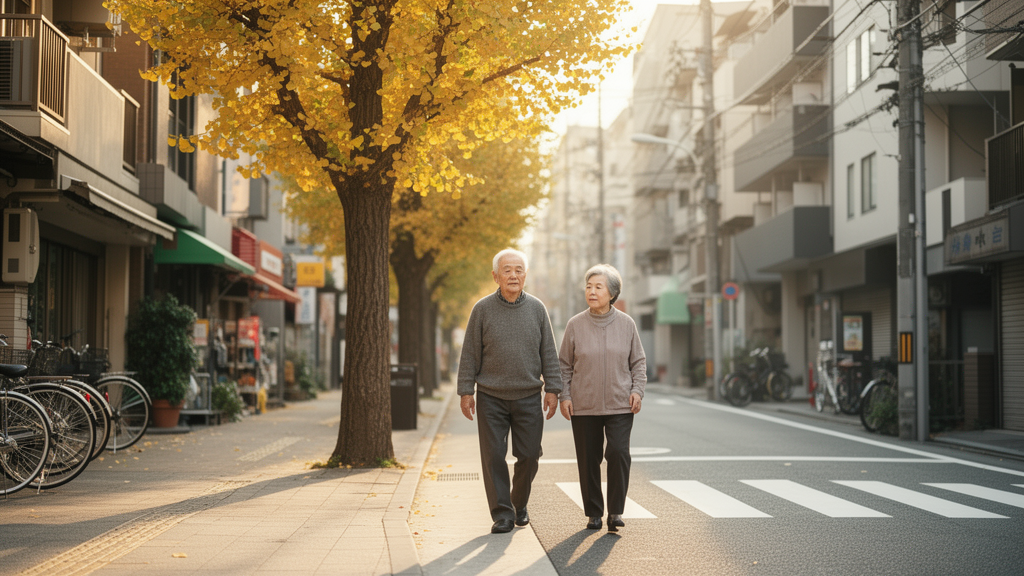
Osteoporotic fractures are among the most common causes of disability in older adults and a major driver of medical spending worldwide, and more than half of these breaks happen outdoors. A new study from Japan now suggests that the design of the neighborhoods where older people live may be closely tied to their risk of fracturing a bone—but only in the places where fracture risk is already highest. The research, published in Frontiers in Public Health, is the first to map fracture hotspots at the level of individual residential addresses and then ask how specific features of the built environment relate to fracture outcomes inside and outside those hotspots.
The scale of the problem gives the findings urgency. In 2010, an estimated 21 million men and 137 million women worldwide had a high probability of osteoporotic fracture, and that number is projected to nearly double to 319 million by 2040, with Asia accounting for 55 percent of those at high risk. By 2050, more than half of all osteoporotic fractures are expected to occur in Asia as the region’s population ages. Japan sits at the leading edge of this demographic shift: its share of residents aged 65 and older is projected to reach 37.7 percent by 2050, and in 2021 the country spent an estimated 1,278 billion yen on conditions related to bone density and structure and on fracture care for its aging population.
Researchers Qiaohui Zhou of Jinhua University of Vocational Technology and Riken Homma of Kumamoto University tackled the question with an unusually rich dataset. They obtained five years of fracture records—2017 through 2021—for 39,577 residents of Kumamoto Prefecture aged 75 or older, drawn from the Kumamoto Prefecture Senior Citizens’ Medical and Wide Area Alliance. Each person was assessed annually, and fracture occurrence was recorded as yes or no for each year, producing an ordered count from zero to five that represents how many years a fracture was recorded rather than clinical severity. Crucially, 98.51 percent of the participants were geocoded at the household level, allowing the team to work with fine-grained residential point data instead of the aggregated census tracts or towns that dominate most epidemiological studies.
To find fracture hotspots, the researchers used Kulldorff’s spatial scan statistics in an ordinal form, which preserves the ranked structure of the fracture counts rather than collapsing them into a simple case–control split. The method places a scanning window across the study area and identifies where the likelihood ratio test statistic reaches its maximum, with significance assessed through 999 Monte Carlo simulations. The team also applied a Gini coefficient procedure to optimize the maximum reported cluster size, settling on 20 percent as the optimal value. The scan revealed exactly two significant clusters: a high cluster in the northwest of the prefecture, covering the Tamana area and Yamaga city, and a low cluster northeast of Kumamoto city, encompassing Koshi city and Kikuyo town.
The two clusters differed sharply in both people and place. In the high cluster, only 74.3 percent of older adults had experienced no fracture over the five years, compared with 83.4 percent in the low cluster. Residents of the high-risk area were older on average, more likely to be women, and more likely to have reduced kidney function, low hemoglobin, dementia, and musculoskeletal disorders. They also reported poorer self-rated health, less satisfaction with daily life, slower walking speed, lower exercise rates, less social engagement, and more falls in the past year. The environment told a parallel story: the low cluster’s average population density was more than three times that of the high cluster, its intersection density more than twice as high, its walk score and mix of function nearly double, and its bus accessibility more than one and a half times greater, while the high cluster actually sat on steeper terrain.
For the statistical core of the study, the researchers turned to a zero-inflated ordered logit model, a technique designed for data crowded with zeros. The team reasoned that people with no fractures over five years belong to two latent groups: a genuinely non-susceptible excess group, and conditional zeros—people who did not fracture but might have if they had lived in less walkable neighborhoods or exercised less. The model therefore runs two processes at once: a binary logit that estimates the probability of being susceptible to fracture at all, and an ordered logit that models fracture frequency among those who are susceptible. This separation matters, because it allows the environment to influence whether someone ever fractures without necessarily changing how often fractures occur among the already vulnerable.
The results split cleanly along the cluster boundary. In the low cluster, no built environment attribute showed any significant association with either fracture occurrence or fracture frequency. In the high cluster, four attributes emerged as statistically significant protective factors for fracture occurrence. Population density was the strongest: older adults in the highest-density areas had odds of fracture occurrence only half those of people in the lowest-density areas, an odds ratio of 0.50 with a confidence interval of 0.35 to 0.71. Intersection density followed with an odds ratio of 0.64, bus accessibility with 0.75, and mix of function with 0.82, while walk score showed a marginal association at 0.75. Slope, by contrast, showed no significant relationship.
The pattern in the predicted probabilities reinforced the message. The probability of experiencing zero fractures rose steadily as walk score, mix of function, population density, intersection density, and bus accessibility increased, while the probability of one fracture fell consistently across the same gradient, with the most pronounced shifts seen for population density and then intersection density. Susceptibility estimates told a similar story: more than 35 percent of residents were susceptible to fracture when population density was zero, dropping below 25 percent at the highest densities, and comparable declines appeared for intersection density, walk score, bus access, and mix of function.
Why would the built environment matter in one place and not another? The authors point to context. Older adults in the low cluster were healthier overall—better physical performance, better oral function, fewer falls, and fewer musculoskeletal disorders—leaving less room for the environment to move the needle. The overall fracture incidence in the low cluster was also 9.1 percent lower than in the high cluster, which reduces statistical power to detect associations. In high-risk areas, by contrast, improving walkability may have more leverage: denser neighborhoods may offer better access to healthcare, more pedestrian-friendly infrastructure, and more social interaction that encourages physical activity, though the study did not directly test these mechanisms.
Notably, none of the built environment attributes was associated with fracture frequency among the susceptible group, suggesting that once someone is prone to fractures, individual factors such as bone density, frailty, and pre-existing musculoskeletal disorders may outweigh the influence of the neighborhood. The findings therefore point to a two-track strategy: urban planning that enhances density and street connectivity in high-risk areas to prevent first fractures, alongside individual-level interventions such as bone health screenings, strength training, and nutrition programs to reduce repeat fractures. The authors caution that the five-year window, cross-sectional covariates, separately modeled attributes, and baseline-only environment measurements limit causal interpretation, and they call for longitudinal studies with time-varying exposure data. Still, by pinpointing where fracture risk concentrates and which neighborhood features travel with it, the study offers local governments a concrete starting point for building neighborhoods that help older residents stay active, mobile, and unbroken.
Subject of Research: The relationship between neighborhood built environment attributes and fracture risk among older adults in high- and low-fracture clusters in Japan.
Article Title: Neighborhood built environment and fracture risk among older adults: comparing high versus low clusters
Article References: Neighborhood built environment and fracture risk among older adults: comparing high versus low clusters. (n.d.). https://doi.org/10.3389/fpubh.2026.1947343
Image Credits: AI Generated
DOI: 10.3389/fpubh.2026.1947343
Keywords: osteoporotic fracture, built environment, walkability, older adults, spatial scan statistics, population density, intersection density, bus accessibility, mixed land use, Japan, public health, aging
Cite Scienmag News
Ophelia Keating. (October 16, 2026). Denser, More Walkable Neighborhoods Tied to Lower Fracture Risk in Older Japanese Adults. Scienmag. https://scienmag.com/denser-more-walkable-neighborhoods-tied-to-lower-fracture-risk-in-older-japanese-adults/
Ophelia Keating. "Denser, More Walkable Neighborhoods Tied to Lower Fracture Risk in Older Japanese Adults." Scienmag, 16 October 2026, https://scienmag.com/denser-more-walkable-neighborhoods-tied-to-lower-fracture-risk-in-older-japanese-adults/. Accessed 16 October 2026.
Ophelia Keating. "Denser, More Walkable Neighborhoods Tied to Lower Fracture Risk in Older Japanese Adults." Scienmag. October 16, 2026. https://scienmag.com/denser-more-walkable-neighborhoods-tied-to-lower-fracture-risk-in-older-japanese-adults/


