


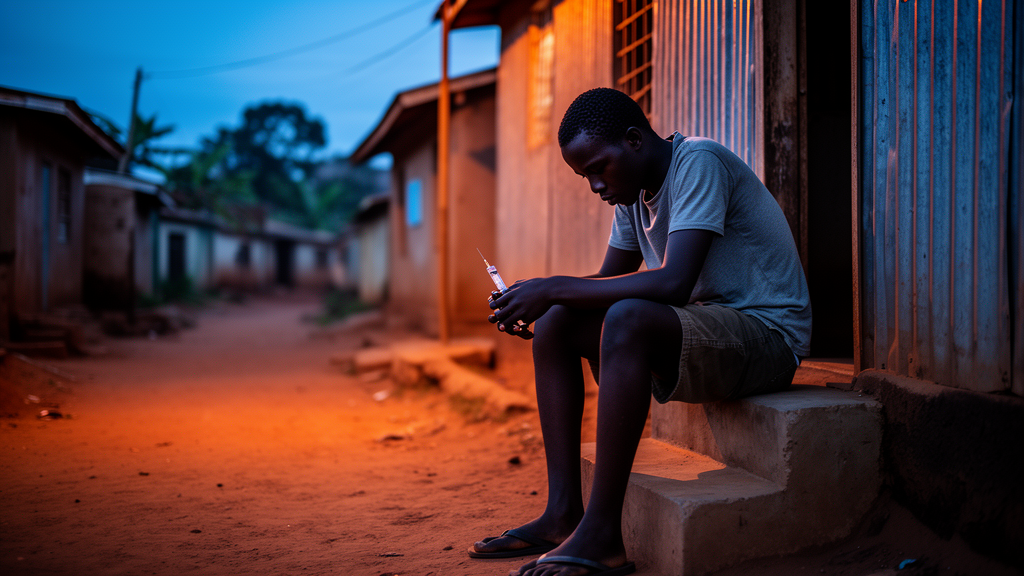
In the crowded neighborhoods of Kigali, Rwanda’s capital, a quiet public health crisis is unfolding at the intersection of mental illness, substance dependence, and HIV risk. A new cross-sectional study published in Advances in Drug and Alcohol Research has provided one of the first systematic portraits of people who inject drugs (PWID) in Rwanda, and its findings are striking: among 480 respondents recruited from populations at high risk for HIV/AIDS, nearly one in three injected drugs, and an overwhelming 86.25 percent reported symptoms of depression. Among those who injected drugs specifically, the figure climbed to 94 percent—a prevalence that far exceeds previously documented rates in the general Rwandan population.
The research, led by Samuel Habimana of Loma Linda University and the Rwanda Resilience and Grounding Organization, together with colleagues from the University of Rwanda and other institutions, set out to untangle the web of sociodemographic characteristics, alcohol and substance dependence, and depressive symptoms associated with injection drug use. The timing matters. Globally, drug use has surged by 23 percent over the past decade, with roughly 296 million people now using drugs and approximately 78 percent of them residing in low- and middle-income countries. While African countries historically reported low rates of injecting drug use, heroin injection has been rising in large East African towns since 2009, and Rwanda is no exception to this troubling trend.
To reach a population that is largely hidden from official view—criminalization and cultural stigmatization of both drug use and same-sex behavior make these groups exceptionally hard to access—the researchers employed snowball sampling. Trusted outreach workers from the Rwandan Health Development Initiative (HDI) recruited participants through their social networks, with data collected at two sites in Kigali: the HDI headquarters and the Nyakabanda Health Clinic. Participants were eligible if they were at least 18 years old, lived in Kigali, and self-identified as men who have sex with men (MSM), female sex workers (FSW), people who inject drugs, or other substance users. Each participant completed a structured questionnaire administered in Kinyarwanda, received five US dollars in compensation, and underwent rapid HIV testing with pretest and posttest counseling.
The methodological toolkit was rigorous. Depressive symptoms were assessed using the Beck Depression Inventory-II (BDI-II), a 21-item instrument with strong psychometric properties in Rwandan populations, which achieved a Cronbach’s alpha of 0.898 in this study—indicating excellent internal consistency. Alcohol and substance dependence were evaluated with the Mini-International Neuropsychiatric Interview (MINI), a short structured diagnostic interview developed for DSM-IV and ICD-10 psychiatric disorders. Injection drug use was operationally defined as self-reported injecting of any illicit drug within the previous 12 months. Of the 480 participants, 151—31.5 percent—met this definition.
The demographic profile of those who injected drugs tells its own story. Among PWID, 93.4 percent were male, 89.4 percent were single, and more than half—52.3 percent—were between 18 and 25 years old. Bivariate analyses using Pearson’s chi-square tests revealed statistically significant associations between injection drug use and age, sex, MSM status, FSW status, marital status, and education level. Notably, MSM participants were heavily overrepresented among injectors: 72.8 percent of PWID identified as MSM, compared with 47.1 percent of non-injecting participants. Employment status, by contrast, showed no significant association.
Substance use patterns among injectors were equally revealing. Nearly three-quarters of PWID reported alcohol use, 61.6 percent reported marijuana use, and a remarkable 96 percent exhibited symptoms of drug dependence. Nearly half met criteria for alcohol dependence or abuse. Injectors were also significantly more likely to have sought treatment for substance use—29.1 percent versus 14.3 percent among non-injectors—and to smoke cigarettes or use diazepam. HIV prevalence in the overall sample was 4.7 percent, higher than the roughly 3 percent reported among Rwandan adults aged 15 to 49, though HIV status itself was not statistically associated with injection drug use in this sample.
The multivariate logistic regression analysis, which adjusted for potential confounders, distilled the picture to a handful of independent risk factors. Participants with substance dependence were nearly four times more likely to inject drugs (adjusted odds ratio [aOR] = 3.547; 95% CI 1.159–10.857). Marijuana users carried more than three times the odds (aOR = 3.261; 95% CI 1.380–7.708). MSM status tripled the odds (aOR = 3.20; 95% CI 1.816–5.640). Most strikingly, individuals with depressive symptoms had 4.5 times the odds of being injectors compared with those without such symptoms (aOR = 4.50; 95% CI 2.55–7.96, p = 0.018). Intriguingly, alcohol dependence was associated with lower odds of injection drug use (aOR = 0.511), as was cocaine use (aOR = 0.404) and female sex (aOR = 0.698)—patterns the authors suggest may reflect distinct trajectories of drug escalation, in which some users progress from alcohol or non-injection routes to injection over time.
The depression finding is the study’s most consequential contribution, and the authors are careful about its interpretation. The association is consistent with the self-medication hypothesis: in low-income settings with limited access to mental health resources, some individuals may turn to injecting drugs as a coping strategy for emotional distress. But because the study is cross-sectional, the reverse pathway is equally plausible. Substance-induced depression—whether during opioid or stimulant withdrawal or as a neuroadaptive consequence of chronic use—is well documented in the neuropsychopharmacology literature, meaning injection drug use may itself generate the depressive symptoms rather than result from them. Stigma surrounding injecting drug use may further discourage individuals with co-occurring depression from seeking mental health assistance, deepening the cycle.
The context of Rwanda makes these numbers even more sobering. Depression affects an estimated 35 percent of genocide survivors and 20 percent of the general population in the country—figures already considered high. Yet the 94 percent prevalence among injectors and 82.3 percent among other high-risk participants in this study dwarf both benchmarks. The findings align with research from China, Kenya, Vietnam, and Tanzania documenting tight links between depression, injecting drug use, and HIV risk behaviors, including studies showing that women who inject drugs and engage in sex work face elevated rates of suicidal ideation and equipment sharing. One unexpected result—a lower HIV prevalence among PWID (2.6 percent) than among other risk groups (5.7 percent)—warrants caution rather than reassurance, the authors note, because injectors were significantly younger and may simply have had less cumulative exposure time.
The study has limitations that temper its conclusions. The nonrandom snowball sampling and recruitment through a single NGO service provider may over-represent individuals already connected to services, and self-reported measures of both drug use and depressive symptoms are vulnerable to social desirability bias. The BDI-II is a screening tool, not a clinical diagnostic instrument, and the MINI’s reliance on DSM-IV criteria may introduce inconsistencies with the updated DSM-5. Family history of substance use, surprisingly, showed no statistical association with injection drug use—contrasting with European findings and possibly reflecting how new injection drug use is as a phenomenon in Rwanda. Still, the implications are clear. The authors call for integrated health services that address mental health, substance use, and HIV-related vulnerabilities together, particularly for young people and sexual minorities, and for longitudinal and mixed-methods research to clarify the temporal relationships at play. As injecting drug use expands across East Africa, harm-reduction strategies that embed mental health care may prove essential to preventing a wider HIV resurgence.
Subject of Research: Risk factors for injection drug use among populations at high risk for HIV/AIDS in Kigali, Rwanda
Article Title: Profile of risk factors for people who inject drugs among a sample at high risk of HIV/AIDS in Kigali, Rwanda
Article References: Profile of risk factors for people who inject drugs among a sample at high risk of HIV/AIDS in Kigali, Rwanda. (n.d.). https://doi.org/10.3389/adar.2026.16156
Image Credits: AI Generated
Keywords: injection drug use, HIV/AIDS, depression, Rwanda, substance dependence, harm reduction, public health, men who have sex with men, female sex workers, Kigali, mental health, cross-sectional study
Cite Scienmag News
Glenn Wilkins. (October 16, 2026). Depression and Drug Dependence Drive Injection Drug Use Among High-Risk Groups in Kigali, Rwanda. Scienmag. https://scienmag.com/depression-and-drug-dependence-drive-injection-drug-use-among-high-risk-groups-in-kigali-rwanda/
Glenn Wilkins. "Depression and Drug Dependence Drive Injection Drug Use Among High-Risk Groups in Kigali, Rwanda." Scienmag, 16 October 2026, https://scienmag.com/depression-and-drug-dependence-drive-injection-drug-use-among-high-risk-groups-in-kigali-rwanda/. Accessed 16 October 2026.
Glenn Wilkins. "Depression and Drug Dependence Drive Injection Drug Use Among High-Risk Groups in Kigali, Rwanda." Scienmag. October 16, 2026. https://scienmag.com/depression-and-drug-dependence-drive-injection-drug-use-among-high-risk-groups-in-kigali-rwanda/


