

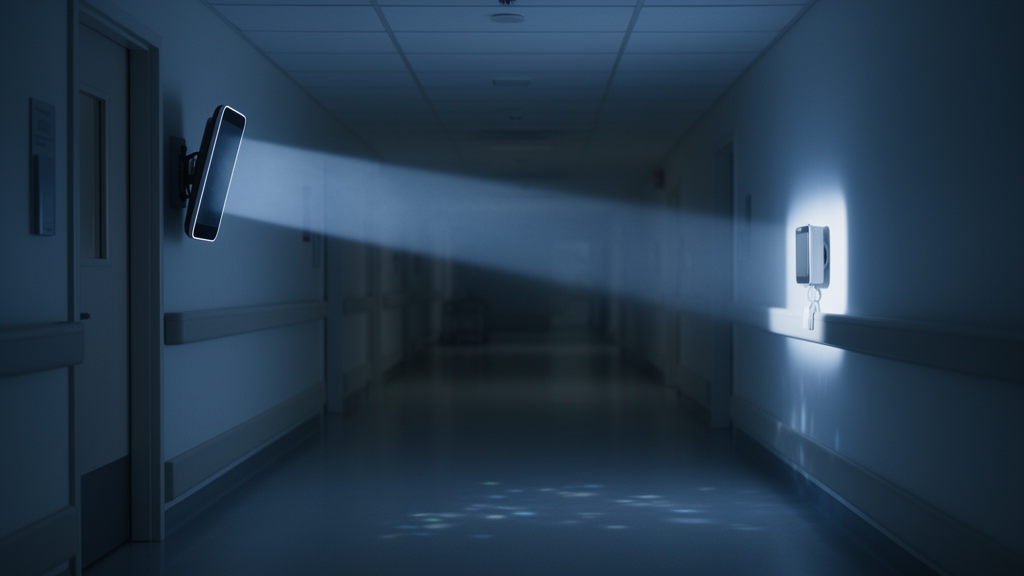
Hospitals are among the most radio-hostile environments imaginable. Sensitive monitoring equipment, strict electromagnetic compatibility rules, and the constant movement of staff and machinery make conventional wireless links fragile in exactly the places where connectivity matters most. Visible light communication, or VLC, has long been proposed as an elegant answer: it rides on ordinary illumination, is immune to electromagnetic interference, and confines its signals behind walls, which also improves physical-layer security. A new analytical study published in Frontiers in Communications and Networks now quantifies a stubborn weakness in the most promising extension of this technology, and the numbers give engineers a clear target.
The research, led by Babak Sadeghi and Seyed Mohammad Sajad Sadough of Shahid Beheshti University in Tehran together with Khadijeh Ali Mahmoodi of Université de Versailles Saint-Quentin-en-Yvelines, tackles pointing errors in VLC systems assisted by intelligent reflecting surfaces, or IRSs. These surfaces, sometimes called optical smart mirrors, consist of electronically controllable reflective elements that can steer an incoming light beam toward a receiver whose direct line of sight has been blocked. In a hospital ward, where beds, curtains, equipment carts, and people constantly interrupt the optical path between a ceiling LED and a photodetector, such NLoS capability is what turns VLC from a fragile novelty into a practical network layer.
The catch is geometry. A conventional line-of-sight VLC link has one beam, one transmitter, and one receiver, so misalignment comes from transmitter jitter and receiver orientation fluctuations. An IRS-assisted link is a cascaded transmitter-IRS-receiver chain, and every stage adds its own misalignment budget: the transmitter must accurately illuminate the designated IRS unit, the IRS controller must steer each mirror element with sufficient precision, the receiver’s position and orientation must be known, and the reflective elements themselves carry fabrication imperfections. Because the law of reflection doubles the angular deviation introduced at the surface, small controller errors translate into disproportionately large beam displacements at the photodetector.
To capture all of this in one tractable model, the team made a set of standard but consequential assumptions. Each angular error component is treated as an independent zero-mean Gaussian random variable, and because the horizontal displacement components along the two receiver-plane axes are then independent and identically distributed, the radial beam displacement follows a Rayleigh distribution. From this foundation the authors derived closed-form expressions for the composite pointing-error variance, the average received optical power, the electrical signal-to-noise ratio, and the outage probability, for both the direct and the reflected link. The received-power derivation exploits the circular symmetry of the photodetector aperture, transforming the two-dimensional surface integral into polar coordinates and evaluating it with the modified Bessel function of the first kind, which yields a compact power-loss factor that depends on the beam waist, the detector radius, and the displacement statistics.
The numerical results are striking. Under the study’s nominal parameters, which include a 5-watt LED transmitter, a 100-element IRS with 0.9 reflectivity, and a 10 dB SNR threshold, the composite pointing-error variance of the IRS-assisted link is roughly 3.5 to 4 times higher than that of the conventional LoS link. This translates into an SNR penalty of approximately 3 to 5 dB under practical conditions. In the direct link, receiver orientation fluctuations dominate the error budget, contributing nearly 64 percent of the total variance. In the IRS-assisted configuration the picture is more distributed: localization uncertainty alone accounts for about 40 percent, with IRS controller inaccuracies and fabrication imperfections adding noticeable further contributions.
The outage behavior is where the trade-off becomes most visible. Outage probability, defined as the chance that the instantaneous SNR falls below the threshold required for reliable communication, rises steeply with beam displacement in both configurations, but the slope is markedly steeper for the reflected path. For small radial displacements both links keep outage probabilities low, around 0.05. As displacement grows to an intermediate value, the LoS link reaches an outage probability of roughly 0.14 while the IRS-assisted link climbs to about 0.20. At larger displacements the gap widens further, to approximately 0.38 versus 0.55. The exponential dependence of outage on the ratio of displacement to beam width means that even modest increases in misalignment can sharply erode reliability, particularly on the cascaded path.
The authors validated their framework against Monte Carlo simulation with 100,000 independent realizations, and the analytical SNR curves track the simulated points closely across the entire range of radial displacements. Minor deviations at large displacements are attributed to the finite number of realizations and the heightened sensitivity of collected optical power under severe misalignment. This agreement matters, because it confirms that the Gaussian error model and the Rayleigh displacement statistics faithfully capture the behavior of practical IRS-assisted VLC links, giving system designers a closed-form tool rather than a purely simulation-based workflow.
What does this mean for hospitals? The study does not argue against IRS deployment; on the contrary, it frames the technology as essential for restoring connectivity whenever the direct optical path is obstructed, which in a busy ward is most of the time. Instead, the findings identify where engineering effort should be concentrated. Accurate user localization emerges as the single largest contributor to the IRS link’s error variance, followed by the precision of IRS beam steering and the manufacturing quality of the reflective elements. The authors conclude that these three factors, together with effective misalignment mitigation, are the primary determinants of link reliability in IRS-assisted VLC deployments.
The work also fills a genuine gap in the literature. Previous studies of IRS-assisted VLC have concentrated on frequency-domain channel characterization, beam-steering design, resource allocation, and performance under idealized alignment, while the statistical characterization of pointing errors in cascaded optical links had received comparatively little attention. By jointly incorporating transmitter jitter, receiver orientation fluctuations, controller inaccuracies, localization uncertainty, and fabrication imperfections into a single statistical formulation, the framework offers the first unified closed-form treatment of the problem, according to the authors.
As hospitals move toward light-based wireless networks that promise interference-free operation alongside life-critical equipment, this study provides a sober calibration of expectations. The reflected beam that keeps a patient monitor connected when a nurse walks past is inherently more fragile than the direct beam it replaces, and the penalty is now quantified: a 3-to-5 dB SNR degradation and a variance three to four times higher, unless localization and steering precision keep pace. For a technology whose value proposition is reliability in the most demanding indoor environments, that arithmetic is not a deterrent but a design specification.
Subject of Research: Pointing error analysis in intelligent reflecting surface-assisted visible light communication systems for indoor hospital environments
Article Title: Pointing error evaluation in IRS-assisted VLC systems for indoor hospital environments: a comparative analytical study
Article References: Pointing error evaluation in IRS-assisted VLC systems for indoor hospital environments: a comparative analytical study. (n.d.). https://doi.org/10.3389/frcmn.2026.1908983
Image Credits: AI Generated
DOI: 10.3389/frcmn.2026.1908983
Keywords: visible light communication, intelligent reflecting surfaces, pointing error, outage probability, signal-to-noise ratio, hospital networks, non-line-of-sight, Rayleigh distribution, channel modeling, optical wireless communication, beam steering, indoor connectivity
Cite Scienmag News
Scienmag. (October 16, 2026). Smart Mirrors Keep Hospital Lights Talking, but Misalignment Comes at a Price. https://scienmag.com/smart-mirrors-keep-hospital-lights-talking-but-misalignment-comes-at-a-price/
Scienmag. "Smart Mirrors Keep Hospital Lights Talking, but Misalignment Comes at a Price." Scienmag, 16 October 2026, https://scienmag.com/smart-mirrors-keep-hospital-lights-talking-but-misalignment-comes-at-a-price/. Accessed 16 October 2026.
Scienmag. "Smart Mirrors Keep Hospital Lights Talking, but Misalignment Comes at a Price." Scienmag. October 16, 2026. https://scienmag.com/smart-mirrors-keep-hospital-lights-talking-but-misalignment-comes-at-a-price/


