


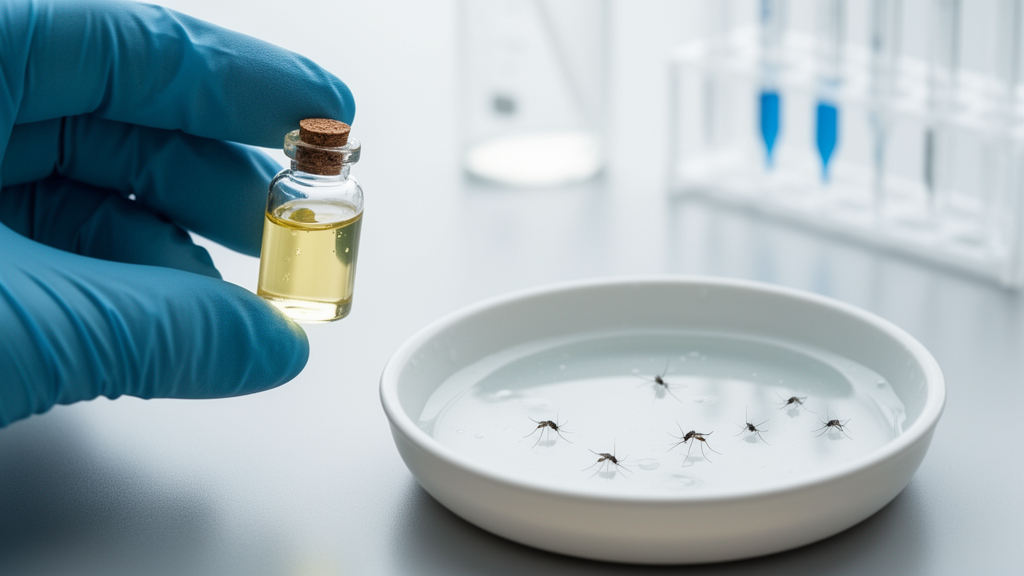
In a development that could reshape how the world fights dengue, Zika, and chikungunya, researchers at Brazil’s Ezequiel Dias Foundation (FUNED) have engineered a peppermint essential oil microemulsion that kills Aedes aegypti larvae with remarkable efficiency while using only a fraction of the raw botanical material. The study, published in Frontiers in Natural Products, demonstrates that a carefully balanced mixture of peppermint oil, surfactant, co-surfactant, and water can transform a volatile, hydrophobic plant extract into a stable, water-compatible larvicide. The most promising formulation, designated PME-05, achieved complete larval mortality while containing just 5% peppermint essential oil and displaying one of the most homogeneous nanoscale droplet distributions ever reported for an essential oil microemulsion.
The urgency behind this work is difficult to overstate. Dengue remains the most prevalent mosquito-borne viral infection on the planet, causing millions of cases annually and imposing a crushing burden on healthcare systems, particularly in tropical and subtropical countries. Over recent decades, dengue, Zika, and chikungunya have undergone dramatic geographic expansion driven by urbanization, climate change, and increased human mobility. Rising temperatures, inadequate sanitation, and the widespread availability of breeding sites have facilitated the spread of Aedes aegypti and Aedes albopictus across ever-larger swaths of the globe. With no broadly effective antiviral therapies available and current vaccination strategies facing significant limitations, vector control remains the cornerstone of arboviral disease prevention. Yet the synthetic insecticides on which that control depends are increasingly compromised, as extensive use has produced resistant mosquito populations while raising serious concerns about environmental contamination and toxicity to non-target organisms.
Essential oils have emerged as promising alternatives to synthetic insecticides precisely because of their renewable origin, biodegradability, and multiple mechanisms of action. A comprehensive review by Luz and colleagues found that more than 337 essential oils obtained from 225 plant species have been evaluated against Aedes aegypti, with over 60% demonstrating significant larvicidal activity at median lethal concentrations below 100 micrograms per milliliter. Notably, Mentha piperita L., the botanical source of peppermint oil, was identified among the most active species. These complex mixtures of terpenes and other secondary metabolites are capable of acting on multiple physiological targets in insects simultaneously, which reduces the probability that resistance will develop. However, the practical application of essential oils has long been limited by their hydrophobicity, volatility, and susceptibility to oxidation, all of which compromise their stability and persistence in the aquatic breeding sites where mosquito larvae develop.
The FUNED research team, led by Carolina Paula de Souza Moreira, Natasha Reynaud, Marcos Paulo Gomes Mol, Gilson Faria, and Sérgio Caldas, approached this challenge by first characterizing the chemical composition of the peppermint essential oil using gas chromatography coupled to mass spectrometry. The analysis identified 14 compounds representing nearly 100% of the total oil composition, with menthol at 50.17% and menthone at 23.02% as the predominant constituents. Together, these two oxygenated monoterpenes accounted for approximately 73% of the total composition, indicating a profile rich in bioactive compounds frequently associated with insecticidal activity. Other notable components included pulegone at 4.21%, D-limonene at 3.28%, and eucalyptol at 2.42%. The chemical profile provides a plausible basis for the biological activity observed in subsequent assays, although the researchers emphasize that the contribution of individual constituents and their potential interactions cannot be established from the experimental design alone.
With the chemical fingerprint established, the team evaluated the larvicidal activity of the free essential oil against third-instar Aedes aegypti larvae under standardized conditions. Groups of 10 larvae were exposed to different concentrations of the oil in dechlorinated water, with mortality recorded after 24 hours of exposure. The results demonstrated a clear concentration-dependent effect, with the median lethal concentration estimated at 175.7 micrograms per milliliter and complete larval mortality achieved at concentrations equal to or greater than 250 micrograms per milliliter. Using the classification commonly applied in studies of plant-derived mosquito larvicides, median lethal concentration values between 100 and 750 micrograms per milliliter are generally considered indicative of effective larvicidal activity, placing peppermint oil firmly within the range of potent botanical larvicidal agents.
Beyond the raw mortality figures, the researchers observed striking behavioral and morphological alterations in larvae exposed to the peppermint oil. A progressive reduction in mobility was noted, characterized by slow and uncoordinated movements that ultimately evolved to complete paralysis. Interestingly, some larvae remained alive for a short period after losing locomotor capacity, maintaining only respiratory movements before death. Morphological examination also revealed darkening of the larval body and, in some individuals, disruption of midgut structures and tissue integrity. These observations suggest that the essential oil affects multiple physiological systems simultaneously, consistent with reports that monoterpenes interfere with acetylcholinesterase activity, neuronal signaling, and mitochondrial function and energy metabolism in insect larvae.
The real innovation of the study lies in the formulation science. The researchers constructed a pseudoternary phase diagram to map the composition space defined by peppermint essential oil, a surfactant and co-surfactant mixture, and water. The surfactant was Polysorbate 20, the co-surfactant was propylene glycol, and the relative proportions of all three components were systematically varied to identify regions capable of forming transparent and macroscopically homogeneous microemulsion systems. Six representative formulations, designated PME-01 through PME-06, were selected to encompass different relative proportions of oil, surfactant mixture, and water, with essential oil content ranging from 2% to 20%. The systems were characterized by dynamic light scattering for mean droplet size and polydispersity index, and stored for seven days to assess short-term physical stability.
The physicochemical characterization revealed droplet sizes within the nanometric range, from 9.6 to 15.6 nanometers, and relatively low polydispersity index values across most formulations. These dimensions fall squarely within the 5 to 200 nanometer range typically reported for microemulsions, confirming the formation of thermodynamically stable and isotropic dispersed systems. However, not all formulations behaved identically. PME-02, which contained the highest proportion of surfactant and co-surfactant at 70% combined with 20% essential oil and only 10% water, exhibited phase separation during the storage period and was excluded from further evaluation. In contrast, PME-06, containing 34% total surfactant mixture, 2% essential oil, and 64% water, maintained a homogeneous appearance throughout the seven-day evaluation period. These contrasting behaviors suggest that microemulsion stability is governed not simply by the total amount of interfacial components but by the overall balance among oil, aqueous, and surfactant phases.
When the five formulations that maintained their physical characteristics were subjected to larvicidal bioassays, the results varied considerably despite all meeting the short-term stability criterion. PME-06, which contained the lowest proportion of peppermint essential oil at just 2%, did not produce larval mortality under the tested conditions. In stark contrast, PME-03, PME-04, and PME-05 all resulted in 100% larval mortality, while PME-01 showed approximately 35% mortality. The Kruskal-Wallis test indicated a statistically significant difference in larval mortality among the evaluated systems, with post hoc comparisons revealing that the significant differences were primarily associated with the lower-performing PME-06. A particularly revealing finding was that PME-01 and PME-05 contained the same proportion of essential oil at 5%, yet resulted in markedly different mortality rates of 35% and 100% respectively, demonstrating that biological performance cannot be attributed solely to essential oil content but arises from the combined effects of formulation composition and physicochemical characteristics.
Among the systems that achieved complete mortality, PME-05 stood out as the most promising candidate for further development. It combined a relatively low essential oil content of 5% with the lowest polydispersity index value of 0.06 ± 0.007, indicating a highly homogeneous dispersed system that may contribute to a more uniform distribution of the essential oil in the aqueous medium. The use of a lower essential oil content is advantageous from a formulation and production perspective, particularly considering the cost and volatility of essential oils and the need to minimize the amount of active material while maintaining biological efficacy. Nevertheless, PME-03 and PME-04 also demonstrated complete larvicidal activity and should be considered as alternative formulation candidates. The researchers are careful to note that the study does not demonstrate an increase in the intrinsic larvicidal potency of the essential oil through microemulsion technology; rather, the results indicate that microemulsion technology can provide a physically stable aqueous-based system while maintaining substantial biological activity. Further studies are needed to evaluate long-term physicochemical stability, residual activity, effects on non-target organisms, and performance under semi-field and field conditions before these formulations can be deployed in real-world mosquito control programs.
Subject of Research: Peppermint essential oil microemulsion shows strong larvicidal activity against Aedes aegypti
Article Title: Microemulsion-based delivery of peppermint essential oil as a sustainable strategy for Aedes aegypti control
Article References: Moreira, C. P. D. S., Reynaud, N., Mol, M. P. G., Faria, G., & Caldas, S. (2026). Microemulsion-based delivery of peppermint essential oil as a sustainable strategy for Aedes aegypti control. Frontiers in Natural Products, 5, Article 1925378. https://doi.org/10.3389/fntpr.2026.1925378
Image Credits: AI Generated
DOI: 10.3389/fntpr.2026.1925378
Keywords: Microemulsion-based, delivery, peppermint, essential, sustainable, strategy, Aedes, aegypti, control, scientific research
Cite Scienmag News
Kristina Jarvis. (October 16, 2026). Peppermint Oil Microemulsion Shows Potent Larvicidal Power Against Aedes aegypti. Scienmag. https://scienmag.com/peppermint-oil-microemulsion-shows-potent-larvicidal-power-against-aedes-aegypti/
Kristina Jarvis. "Peppermint Oil Microemulsion Shows Potent Larvicidal Power Against Aedes aegypti." Scienmag, 16 October 2026, https://scienmag.com/peppermint-oil-microemulsion-shows-potent-larvicidal-power-against-aedes-aegypti/. Accessed 16 October 2026.
Kristina Jarvis. "Peppermint Oil Microemulsion Shows Potent Larvicidal Power Against Aedes aegypti." Scienmag. October 16, 2026. https://scienmag.com/peppermint-oil-microemulsion-shows-potent-larvicidal-power-against-aedes-aegypti/


