


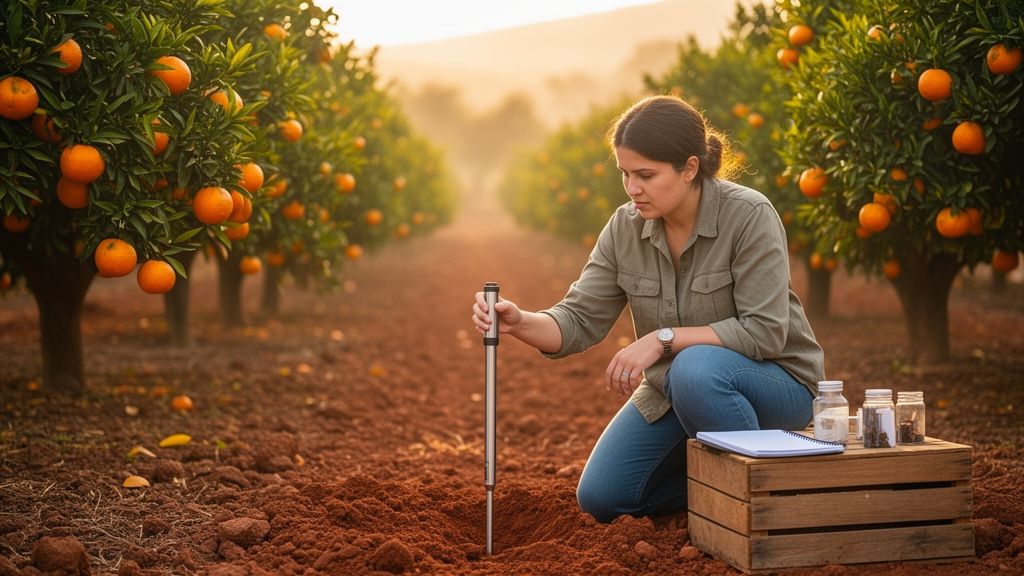
Orange groves in north-eastern Mexico are quietly accumulating heavy metals in their soils, and the amount that actually matters is not the total metal content but the fraction that plants can absorb. A new study published in the journal BioRisk examined bioavailable concentrations of copper, cadmium, chromium and lead in soils of Valencia orange orchards in the Municipality of Hidalgo, in the State of Tamaulipas, and found that the physicochemical properties of the soil strongly govern how mobile these contaminants are. The findings carry weight far beyond the citrus zone, because Mexico ranked as the fourth-largest producer of oranges globally in 2023, and Tamaulipas was the second-largest producing state, with an estimated output of 600,000 tonnes, roughly 13 percent of national production.
Heavy metal pollution of soils has increased worldwide due to anthropogenic activities, and agriculture is one of the major long-term sources of contamination. Intensive agrochemical use contributes steadily to contaminant accumulation in cultivated land. Inputs such as phosphate fertilisers, copper sulphate and zinc oxide fungicides, glyphosate and 2,4-D herbicides, and insecticides including cypermethrin and fipronil can all introduce metals such as copper, chromium, lead, cadmium and zinc into the soil. Because these elements are not degradable and persist for hundreds of years, even after agrochemical applications cease, perennial cropping systems like orange orchards are particularly vulnerable to gradual accumulation over time.
The research team, working from the Autonomous University of Tamaulipas, conducted an exploratory soil sampling in the summer of 2024, collecting 60 composite surface-soil samples from six orange orchards in the Municipality of Hidalgo, following a simple random sampling design in accordance with the Mexican standard NMX-AA-132-SCFI-2016. The study area sits at 329 metres above sea level in a semi-arid subhumid climate with summer rainfall, an average annual temperature of 24 degrees Celsius, and annual precipitation between 800 and 1,000 millimetres. Valencia orange is the most important crop in the zone, followed by Italian lemon, grapefruit and Mandarin, and the main citrus-producing area of Santa Engracia covers 5,940 hectares of cultivated land.
To isolate the bioavailable fraction, the researchers used diethylenetriaminepentaacetic acid, or DTPA, extraction, a chelating method that pulls out the fraction of heavy metals available for plant uptake and associated with organic matter. Ten grams of air-dried, sieved soil were mixed with 20 millilitres of DTPA solution, agitated for two hours, filtered, and then quantified by Flame Atomic Absorption Spectrophotometry. Alongside the metal analysis, the team evaluated six soil physicochemical properties: texture, bulk density, particle density, porosity, pH and electrical conductivity, following the technical specifications of Mexican standard NOM-021-RECNAT-2000.
The results revealed a consistent hierarchy of bioavailable concentrations, with copper highest, followed by chromium, lead and cadmium. Bioavailable copper ranged from 1.1 to 3.2 milligrams per kilogram, chromium from 0.1 to 0.8, lead from 0.2 to 0.4, and cadmium from 0.04 to 0.2 milligrams per kilogram. Copper exhibited the highest bioavailable concentration across all sites, suggesting a common contamination source. The study points to the widespread use of copper-based fungicides, such as copper oxychloride, copper hydroxide and copper sulphate, which have been crucial for controlling fungal pathogens in citrus but leave a persistent metallic legacy in the soil. Some insecticides, including cypermethrin, fipronil and methomyl, may also contain copper in trace amounts as impurities.
The soils themselves showed considerable diversity. Three sites exhibited clay textures, while the others were classified as loam, silty clay loam and clay loam. Bulk density varied from 1.13 to 1.42 grams per cubic centimetre, particle density from 2.09 to 2.23, and porosity from roughly 35 to 49 percent. All sites were moderately to strongly alkaline, with pH values between 7.3 and 8.3, and electrical conductivity remained low, between 0.31 and 0.61 decisiemens per metre, indicating negligible salinity effects. This low salt condition favours metal mobility and bioavailability by reducing ionic competition at absorption sites.
Spearman’s correlation analysis at a 95 percent confidence level uncovered significant associations between the metals and the soil properties. Soil porosity showed a negative correlation with copper and lead but a moderate positive correlation with chromium. Bulk density was positively correlated with copper and negatively correlated with chromium, reflecting how greater soil compaction reduces pore space and alters metal mobility. Particle density correlated negatively with lead and positively with chromium. Electrical conductivity was negatively correlated with cadmium and chromium, while pH emerged as the only property significantly correlated with all four metals, showing weak negative correlations with copper and chromium and weak positive correlations with cadmium and lead.
The pH result is technically significant because it regulates absorption-desorption processes at clay cation exchange sites. Acidification of the soil reduces the absorption of copper and chromium at these exchange sites, increasing their mobility and bioavailability, a pattern consistent with previous studies. Under alkaline conditions, lead and cadmium bioavailability increases, explained by the formation of lead-organic and lead-hydroxide complexes in alkaline soils. The correlations among the metals themselves also told a story: the positive correlation between copper and cadmium suggests a common contamination source, whereas the negative correlation between chromium and lead indicates these elements may derive from different sources or undergo competitive processes affecting their bioavailability.
Importantly, the bioavailable concentrations of copper, chromium, cadmium and lead did not exceed the maximum permissible limits established by NOM-147-SEMARNAT/SSA1-2004 for agricultural soils. However, the researchers caution that current regulations are based solely on total heavy metal concentrations and do not consider bioavailable fractions, which represent the fraction potentially available for plant uptake. These fractions are more relevant for assessing actual environmental and toxicological risks, because once in bioavailable form, heavy metals can be absorbed by plant roots and translocated to stems, leaves and fruits, entering the food chain through soil-plant transfer. Risk assessments based exclusively on total concentrations may therefore overestimate the real hazard.
The health stakes are considerable. Ingestion of contaminated food represents one of the primary exposure pathways to heavy metals, and consuming contaminated food has been linked to effects ranging from mild intoxication and neurological or muscular impairment to chronic diseases such as chronic kidney disease, Parkinson’s disease, muscular dystrophy, cancer and even death. The study’s authors emphasise that changes in management practices could alter soil physicochemical properties and increase metal bioavailability, potentially raising toxicological risks. Their findings highlight the need for continuous soil monitoring in the citrus zone to assess changes over time, and contribute to a better understanding of heavy metal dynamics in perennial crop systems, where repeated agrochemical inputs over the long productive lifespan of orchards favour gradual accumulation that can persist for centuries.
Subject of Research: Soil properties and bioavailability of heavy metals in soils of orange orchards in north-eastern Mexico
Article Title: Soil properties and bioavailability of heavy metals in soils of orange orchards in north-eastern Mexico
Article References: Herrera-Mendoza, M. D. P., Sánchez-Castillo, L., Meléndez-Jaramillo, E., Osorio-Hernández, E., Delgado-Martínez, R., & Rodríguez-Morán, H. (2026). Soil properties and bioavailability of heavy metals in soils of orange orchards in north-eastern Mexico. BioRisk, 24, 119-131. https://doi.org/10.3897/biorisk.24.182472
Image Credits: AI Generated
DOI: 10.3897/biorisk.24.182472
Keywords: Soil, properties, bioavailability, heavy, metals, soils, orange, orchards, north-eastern, Mexico, scientific research
Cite Scienmag News
Bethany Barker. (October 16, 2026). Hidden Metals in Orange Groves: Soil Chemistry Controls Toxic Metal Bioavailability in Mexico. Scienmag. https://scienmag.com/hidden-metals-in-orange-groves-soil-chemistry-controls-toxic-metal-bioavailability-in-mexico/
Bethany Barker. "Hidden Metals in Orange Groves: Soil Chemistry Controls Toxic Metal Bioavailability in Mexico." Scienmag, 16 October 2026, https://scienmag.com/hidden-metals-in-orange-groves-soil-chemistry-controls-toxic-metal-bioavailability-in-mexico/. Accessed 16 October 2026.
Bethany Barker. "Hidden Metals in Orange Groves: Soil Chemistry Controls Toxic Metal Bioavailability in Mexico." Scienmag. October 16, 2026. https://scienmag.com/hidden-metals-in-orange-groves-soil-chemistry-controls-toxic-metal-bioavailability-in-mexico/


