


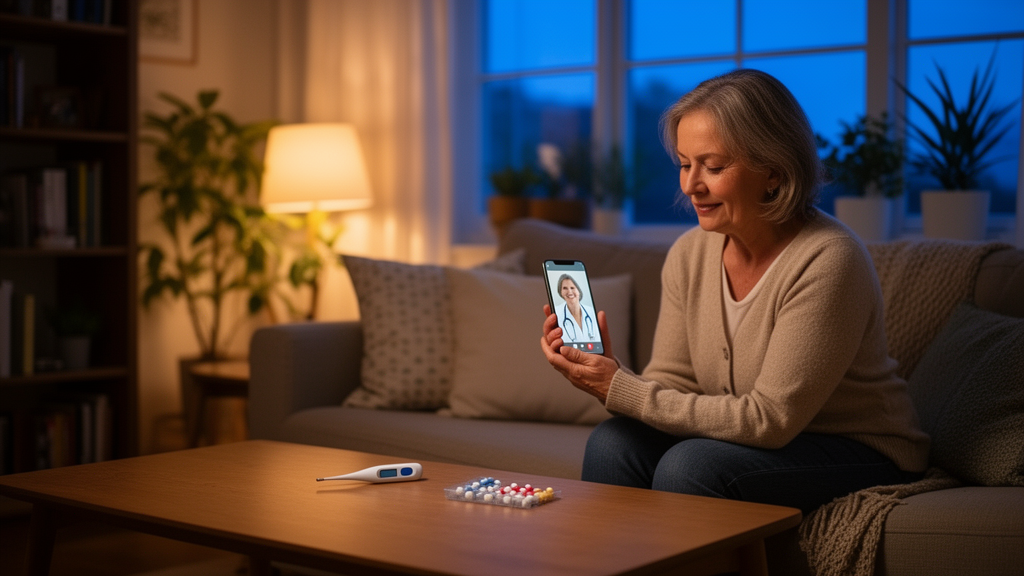
Telehealth has moved from pandemic-era stopgap to structural pillar of modern medicine, and a new collection of peer-reviewed studies shows just how far the transformation now reaches. An editorial published in Frontiers in Medical Engineering on 21 May 2026, led by Raviraj Nataraj of Stevens Institute of Technology together with Juan Pedro Dominguez-Morales of the Universidad de Sevilla and M. Jagannath of the Vellore Institute of Technology, gathers ten papers spanning artificial intelligence diagnostics, mobile health apps, workflow optimization, smart home sensing, and adoption studies across four countries. The throughline is blunt: the technology largely works, but whether it reaches patients depends on usability, infrastructure, and trust as much as on algorithms.
The most striking technical contribution comes from Japan, where Nageishi and Kano tested an AI-based throat camera for influenza screening under a framework they call Biosampling Alternative Diagnostic Imaging, or BADI. The idea is deceptively simple: instead of asking patients to travel to a clinic for a swab, a connected camera images the throat at home and a machine learning model reads the visual signs of infection. The authors argue that remote biosampling can only succeed if four conditions are met simultaneously: the technology must be available, diagnostically accurate, usable by non-experts, and integrated into existing medical systems. Their feasibility analysis suggests AI-driven imaging could meaningfully reduce the burden of in-clinic testing, expanding what remote care can legitimately diagnose rather than merely triage.
Neurology is getting its own remote upgrade. Pless and colleagues validated a smartphone platform that monitors cognitive function in people with multiple sclerosis through adaptive game-based tasks. Because the games adjust to each user and are played repeatedly in everyday settings, the system captures ecologically valid data that clinic visits miss, allowing longitudinal tracking of subtle cognitive drift outside the hospital. For a disease whose progression is notoriously difficult to measure between appointments, continuous smartphone-based assessment could reshape how clinicians detect deterioration and adjust treatment.
Cardiac rehabilitation offers one of the clearest quantitative wins in the collection. Harpula and colleagues studied patients recovering from acute myocardial infarction enrolled in a coordinated rehabilitation program and found that integrating a dedicated mobile application called AHP-KOS lifted program adherence from 67.4 percent to 91.7 percent while shortening the duration of onsite visits. Adherence is the perennial weak point of cardiac rehab, and a jump of more than twenty percentage points from an app-mediated workflow is the kind of result that hospital administrators notice. The study underscores that mobile health tools are not just patient conveniences; they can restructure institutional workflows themselves.
Underneath the headline applications, the collection also probes the unglamorous plumbing of virtual care. In an opinion piece, Khashu argues that the telehealth check-in process is an overlooked determinant of care quality, plagued by incomplete forms, unclear instructions, poor communication, duplicate data entry, and digital literacy gaps. His proposed remedies are data-driven: AI-powered reminders, patient portals, predictive analytics, chatbots, and real-time updates. Streamlining check-in, he contends, would reduce no-shows, raise patient satisfaction, optimize staffing, and improve data accuracy — the difference between a telehealth service that scales and one that stalls.
What patients actually want from virtual care is quantified in a discrete choice experiment by Chen and colleagues, who examined China’s fast-growing Internet hospital framework. Patients prioritized shorter waiting times, payment through medical insurance, and continuity with their original diagnosing physician. Although respondents favored high-quality care from tertiary hospitals and liked video consultations, the primary drivers of adoption were speed and cost reduction. That finding matters for policymakers: sustainable online outpatient services may depend less on cutting-edge features than on waiting rooms that are short and bills that are covered.
Mental health monitoring is also going remote and real-time. Pei and colleagues built a multimodal stress detection system combining electroencephalography with peripheral physiological signals. Eleven participants underwent validated social and mental stress protocols, and machine learning models classified stress from short signal windows with 98.1 percent accuracy for stress type and 97.8 percent for stress level using just four seconds of data. The brevity of the effective signal is the technical headline — real-time, wearable-grade stress assessment becomes plausible when four-second recordings suffice, opening a path to early mental health intervention before crises escalate.
Ageing in place is another frontier. Yang and colleagues proposed a wireless sensor network system for older adults in China’s sports and wellness towns, combining continuous health monitoring with smart home assistance. The platform collects daily activity and physiological data for behavior analysis and preliminary health assessment, running over a hybrid Sub-G and Wi-Fi network optimized for efficient transmission. In parallel, Yan and colleagues surveyed rural older adults in Henan Province and found that perceived usefulness, awareness, and accessibility drive willingness to use internet-based home care services, while digital literacy and infrastructure gaps remain the chief barriers. Together, the two studies sketch both the engineering blueprint and the social reality of remote eldercare.
Adoption economics emerge from Pakistan, where Saifullah and colleagues applied structural equation modeling to identify which service quality characteristics predict doctors’ intentions to use telehealth. Medical service quality, affordability, information quality, waiting time, and safety all emerged as significant predictors, and actual utilization showed a substantial positive impact on sustainable development. The authors argue that a well-structured telehealth model could revolutionize healthcare infrastructure and accessibility in developing nations — a claim the data on physician intent at least supports directionally.
Even clinical education has been pulled into the telehealth orbit. Khoza-Shangase reviewed how the COVID-19 pandemic accelerated virtual simulation, tele-supervision, and remote learning in audiology training in South Africa, improving accessibility and continuity of education while exposing persistent challenges in engagement, assessment, and infrastructure. The editorialists’ synthesis is measured: technological advancement alone is insufficient, and successful implementation depends on usability, accessibility, and alignment with the needs of both patients and providers. Looking forward, they call for integrating engineering innovation with rigorous clinical validation, human-centered design, and equitable deployment, with particular attention to bridging gaps in digital literacy and infrastructure so that emerging technologies do not deepen existing healthcare disparities. If the ten studies collected here are any guide, the future of telehealth will be decided less in laboratories than at the intersection of workflow design, payment policy, and the everyday digital confidence of patients.
Subject of Research: Telehealth and remote patient monitoring technologies for accessible healthcare delivery
Article Title: Editorial: Telehealth and remote monitoring solutions: advancing accessible and effective healthcare delivery
Article References: Nataraj, R., Dominguez-Morales, J. P., & Jagannath, M. (2026). Editorial: Telehealth and remote monitoring solutions: advancing accessible and effective healthcare delivery. Frontiers in Medical Engineering, 4, Article 1864948. https://doi.org/10.3389/fmede.2026.1864948
Image Credits: AI Generated
DOI: 10.3389/fmede.2026.1864948
Keywords: telehealth, remote patient monitoring, artificial intelligence, mobile health, digital health equity, wearable sensors, cardiac rehabilitation, multiple sclerosis, stress detection, smart homes, healthcare workflow, Internet hospitals
Cite Scienmag News
Ophelia Keating. (October 16, 2026). From throat cameras to smart homes: how telehealth is quietly rewriting the rules of care. Scienmag. https://scienmag.com/from-throat-cameras-to-smart-homes-how-telehealth-is-quietly-rewriting-the-rules-of-care/
Ophelia Keating. "From throat cameras to smart homes: how telehealth is quietly rewriting the rules of care." Scienmag, 16 October 2026, https://scienmag.com/from-throat-cameras-to-smart-homes-how-telehealth-is-quietly-rewriting-the-rules-of-care/. Accessed 16 October 2026.
Ophelia Keating. "From throat cameras to smart homes: how telehealth is quietly rewriting the rules of care." Scienmag. October 16, 2026. https://scienmag.com/from-throat-cameras-to-smart-homes-how-telehealth-is-quietly-rewriting-the-rules-of-care/


