


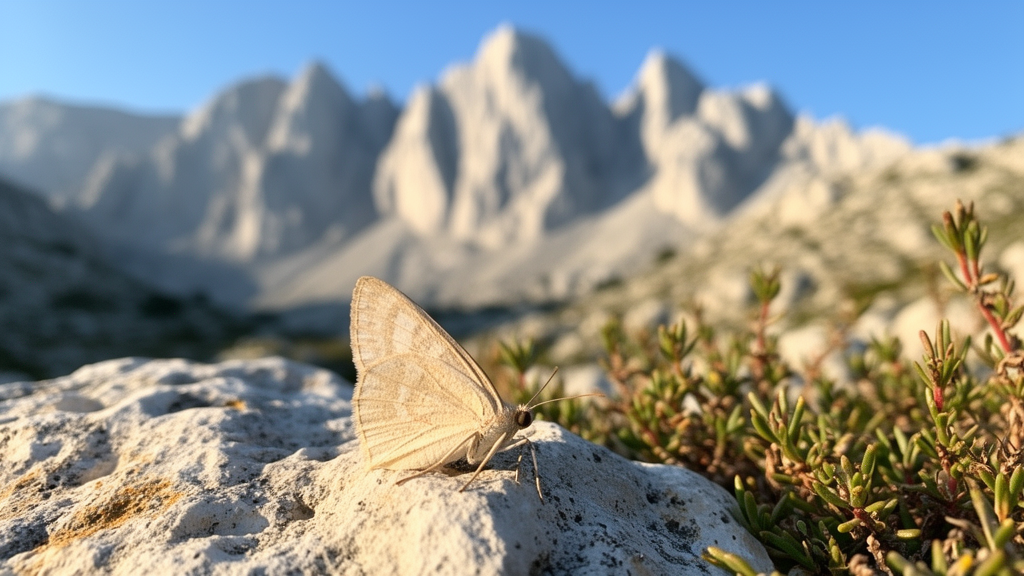
A striking purple-and-white moth hiding in the mountain plateaus of western Crete has turned out to be a species entirely new to science. Researchers describing Pyralis papaleonei sp. nov. in the journal Nota Lepidopterologica combined DNA barcodes with detailed anatomical study to show that populations long assumed to belong to a widespread Eurasian moth are, in fact, an endemic Cretan species. The find is the latest reminder that even among showy, well-collected European insects, undiscovered species can still slip through the net.
The new moth belongs to the genus Pyralis, a group of snout moths in the family Pyralidae that includes some of the most familiar pantry pests as well as some of the most ornately patterned members of the European fauna. Its close relatives in the Pyralis regalis species group have long been favourites among collectors thanks to their bold contrasts of purple, orange and white on the wings. Yet, as the authors note, the taxonomy of these conspicuous insects was considered essentially settled only a few years ago, before successive discoveries revealed that the group harboured far more diversity than anyone suspected.
The trail to the new species began with a genetic anomaly. When researchers previously catalogued DNA barcodes of the Pyralis regalis group, one sequence from Crete assigned to the species Pyralis kacheticalis stood out as unusually divergent. At the time, that variation was interpreted as mere intraspecific difference. But extensive fieldwork on the Lepidoptera fauna of Crete subsequently yielded substantial additional material of the doubtful populations, allowing the team to reanalyse the problem with far more data in hand.
The molecular evidence proved decisive. In total, the researchers analysed roughly 100 specimens from the species group, including 45 individuals of the new species, supplementing about 600 specimens examined in earlier work. DNA barcodes of the mitochondrial COI gene, a 658-base-pair fragment widely used for species identification, were generated for dozens of additional samples and processed at the Biodiversity Institute of Ontario in Canada. Every sequence except one was sorted into Barcode Index Numbers, or BINs, algorithmically defined clusters in the Barcode of Life Database that serve as reliable proxies for species boundaries.
The numbers tell a clear story. The new species carries a unique barcode signature with zero internal variation among its sampled members, while its minimum genetic distance to its nearest neighbour, populations of P. kacheticalis from Samos, Ukraine, Armenia and Iraq, is 5.78 percent. The gap to Pyralis regalis, the geographically closest relative on the Peloponnese, is even wider at 9.4 percent, and the distance to the Cypriot cluster of P. kacheticalis reaches 6.29 percent. Across the species group, interspecific distances range from 4.1 to 8.82 percent, comfortably exceeding the much lower intraspecific variation observed within most species. In short, the Cretan moth sits firmly on its own branch of the neighbour-joining tree.
Genetics alone, however, was not enough. Under the standards of integrative taxonomy, the researchers also scrutinised the external appearance and the genitalia of both sexes, structures whose fine details have long served as diagnostic characters in moth systematics. The new species is immediately recognisable by its narrow white forewing markings, with an almost uniformly slender white median band running across the entire wing. In all other members of the group, the white pattern elements are distinctly broader, sometimes abruptly narrowed or cut off mid-wing. The hindwings are also characteristic: nearly uniform pale greyish-purple, divided into three sections by two jagged whitish lines, with the basal section only slightly darker than the outer ones, a pattern that differs from the conspicuously darkened hindwing bases of P. kacheticalis and the purplish suffusion of P. regalis.
Under the microscope, the genitalia provide further confirmation. Males of the new species lack the cornuti, small barbed structures, found in the phallus of several relatives, and differ from P. regalis in the shape of the valva, which lacks an abruptly widened distal portion. The females carry the most distinctive feature of all: a sclerotized signum, a hardened lens-shaped structure in the bursa copulatrix armed with strongly sclerotized microthorns, which is absent in every other species of the group, along with a sterigma bearing broadly rounded posterior projections. The holotype, an adult male, was collected at Omalos on the island’s Omalos plateau at 1,075 metres elevation in June 2025, with paratypes drawn from several mountain localities and museum collections dating back decades.
The species appears to be a true Cretan endemic, known only from a handful of localities in the White Mountains, or Lefka Ori, in the west of the island. Nearly all specimens were collected at around 1,000 to 1,200 metres in mountainous habitat, with adults flying mainly in June, though a single October record hints at either a prolonged flight season or a second generation. Host plants and early stages remain unknown. The moth shares its high-altitude habitat with several other endemics confined to the same region, including a geometer moth described as recently as 2019 and additional undescribed species recorded in the greater Omalos area, underscoring how much of the island’s insect fauna still awaits discovery.
Why had such a colourful insect gone unrecognised for so long? The authors point to a combination of circumstances. Crete sits between the Peloponnese, home to P. regalis, and Cyprus, where a divergent population of P. kacheticalis occurs, so the Cretan populations were naturally assumed to belong to one of those neighbours. Indeed, the species was initially misidentified in the Barcode of Life Database as P. kacheticalis. Its preference for the less intensively sampled mountain interior, rather than the heavily visited coast, meant only a few entomologists had ever encountered it. The description brings the tally of endemic moth species documented on Crete to 76, a remarkable 40 percent of which have been described since the turn of the millennium.
The study also carries a broader message about hidden diversity across the wider region. As well as the new species, the researchers report the first records of P. kacheticalis from Iraq and Armenia, extending the known range of that species considerably. Meanwhile, P. kacheticalis itself shows pronounced, geographically correlated barcode divergence that may be accompanied by morphological differentiation, and two genetically distinct clusters from China currently mislabelled as P. regalis almost certainly represent further undescribed species. Comparable patterns of deep intraspecific variation have been documented in other Pyralis congeners. Resolving these lineages, the authors conclude, will require continued integrative taxonomy combining DNA barcodes, morphology and fieldwork, a reminder that the inventory of even Europe’s most conspicuous insects remains unfinished.
Subject of Research: Description of a new endemic snout moth species from Crete using DNA barcoding and morphology
Article Title: Pyralis papaleonei sp. nov. from Crete (Greece) ( Lepidoptera , Pyralidae )
Article References: Huemer, P., Kaila, L., & Segerer, A. H. (2026). Pyralis papaleonei sp. nov. from Crete (Greece) (Lepidoptera, Pyralidae). Nota Lepidopterologica, 49, 63-74. https://doi.org/10.3897/nl.49.185483
Image Credits: AI Generated
DOI: 10.3897/nl.49.185483
Keywords: Pyralis papaleonei, Pyralidae, Lepidoptera, Crete, DNA barcoding, COI gene, endemic species, integrative taxonomy, White Mountains, Greece, species discovery, Barcode Index Number
Cite Scienmag News
Juliet Wilcox. (October 16, 2026). New Moth Species from Crete’s White Mountains Named After Pope Leo XIV. Scienmag. https://scienmag.com/new-moth-species-from-cretes-white-mountains-named-after-pope-leo-xiv/
Juliet Wilcox. "New Moth Species from Crete’s White Mountains Named After Pope Leo XIV." Scienmag, 16 October 2026, https://scienmag.com/new-moth-species-from-cretes-white-mountains-named-after-pope-leo-xiv/. Accessed 16 October 2026.
Juliet Wilcox. "New Moth Species from Crete’s White Mountains Named After Pope Leo XIV." Scienmag. October 16, 2026. https://scienmag.com/new-moth-species-from-cretes-white-mountains-named-after-pope-leo-xiv/


