


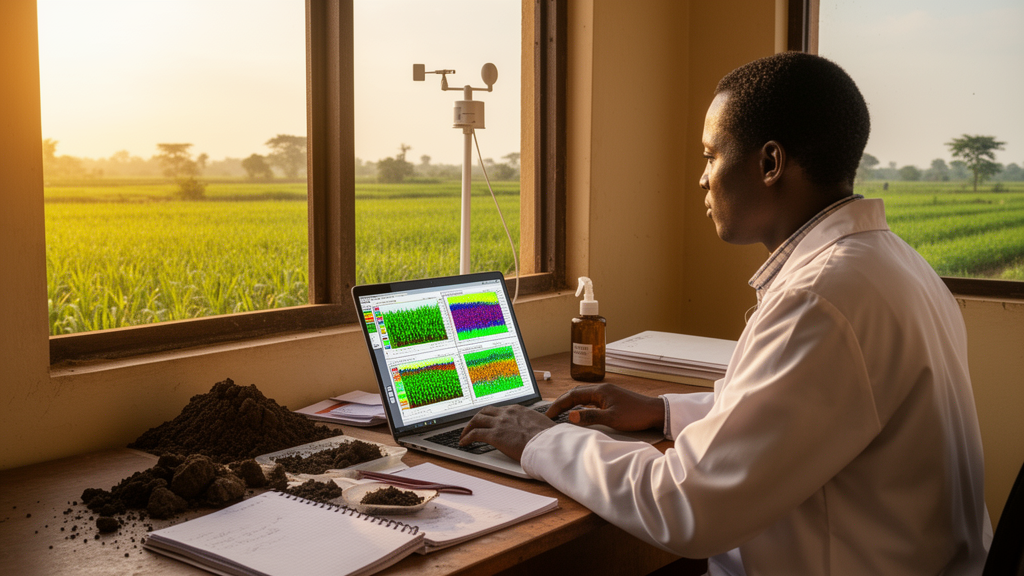
For decades, scientists trying to simulate the future of farming in developing countries have faced a stubborn problem: every research team builds its own bespoke model, tailored to one village or one question, and the result is a patchwork of simulations that cannot be replicated, compared, or reused. A new study published in the Food and Ecological Systems Modelling Journal proposes a way out of this fragmentation. Researchers have unveiled MAASSD, the Methodology for Agent-based Modelling for Agricultural System Simulation in Developing Countries, a step-by-step framework designed to bring order, transparency, and reproducibility to a field that has long operated without a shared playbook.
The stakes are considerable. Agricultural systems in developing countries sit at the intersection of climate change, population growth, food insecurity, and rural migration, and policy-makers increasingly rely on models to test decisions before implementing them in the real world. Agent-based modelling, or ABM, has emerged as the tool of choice for this task because it can capture what statistical and optimization models often cannot: the heterogeneity of individual farmers. Two farmers in the same village may differ in farm size, labour availability, cropping choices, and responses to a new subsidy, and ABM simulates each of them as a distinct decision-making agent interacting with neighbours, markets, organizations, and the environment itself.
As the authors note, agent-based models are particularly well suited to developing-country contexts, where quantitative data are scarce and statistically reliable surveys are difficult to mount. Yet the field’s greatest strength has also been its weakness. A review of the literature revealed that although the number of farm-level agent-based models has grown substantially over time, most were built for specific purposes and locations and are not easily adaptable or reusable for policy evaluation. Each modelling effort starts nearly from scratch, duplicating work and making it nearly impossible to compare findings across regions or to build cumulatively on prior results.
To address this, the research team first conducted a systematic review of existing methodologies, dividing them into two families. The first comprises software-oriented approaches developed by computer scientists, such as Tropos, ADELFE, MESSAGE, INGENIAS, and extensions of the Unified Modelling Language like AUML, AML, and MAS-ML. These are powerful but ill-suited to agricultural simulation, because agent-based models of farming are usually built by agronomists, economists, and geographers rather than software engineers. The second family includes social-simulation frameworks such as ARDI, ORIGAMI, and the widely used ODD protocol. These provide valuable foundations for identifying stakeholders and documenting models, but they are too general to be applied directly to agricultural systems without substantial adaptation.
MAASSD synthesizes the strengths of these approaches into five sequential steps. Step one establishes system requirements: identifying the stakeholders, the processes to be simulated, and the scales of analysis. Drawing on the ARDI method, modellers map out the scientists, decision-makers, and local actors whose perspectives shape the model. The processes are organized around five components of the agricultural system identified in earlier work: cropping systems, livestock production, socio-economic factors, environmental factors, and policy factors. Step two is domain analysis, in which the team extracts the core concepts of the target system from existing studies, agricultural ontologies, and participatory workshops, producing a shared vocabulary and a UML class diagram that all participants can understand.
The methodology’s commitment to multi-stakeholder engagement is one of its distinguishing features. Farmers, researchers, and policy-makers pursue different objectives and hold different kinds of knowledge, and MAASSD treats their integration as a formal requirement rather than an afterthought. Ontologies, explicit specifications of the concepts and relationships within a domain, serve as bridges between these knowledge communities. The authors also propose a set of meta-models, essentially templates covering household structure, cropping strategies, household occupations, and policy interventions, that can be extended to build specific models for any given region, dramatically lowering the barrier to entry for new modelling projects.
Step three addresses the selection of tools, reviewing platforms such as Cormas, NetLogo, GAMA, and Repast, as well as integration frameworks like RECORD, Crop2ML, and OpenMI that allow existing models of soil dynamics, plant growth, or hydrology to be coupled into a larger simulation. Step four covers model design, anchored by a meta-model in which interacting households, composed of individuals differentiated by sex and age, apply cropping strategies across plots of land, and by a simulation framework with initialization, simulation, and output phases. Step five turns to implementation, recommending rapid prototyping so that simplified versions of the model can be built, discussed with stakeholders, and refined before the final version is completed.
To demonstrate the framework’s robustness, the researchers applied MAASSD to a pressing question in Burkina Faso: the feedback loop between agricultural dynamics and migration. The test case focused on the Province of Boulkiemdé in the country’s Sudano-Sahelian climatic zone, simulating a population of 400 individuals distributed across 40 households in four categories, from small farmers with lower potential to large farmers with higher potential. The model integrated a climate module, a crop production module, a biophysical component, and an explicit social network representation, and it ran three climate scenarios over 45 simulated years each, with drought probabilities ranging from 30 percent in the wet scenario to 70 percent in the drought scenario.
The results were striking. Migration increased sharply under the driest scenario, confirming that households turn to migration as an adaptation strategy when climate shocks prevent them from meeting their food and income needs. More unexpectedly, the largest and most resource-endowed household types, types 3 and 4, sent the most migrants under every scenario, revealing that they were the most vulnerable to climate shocks, while the small farmers of type 2 proved the most resilient. This kind of counterintuitive finding, which depends on representing the heterogeneity of farm households rather than treating them as an average, illustrates exactly why agent-based modelling matters for policy design in the developing world.
The authors acknowledge limitations: the methodology does not yet cover scenario development, validation, or a dedicated software tool. But they position MAASSD as the first methodology specifically designed for simulating agricultural systems in developing countries, one that captures farmer heterogeneity, supports multi-scale representation from field to community, and integrates knowledge from stakeholders of different origins. The next step is to test the framework across a large number of contexts, and if it holds up, the era of one-off, unrepeatable farm models may finally be drawing to a close.
Subject of Research: A standardized agent-based modelling methodology for simulating agricultural systems in developing countries
Article Title: MAASSD: Methodology for Agent-based modelling for Agricultural System Simulation in Developing Countries
Article References: Belem, M. (2025). MAASSD: Methodology for Agent-based modelling for Agricultural System Simulation in Developing Countries. Food and Ecological Systems Modelling Journal, 6, Article e167755. https://doi.org/10.3897/fmj.6.167755
Image Credits: AI Generated
DOI: 10.3897/fmj.6.167755
Keywords: agent-based modelling, agricultural systems, developing countries, Burkina Faso, climate change, migration, food security, multi-scale modelling, UML, stakeholder engagement, simulation methodology, household heterogeneity
Cite Scienmag News
Violet Maxwell. (October 16, 2026). New Modelling Blueprint Aims to Standardize Agricultural Simulations in Developing Countries. Scienmag. https://scienmag.com/new-modelling-blueprint-aims-to-standardize-agricultural-simulations-in-developing-countries/
Violet Maxwell. "New Modelling Blueprint Aims to Standardize Agricultural Simulations in Developing Countries." Scienmag, 16 October 2026, https://scienmag.com/new-modelling-blueprint-aims-to-standardize-agricultural-simulations-in-developing-countries/. Accessed 16 October 2026.
Violet Maxwell. "New Modelling Blueprint Aims to Standardize Agricultural Simulations in Developing Countries." Scienmag. October 16, 2026. https://scienmag.com/new-modelling-blueprint-aims-to-standardize-agricultural-simulations-in-developing-countries/


