


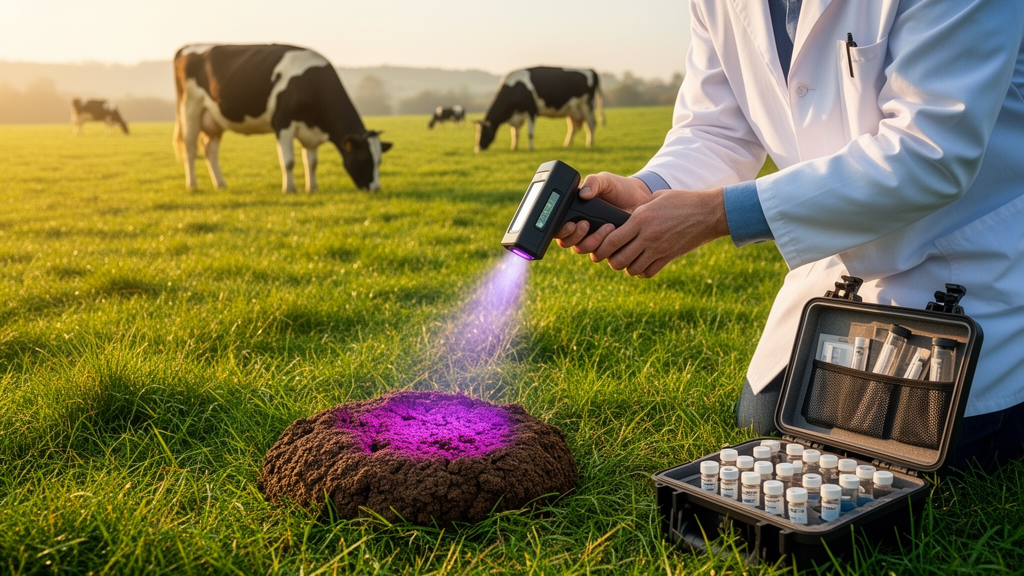
For more than forty years, scientists have been reading the nutritional story of grazing animals in an unlikely place: their dung. A new review published in Frontiers in Animal Science traces four decades of progress in fecal near-infrared reflectance spectroscopy, or fecal-NIRS, a technique that predicts what free-grazing herbivores have eaten simply by shining near-infrared light on their feces and analyzing the reflected spectrum. According to the review by Negusse Kidane of Prairie View A&M University and Doug Tolleson of Texas A&M AgriLife Research, the method has matured from an experimental curiosity into a reliable, cost-effective and noninvasive tool for assessing diet quality in livestock and wildlife alike.
The appeal of the approach lies in a fundamental problem of rangeland science. Free-grazing herbivores, from cattle and sheep to elk and mountain gorillas, depend on forage whose quality and quantity vary enormously across landscapes and seasons. Climate change is expected to intensify this variability by shifting plant species composition, altering the balance of C3 and C4 grasses, and changing crude protein concentrations, fiber fractions, lignification and digestibility. Traditional assessment methods struggle to keep pace. Wet-chemistry analysis requires hand-collected forage samples that may not reflect what animals actually select, because herbivores graze selectively and their preferences shift with physiological state, age, experience, plant community composition and even the presence of competitors or predators. Visual evaluation of forage is subjective, and body condition scoring reflects past nutrition and can be confounded by workload, disease or parasite burden.
Fecal-NIRS sidesteps these problems by working from the animal’s end of the equation. The core assumption is that feces contain chemical bonds and functional groups, such as carbon-hydrogen, oxygen-hydrogen and nitrogen-hydrogen bonds, derived from undigested feed residues and metabolic end products. When near-infrared radiation, spanning roughly 770 to 2500 nanometers, strikes these bonds, it induces stretching, bending and wagging vibrations that produce characteristic absorption features. Water absorbs near 1450 and 1940 nanometers, aliphatic carbon-hydrogen bonds near 1210, 1400, 1725 and 2310 nanometers, carbohydrate-related oxygen-hydrogen absorptions fall between 1600 and 2100 nanometers, and protein-related nitrogen-hydrogen absorptions occur near 2055 and 2180 nanometers. Because these functional groups abound in forage and fecal material, the spectra encode information about crude protein, digestibility, fiber fractions, moisture and energy value.
The technique is a secondary analytical method, meaning it must first be calibrated against conventional laboratory measurements. Researchers pair fecal samples with known diet compositions from in vivo, in vitro or in situ feeding trials, then apply chemometric methods such as multiple linear regression, principal component regression or partial least squares regression to build predictive equations. Before calibration, spectra are preprocessed mathematically to reduce light scattering, particle-size effects, baseline shifts and instrument noise, using techniques like first- and second-derivative transformations, smoothing, standard normal variate correction and detrending. Model quality is judged by the coefficient of determination, the standard error of calibration and the standard error of cross-validation, with high R-squared values and low errors preferred for routine use.
The review’s synthesis of published calibration statistics reveals a clear hierarchy of predictive performance. Across studies, fecal-NIRS consistently delivered accurate predictions of dietary crude protein, with R-squared values ranging from 0.85 to 0.99. Prediction accuracy for digestibility was more variable, spanning R-squared values of 0.60 to 0.93, and intake predictions ranged from 0.41 to 0.89. The authors attribute this pattern to the fact that dietary nitrogen is strongly reflected in fecal chemistry and can be measured with highly standardized laboratory procedures such as the Kjeldahl method. Digestibility and intake, by contrast, are shaped by animal-specific factors including age, physiological status, health, production stage and feeding behavior, all of which inject additional variation into calibration datasets.
The historical arc of the technology is striking. The first fecal-NIRS calibration models were developed at the University of Alaska’s Agricultural Experiment Station to predict diet quality in elk, achieving an R-squared of 0.99 for crude protein and 0.88 for digestible organic matter. Lyons and Stuth then extended the method to cattle in Texas using esophageal-fistulated steers and in vitro digestibility assays, obtaining validation R-squared values of 0.98 for crude protein and 0.87 for digestible organic matter. From there the technique spread to goats on Mediterranean rangelands in Israel, sheep in Europe and Africa, and cattle across Ethiopia, Niger, Nigeria, Australia and South America. Recent work in Brazil has even produced bi-species calibration models for cattle and sheep, achieving an R-squared of 0.92 for crude protein, suggesting that calibrations may become increasingly transferable across ruminant species.
Wildlife applications have proven equally compelling. Calibration equations have been developed for white-tailed deer fed diets containing fifty forage species, Rocky Mountain elk, red deer and fallow deer using Fourier-transform near-infrared spectroscopy, and even mountain gorillas in Uganda, where crude protein models reached an R-squared of 0.97. The technique has been applied to rabbits, common voles, ostriches, donkeys, horses, pigs, poultry and lactating buffaloes. Non-ruminants and wild herbivores account for roughly 21 and 18 percent of the 28 crude protein models summarized in the review, respectively, with domestic ruminants making up the remainder. Hindgut fermenters such as equines show somewhat lower precision than ruminants, likely because microbial fermentation in the cecum and colon transforms dietary nutrients before excretion, weakening the link between diet composition and fecal chemistry.
The review is candid about the challenges that remain. A common misconception is that a single calibration model can be universally applied, but models developed under limited dietary or environmental conditions often perform poorly outside their original calibration domain. Biological variation associated with animal age, sex, breed and physiological status alters fecal chemistry, and calibration datasets derived from few animals may not capture this variability even when dietary diversity is present. Field-collected samples demand meticulous handling, because sunlight, rainfall, wind and microbial activity can alter fecal chemistry and spectral characteristics before collection. The authors also caution that many recent studies rely on cross-validation rather than independent external validation, which can overestimate model robustness when models are tested on truly independent datasets.
Looking forward, the authors see portable handheld spectrometers as a potential game changer. Devices such as the DLP NIRscan Nano, SCiO and PHAZIR 1624 have achieved prediction accuracies comparable to benchtop instruments for several key nutritional attributes, and early studies have shown that unprocessed feces scanned in plastic bags can yield useful predictions of crude protein, dry matter, fiber fractions and health-related biomarkers. Unprocessed samples introduce greater physical heterogeneity and light scattering, so further validation is needed, but the prospect of real-time nutritional monitoring in the field, without drying, grinding or centralized laboratories, could dramatically expand adoption.
Perhaps the most ambitious proposal in the review is a conceptual Nutritional Health Index that would integrate fecal-NIRS diet-quality estimates with GPS tracking of grazing behavior, wearable sensors measuring rumination, intraruminal sensing of rumen function, and production indicators such as body weight, body condition, growth rate, reproductive performance and milk yield. Such an index could serve as an early-warning system for nutritional deficiencies, forage limitations and digestive disturbances, and function as a quantitative decision-support tool for animal-specific nutritional management. Combined with RFID systems, remote sensing of forage biomass and decision-support software, fecal-NIRS appears poised to evolve from a nutritional assessment method into a data-driven platform for precision nutritional management of both domestic and wild grazing herbivores, a transformation four decades in the making.
Subject of Research: Fecal near-infrared reflectance spectroscopy for monitoring diet quality in free-grazing herbivores
Article Title: Transforming nutritional monitoring of free-grazing herbivores: four decades of progress in fecal near-infrared reflectance spectroscopy
Article References: Kidane, N., & Tolleson, D. (2026). Transforming nutritional monitoring of free-grazing herbivores: four decades of progress in fecal near-infrared reflectance spectroscopy. Frontiers in Animal Science, 7, Article 1965119. https://doi.org/10.3389/fanim.2026.1965119
Image Credits: AI Generated
DOI: 10.3389/fanim.2026.1965119
Keywords: fecal NIRS, near-infrared spectroscopy, forage quality, grazing herbivores, crude protein, digestibility, feed intake, rangeland, wildlife nutrition, precision livestock farming, calibration models, portable spectrometers
Cite Scienmag News
Daisy Hatcher. (October 16, 2026). How Reading Dung With Light Is Transforming Grazing Animal Nutrition. Scienmag. https://scienmag.com/how-reading-dung-with-light-is-transforming-grazing-animal-nutrition/
Daisy Hatcher. "How Reading Dung With Light Is Transforming Grazing Animal Nutrition." Scienmag, 16 October 2026, https://scienmag.com/how-reading-dung-with-light-is-transforming-grazing-animal-nutrition/. Accessed 16 October 2026.
Daisy Hatcher. "How Reading Dung With Light Is Transforming Grazing Animal Nutrition." Scienmag. October 16, 2026. https://scienmag.com/how-reading-dung-with-light-is-transforming-grazing-animal-nutrition/


