


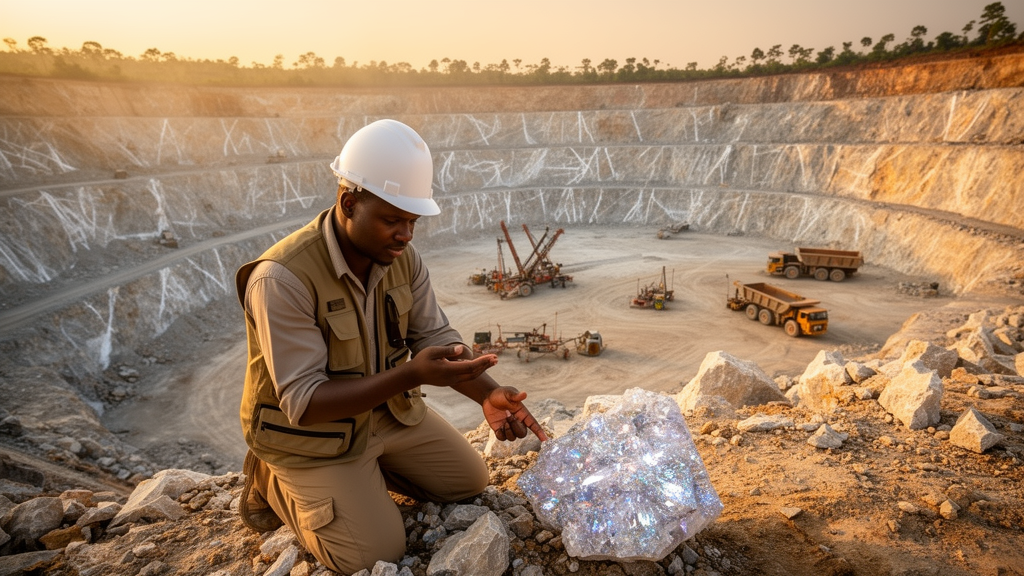
Lithium has become the defining metal of the clean energy transition, and a new review published in Frontiers in Geochemistry argues that Nigeria, long absent from the world’s lithium map, may hold deposits capable of reshaping the global supply chain. The study, led by S. I. Olajuyi of the African University of Science and Technology in Abuja, together with colleagues at Pennsylvania State University, pulls together geological surveys, government data and laboratory analyses to sketch the most complete picture yet of Nigerian lithium ores. Its conclusion is striking: ores from sites such as Panda in Nasarawa State contain lithium oxide concentrations that, after beneficiation, reach levels comparable to the world’s highest-grade spodumene concentrates.
The chemistry behind lithium’s battery dominance explains why the stakes are so high. Lithium, discovered in 1817 by Johan Arfvedson, is a silver-white metal with an atomic weight of 6.93 that never occurs naturally in metallic form because of its violent reactivity with air. Its low standard reduction potential makes it the lightest metal suitable for high-density, high-voltage cells, the property that underpins every lithium-ion battery in an electric vehicle or grid-scale storage installation. Global demand for the element has been growing at roughly 20 percent annually, driven by the electrification of transport and the expansion of renewable energy storage, and the review notes that this trajectory is likely to continue as countries race toward decarbonization targets.
Geologically, lithium concentrates in three principal reservoir types: continental brines trapped in salt flats known as salars, hard-rock pegmatites, and sedimentary clay deposits. The South American Lithium Triangle spanning Bolivia, Chile and Argentina holds approximately 56 percent of the world’s lithium resources and 52 percent of its reserves in brine form, offering low extraction costs but raising serious socio-environmental concerns over water depletion in arid regions. Australia, by contrast, dominates hard-rock production, mining spodumene from pegmatite bodies that formed during ancient supercontinent cycles. Sedimentary clay deposits, found in lacustrine basins across North America, Europe and China, remain less exploited but carry high development potential. Global lithium resources are estimated to exceed 62 million tons, suggesting no imminent shortage of the element itself, though production may be constrained by environmental and social factors rather than geology.
Pegmatites, the deposit type most relevant to Nigeria, are coarse-grained igneous rocks classified as lithium-cesium-tantalum, or LCT, ores. They are among the oldest lithium deposits on Earth, dated to roughly 3,000 to 3,100 million years, and are associated with continental crust formation at the onset of plate tectonics. Within these rocks, lithium resides in minerals such as spodumene, lepidolite, petalite, amblygonite and zinnwaldite, interlocked with quartz, feldspar and mica. Spodumene is particularly prized for its high lithium content and economic value, though its composition varies with trace elements including iron, manganese, gallium and tin. The formation mechanisms are equally varied, involving interactions between lithium-rich magmatic-hydrothermal fluids and sedimentary clays, or the adsorption of lithium by clay minerals from lithium-bearing brines.
Nigeria’s lithium endowment sits within the country’s Precambrian Basement Complex, a foundation of crystalline igneous and metamorphic rocks interspersed with Cretaceous and Cenozoic sedimentary basins. The lithium-bearing pegmatites occur as steeply inclined intrusive bodies within gneisses and schistose assemblages, and they carry not only lithium but also tantalum, niobium, tin and beryllium. The review maps a Lithium Belt, a pegmatite metallogenic province trending west-southwest to east-northeast across more than 700 kilometers, from Oyo State in the southwest to Plateau State in the north-central region. Significant deposits have been documented in Kogi, Nasarawa, Ekiti, Kwara, Cross River, Oyo and Plateau States, with twenty named deposit sites ranging from Panda and Wamba in Nasarawa to Ilesha in Osun and Kafanchan in Kaduna.
The analytical data emerging from these deposits is remarkable. Energy-dispersive X-ray fluorescence analysis conducted under the Nigerian Ministry of Mines and Steel Development found lithium oxide contents averaging 9.53 weight percent at Panda, 8.69 percent at both Wamba and Kabba, and 9.34 percent at Isanlu Egbe, values the authors describe as far above the highest percentages of lithium oxide in spodumene reported globally. Even the comparatively modest Kushaka deposit at 3.51 percent qualifies as an economic source when appropriate beneficiation is applied. Froth flotation trials demonstrated the transformative power of mineral processing: lithium oxide in Kushaka concentrates rose from 3.51 to 34.51 weight percent, while Panda concentrates climbed from 9.53 to 37.96 percent, accompanied by sharp reductions in the silica gangue that dilutes the ore.
Turning ore into battery-grade material, however, demands a sophisticated processing chain. The conventional route begins with mining and comminution, the crushing and grinding that liberates lithium minerals from their host rock, followed by froth flotation, which exploits differences in surface properties to separate spodumene or lepidolite from quartz and feldspar. The concentrate is then roasted to convert lithium minerals into water-soluble compounds; sulfuric acid roasting at 750 degrees Celsius, for example, converts lithium oxide into lithium sulfate that dissolves readily in water. Leaching follows, with acid solutions selectively dissolving lithium before purification and precipitation as lithium carbonate. Emerging alternatives promise cleaner routes: electrochemical extraction using lithium iron phosphate electrodes can pull lithium ions directly from brines and even seawater, while calcination-leaching with oxalic acid has achieved 91.35 percent recovery from lithium-bearing clays, and electrochemical leaching of spodumene with hydrogen peroxide reached 92.2 percent efficiency.
Nigeria’s processing capacity remains nascent. Large-scale primary lithium processing only began in 2023, when Ganfeng Lithium Industry Ltd commenced operations, followed by Avatar New Energy Materials Company Ltd, which opened a facility in Nasarawa State with a daily capacity of 4,000 tons and an estimated investment of 100 million US dollars. The facility is projected to generate 500 million dollars in revenue over a 15-to-20-year mining lifespan and aligns with Nigeria’s ambition to become Africa’s solar and battery energy storage hub. Yet the review cautions that full-scale processing at these sites remains uncertain, and that foreign investors dominate the lithium processing space, raising questions about whether local value addition will materialize without indigenous investment and research into African-adapted extraction and purification technologies.
The environmental shadow of lithium mining looms large over this opportunity. Unregulated extraction can drive chemical leaching, water depletion and contamination, air pollution and soil degradation, with public health consequences the authors compare to the devastation of oil spills and gas flaring in the Niger Delta. Lithium processing is energy-intensive, contributing to carbon emissions, and mining wastes from granite-pegmatite operations can carry ecological risks due to uranium and thorium. In water-scarce regions, extracting lower-grade brines carries particularly high environmental costs. The review argues that integrating environmental, social and governance considerations, alongside battery recycling through hydrometallurgical methods and dynamic policy modeling, will be essential if Nigeria’s lithium boom is to avoid replicating the failures of its extractive past.
The path forward, the authors conclude, requires simultaneous progress on several fronts: comprehensive geological surveys using advanced geophysical tools such as airborne magnetic and radiometric mapping, which remain unapplied to Nigerian lithium exploration; sustainable investment in mining infrastructure; and a research-industry-government-community nexus capable of developing the full lithium value chain from ore to battery. Government initiatives, including the Electronic Mining Cadastre System for transparent mineral title management and the reactivated Solid Minerals Development Fund in partnership with the Africa Finance Corporation, signal political will, though enforcement against illegal mining, which has been linked to banditry and corruption, remains inconsistent. With proper investment and regulatory frameworks, the review concludes, Nigeria could become a significant lithium supplier, converting a poorly documented geological endowment into a cornerstone of the global transition toward clean energy.
Subject of Research: Geology, mineralogy and processing of Nigerian lithium ore deposits for energy applications
Article Title: Mechanistic insights into nigerian lithium ores: implications for energy and industrial applications
Article References: Mechanistic insights into nigerian lithium ores: implications for energy and industrial applications. (n.d.). https://doi.org/10.3389/fgeoc.2025.1659636
Image Credits: AI Generated
DOI: 10.3389/fgeoc.2025.1659636
Keywords: lithium, Nigeria, pegmatites, spodumene, lepidolite, batteries, energy transition, mineral processing, froth flotation, LCT pegmatites, clean energy, mining
Cite Scienmag News
Faith Mcneil. (October 16, 2026). Nigeria’s Lithium Belt: Inside the Geology That Could Power the Global Battery Race. Scienmag. https://scienmag.com/nigerias-lithium-belt-inside-the-geology-that-could-power-the-global-battery-race/
Faith Mcneil. "Nigeria’s Lithium Belt: Inside the Geology That Could Power the Global Battery Race." Scienmag, 16 October 2026, https://scienmag.com/nigerias-lithium-belt-inside-the-geology-that-could-power-the-global-battery-race/. Accessed 16 October 2026.
Faith Mcneil. "Nigeria’s Lithium Belt: Inside the Geology That Could Power the Global Battery Race." Scienmag. October 16, 2026. https://scienmag.com/nigerias-lithium-belt-inside-the-geology-that-could-power-the-global-battery-race/


