


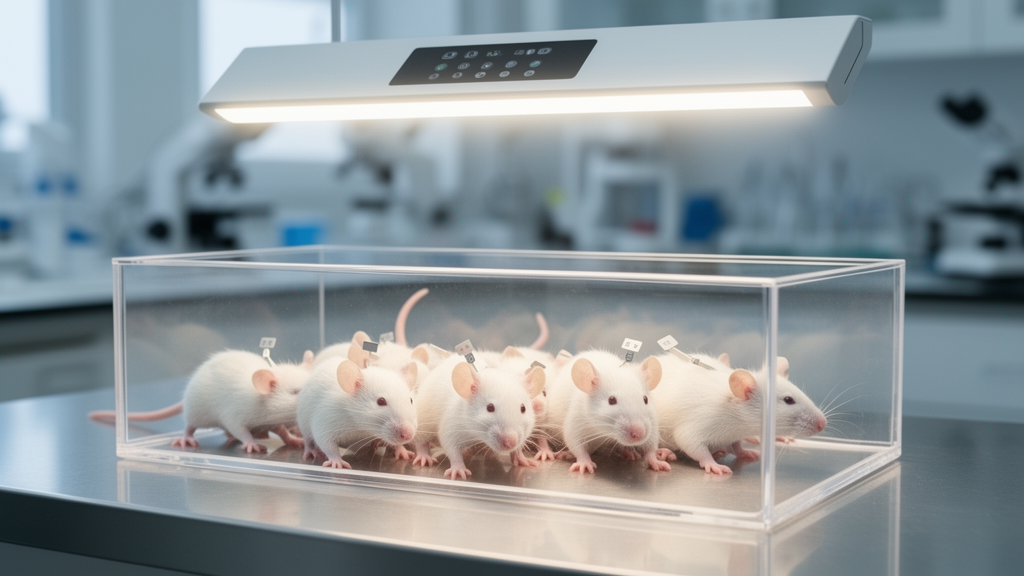
For decades, one of the most stubborn bottlenecks in behavioral neuroscience has been deceptively simple: how do you watch animals around the clock without disturbing them, and how do you tell individuals apart when they huddle, chase, and pile on top of one another? A team of researchers from Japan and Switzerland now reports a solution that may reset the field’s expectations. In a study published in Frontiers in Behavioral Neuroscience, they unveil eeeHive, an automated behavioral monitoring system built on high-frequency (HF) radio frequency identification, or RFID, that tracks group-housed animals with a speed and precision that conventional low-frequency systems cannot match.
The technology at the heart of the system is not new in principle. Passive RFID tags, tiny glass-encapsulated microchips implanted under an animal’s skin, have been used to identify laboratory rodents, livestock, pets, and even wild animals since the 1990s. When a reader’s antenna generates an electromagnetic field, the battery-free tag harvests power from it and transmits its unique identification code back. Deploy many antennas around a cage, and each detection event becomes a timestamped record of which animal was where. But the standard that animal research settled on, the low-frequency ISO 11784/11785 FDX-B protocol operating at 134.2 kilohertz, was designed in the mid-1990s for identification, not for high-resolution behavioral tracking, and its constraints have shaped what researchers could and could not see.
The core problem is data rate. The LF standard transfers data at roughly 4.19 kilobits per second, which means a reader needs at least 30.52 milliseconds just to receive one full data block from a tag. Because the reader cannot verify that no tag is present, it must sustain the activation field for that entire duration even over empty antennas, wasting time on nothing. In practice, this forces a harsh trade-off: researchers can either poll a dense array of antennas quickly, or space them out and accept slower sampling, but not both. The second limitation is more damaging still. When two or more animals crowd into the same antenna field, their simultaneous responses collide and the reader loses data entirely, a phenomenon known as tag collision. For species like mice, which naturally aggregate in dense clusters, this means a substantial fraction of behavioral information simply vanishes.
eeeHive, whose name stands for easy extensions for ethologically-relevant and home cage-integrated in vivo experiments, attacks both weaknesses by moving to the 13.56-megahertz HF band and the ISO/IEC 15693 standard. At that frequency, the data rate rises to 26.48 kilobits per second, so requesting and receiving a tag identification takes only about 5.9 milliseconds, and an empty antenna is recognized and skipped in roughly 2.1 milliseconds. More importantly, the HF protocol includes an anti-collision scheme based on slotted ALOHA, which divides the response window into 16 discrete time slots so that multiple tags can answer without drowning each other out. The hardware is fully custom: a reader built around a Texas Instruments microcontroller and an NXP RFID chip drives an antenna multiplexer using RF switches that sequentially activate up to 24 antennas. Two configurations emerged from this architecture, a 2D module with a grid of 24 tile antennas on a 200 by 300 millimeter board for two-dimensional position tracking, and a FLEX module that accepts up to 24 ring antennas placed flexibly at tunnels, feeders, water stations, and nestbox entrances for event-based and three-dimensional coverage.
Bench testing confirmed the speed gains. A full polling cycle across 24 antennas took an estimated 142 milliseconds when no tags were present, equivalent to 5.9 milliseconds per antenna, with an additional 8.2 milliseconds of read time per detected tag. The read range of the tile antennas reached up to 40 millimeters, and, contrary to the expectation that higher-frequency signals would be crippled by conductive media, the range shrank by only about 1.4 millimeters on average in saltwater compared with freshwater. That matters because the penetration depth of HF fields, roughly 30 to 2,500 centimeters in freshwater and 6.8 centimeters in seawater, is still far larger than the few centimeters separating an implanted tag from a nearby antenna in a home-cage setup.
To put the system through its paces, the team tracked 24 male C57BL/6J mice, each implanted with a subcutaneous abdominal tag, in a compartmentalized acrylic cage fitted with four 2D modules beneath the floor, 96 antennas in total, for one week. Validation against simultaneous video recording showed that positional agreement reached nearly 90 percent when the two closest candidate antennas were considered, and tag read success rates ranged from 96.0 to 99.4 percent during the light phase and 78.4 to 78.9 percent during the dark phase, when the animals were most active. Over the full seven days, the mean per-second detection rate across all 24 mice was 83.6 percent. The behavioral payoff was immediate. The mice rapidly converged on a single shaded compartment as a shared home base, segregated their latrine sites from their resting area, and dispersed during active phases while clustering tightly when resting. Individual differences emerged just as clearly: some mice, dubbed corner occupiers, stayed pinned to the secure corner of the home base, while roamers ranged widely and showed markedly less engagement in reciprocal following behavior, a pattern the authors interpret as potentially reflecting social dominance over access to a limited spatial resource.
The FLEX module then demonstrated the system’s reach beyond rodents. Six common marmosets, small and highly social primates, were tagged and monitored for seven weeks in a 44.65-cubic-meter enclosure equipped with 20 ring antennas at nestboxes, feeders, and water stations. All 850 access events detected by the antennas matched independent video observations perfectly. The logs revealed rich social structure: follow and chasing events between pairs occurred far more often than chance, with observed-to-expected ratios for chasing averaging 17.8 and peaking at 56.1, and the most asymmetric relationships aligned precisely with caretakers’ daily observations of dominance, mating pursuit, and affiliative bonds. Nighttime nestbox co-occupancy correlated strongly with daytime following behavior, and two subordinate individuals increasingly slept alone or outside nestboxes, patterns consistent with early social exclusion.
Perhaps the most surprising demonstration came underwater. Japanese fire-bellied newts tracked on a 48-antenna array showed strong preferences for tank walls and corners, transient group cohesion episodes that occurred more frequently than chance, and pair-specific proximity patterns, with every dyad except one male-male pair spending significantly more time close together than expected. Juvenile Nile tilapia in a two-compartment tank with submerged ring antennas achieved 100 percent agreement with video across 207 compartment transitions, displayed clear light-entrained activity rhythms, and showed short-latency following behavior characteristic of fish shoaling, with 62 of 110 dyads following each other significantly more than chance. Together, these aquatic tests show that HF RFID, long dismissed as too vulnerable to water and tissue attenuation for animal work, performs reliably at the short ranges home-cage monitoring actually requires.
The stakes of the collision problem become stark in the authors’ own data. In the mouse experiment, 48.7 percent of all valid positional records involved two or more animals sharing the same antenna field. Had the system relied on conventional LF hardware, which can read only one tag at a time, an estimated 27.1 percent of positional data would have been lost to collisions alone, before accounting for slower polling and longer read times. That loss would have crippled exactly the analyses that matter most in social neuroscience: proximity, aggregation, following, and avoidance. By resolving multiple tags simultaneously, eeeHive preserves the raw material for quantifying social behavior rather than discarding it.
The implications stretch well beyond ethology. Automated home-cage monitoring is increasingly championed as a tool for drug efficacy and safety assessment, where continuous, undisturbed observation can catch subtle behavioral changes that brief closed-session tests miss, and for animal welfare refinement, where knowing which environments animals prefer or avoid can reshape housing standards. The authors also point toward ambitious targets, noting that complex behaviors such as the tactical deception recently documented in wild mice could, in principle, be reproduced and systematically studied in controlled laboratory settings if the tracking infrastructure is fast and flexible enough. Long-term safety data add reassurance: mice implanted at one month of age showed no implant-related abnormalities at 25 months, marmosets remain healthy 3.5 years after implantation, and newts and tilapia have thrived for over three years. With no adverse health effects identified from HF-band electromagnetic exposure at guideline limits, and with the system running continuously for up to seven weeks without hardware failure, the researchers argue that the historical inertia that locked animal research into 1990s-era LF standards has now outlived its justification. A technology born for livestock ear tags may finally be ready to reveal what animals actually do when no one is watching.
Subject of Research: A high-frequency RFID-based automated behavioral monitoring system for tracking group-housed laboratory animals
Article Title: eeeHive: a new HF RFID-based automated behavioral monitoring system enabling high spatiotemporal resolution tracking of group-housed animals
Article References: eeeHive: a new HF RFID-based automated behavioral monitoring system enabling high spatiotemporal resolution tracking of group-housed animals. (n.d.). https://doi.org/10.3389/fnbeh.2026.1861925
Image Credits: AI Generated
DOI: 10.3389/fnbeh.2026.1861925
Keywords: RFID, behavioral neuroscience, automated home-cage monitoring, animal tracking, group-housed animals, HF RFID, ISO/IEC 15693, mice, marmosets, social behavior, ethology, animal welfare
Cite Scienmag News
William Thompson. (October 16, 2026). New HF RFID System Tracks Group-Housed Animals With Unprecedented Speed and Precision. Scienmag. https://scienmag.com/new-hf-rfid-system-tracks-group-housed-animals-with-unprecedented-speed-and-precision/
William Thompson. "New HF RFID System Tracks Group-Housed Animals With Unprecedented Speed and Precision." Scienmag, 16 October 2026, https://scienmag.com/new-hf-rfid-system-tracks-group-housed-animals-with-unprecedented-speed-and-precision/. Accessed 16 October 2026.
William Thompson. "New HF RFID System Tracks Group-Housed Animals With Unprecedented Speed and Precision." Scienmag. October 16, 2026. https://scienmag.com/new-hf-rfid-system-tracks-group-housed-animals-with-unprecedented-speed-and-precision/


