


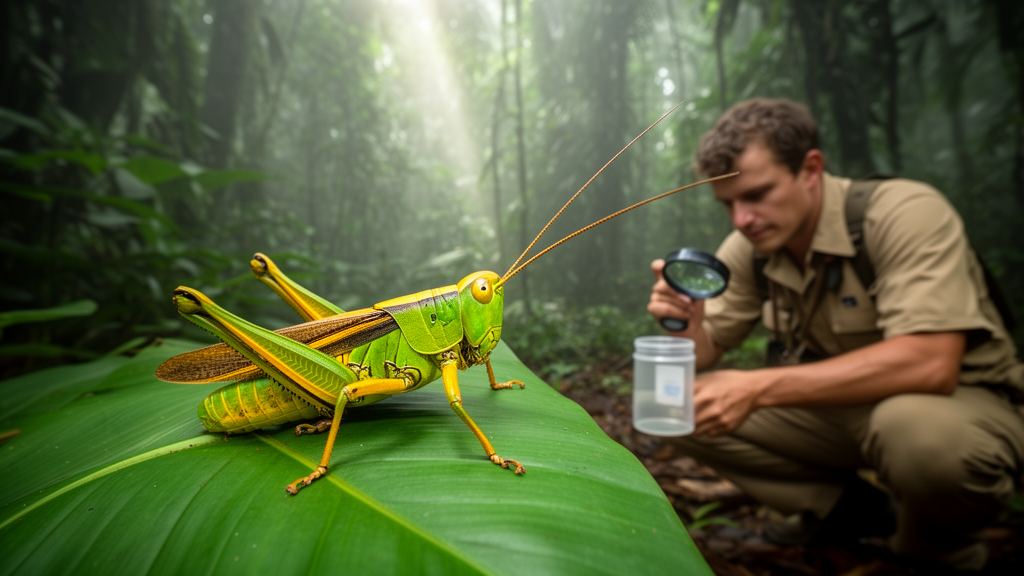
Deep in the swampy gallery forests of Cameroon’s Littoral Region, a grasshopper that science had almost entirely lost has been found again. Gerista dimidiata, a striking yellow-and-black insect first described in 1905, has now been recorded in Cameroon for the first time, extending its known range eastwards and filling a significant gap in the map of Afrotropical grasshopper diversity. The discovery, published in African Invertebrates, is remarkable not only for what it reveals about this single species but for what it says about how little we still know about the insects living in Central Africa’s rapidly changing forests.
Gerista dimidiata is the only species in its genus, a monotypic Afrotropical lineage within the grasshopper subfamily Oxyinae. Before this study, the species was known exclusively from Nigeria and Bioko Island in Equatorial Guinea, where it inhabits the edges of swampy forests and clings to broad-leaved forest grasses. Its scarcity is legendary among orthopterists: for more than a century, the species was represented in collections solely by the male holotype preserved at the Museo Nacional de Ciencias Naturales in Madrid, with no paratypes and no additional confirmed specimens reported in the literature. That a whole species could rest on a single specimen for 120 years says something profound about both the rarity of the animal and the incompleteness of our knowledge of African insect fauna.
The new research, conducted between February 2020 and March 2026, reports the species from two localities in Cameroon’s Littoral Region: Yansoki and Missole I. Seven adult individuals, all male, were captured during monthly surveys spanning six years, five from Yansoki and two from Missole I. Specimens were collected using sweep nets, with targeted sampling of 60 minutes per day between 10 a.m. and 4 p.m., following established grasshopper survey protocols. The collectors searched actively on grasses edging swamps in gallery forests, precisely the kind of habitat where historical accounts had placed the species. Photographs taken in the natural habitat with a rugged digital camera formed the basis of the species’ colour description, while GPS devices recorded precise coordinates for each collection site.
The Littoral Region of Cameroon is an equatorial zone of extraordinary biological richness and climatic intensity. Annual rainfall there reaches approximately 4,000 millimetres, with relatively constant temperatures around 27 degrees Celsius. The climate is hot and humid, with a unimodal rainfall regime: the rainy season extends for roughly nine months of the year. Dense rainforest covers approximately 20,248 square kilometres of the region, accounting for 4.4 percent of the country’s total forest cover. Along the estuarine coasts near the mouths of the Sanaga and Nyong Rivers, mangrove ecosystems dominated by Rhizophora species line the amphibious margins. Inland, lowland coastal forests extend 50 to 100 kilometres around Douala, where Lophira alata is the dominant tree. Beyond that zone lie dense, humid evergreen forests of low to medium altitude, giving way further north to semi-deciduous forests rich in Sterculiaceae.
Yet much of this forest has been transformed. Industrial plantations of coffee, oil palm, banana and rubber have replaced broad tracts of the original vegetation, and the study’s authors note that extensive deforestation and increasing forest fragmentation have been documented in the Littoral Region, driven primarily by agricultural expansion, logging, land clearing, oil-palm cultivation and settlement growth. Against this backdrop, the persistence of Gerista dimidiata in the region’s remaining gallery forests is both a scientific gift and a conservation warning. The species was found in gallery forests bordering swampy areas and wetlands, corroborating the ecological notes of Jago, who in 1962 described it as a forest-edge species associated with broad-leaved grasses. Such humid forest-wetland transition zones provide suitable microclimatic conditions, food resources and shelter that may be essential for the persistence of this apparently localised insect.
The redescription of the species is a technical achievement in its own right. The male is small, with a large head, prominent eyes, and a fastigium of the vertex obtusely produced forwards. The antennae are thick and filiform, much longer than the head and pronotum combined, with a constant count of 26 segments across all examined specimens. The pronotum is rugose and subcylindrical, crossed by three sulci, with the metazona about one-third the length of the prozona. The tegmina are brachypterous, reaching only the mid-line of the abdomen in dorsal view, with strong longitudinal veins tapering towards the apex, and the wings are smoky. The hind tibiae are strongly hirsute and expanded in the apical half, bearing seven outer and nine inner tibial spines, with the external apical spine absent. Total body length ranges from 19.43 to 20.15 millimetres, with a mean of 19.90 millimetres.
The colouration is what makes this grasshopper unforgettable. The body is predominantly yellow with black stripes: the head is yellow with a black vertex and occiput, the eyes are black, and the antennae are brown with yellow scape and pedicel. In life, the fifth basal antennal segments are bluish, while the remaining apical segments are black. The prozona is yellow, the metazona bluish, and the lateral lobes of the pronotum carry large black bands extending from behind the eyes to the posterior margin. The hind femur is yellow with two large black stripes, the hind knees are black dorsally with blue basal lobes, and the hind tibiae are blue with a yellow basal stripe and black spines. The elytra are bluish with a black radial vein. This is not a drab cryptic insect but a boldly patterned one, which makes its century of obscurity all the more puzzling.
The most significant taxonomic contribution of the study is the first description of the male genitalia, structures never before documented for this species. Male genital morphology has proven highly informative in Orthoptera taxonomy, often providing reliable characters for species identification, species delimitation and phylogenetic reconstruction. The epiphallus shows a divided bridge typical of Oxyinae, with well-developed ancorae pointed inwards with acute apices, and lobiform lophi curved upwards with angular apices bearing small inner lobes. The phallic complex is stout and robust, with a U-shaped dorsal arch of the cingulum, narrow apodemes curved inwards, large laterally expanded endophallic apodemes, and slender apical valves of the penis with divergent tips. The ejaculatory sac is cylindrical, longer than wide, extending beyond the endophallic apodemes. By incorporating genital morphology into the diagnosis, the study brings Gerista dimidiata in line with current taxonomic practices increasingly adopted in Acrididae systematics.
Morphometric analysis of the five measured specimens, conducted with PAST software, revealed remarkably low variation across most characters. Head width ranged from 3.47 to 3.60 millimetres with a mean of 3.50, pronotum length from 4.48 to 5.02 millimetres, and hind femur length from 13.25 to 14.31 millimetres. The number of antennal segments, outer tibial spines and inner tibial spines were constant across all specimens, at 26, seven and nine respectively. Ethanol-preserved specimens were photographed in frontal, lateral and dorsal views at the State Museum of Natural History Karlsruhe in Germany using a Keyence VHX-7000 digital microscope, and the dissection and preparation of male genitalia followed standard procedures, with terminology following Dirsh, Rowell and Khan. Measurements were taken with digital calipers to the nearest 0.1 millimetre.
The biogeographic implications of the discovery are considerable. The new records fill an important distributional gap between Nigeria and Bioko Island, and suggest that the species may be more widespread within the Guineo-Congolian forest block than currently documented. Two non-exclusive hypotheses may explain the observed pattern: the species may naturally exhibit a fragmented distribution, with populations restricted to isolated patches of suitable habitat, or it may once have possessed a broader, more continuous distribution that was subsequently fragmented by historical climatic fluctuations, geological processes and more recent anthropogenic disturbances. Evidence from the Guineo-Congolian Region indicates that historical contractions and fragmentation of tropical rainforest have influenced the distribution and diversification of forest-associated organisms. Similar effects of forest fragmentation on biodiversity and population connectivity have been documented in other Afrotropical forest systems, and the current distribution of Gerista dimidiata may reflect either naturally discontinuous populations or remnants of formerly more widely connected populations that have become increasingly isolated through long-term environmental change and habitat modification.
Only seven individuals captured over six years of monthly surveys is a detection rate that strongly indicates the species is either naturally uncommon, occurs at very low population densities, or persists in highly localised populations. The authors emphasise the need for further targeted surveys throughout the Guineo-Congolian forest region to clarify the species’ true distribution, population status, habitat requirements and conservation needs. Additional surveys across different seasons and other forested regions of Cameroon will be necessary to understand its distribution, habitat preferences and conservation status. The study underscores the need for further taxonomic and faunistic surveys in Central African forest ecosystems, which continue to yield previously unrecorded or poorly known species, and highlights the critical role of gallery forests as refugia for endemic and potentially vulnerable grasshopper species. With urbanisation accelerating in Cameroon’s Littoral Region, the authors call for integrated conservation strategies before these forest-wetland refugia, and the rare insects they shelter, disappear.
Subject of Research: First record and redescription of Gerista dimidiata Bolívar, 1905 ( Orthoptera , Acrididae , Oxyinae ) from Cameroon
Article Title: First record and redescription of Gerista dimidiata Bolívar, 1905 ( Orthoptera , Acrididae , Oxyinae ) from Cameroon
Article References: Djomnang Nkwala, A. L., Yetchom Fondjo, J. A., Wandji, A. C., Mbajoun Nzike, M., Husemann, M., & Kekeunou, S. (2026). First record and redescription of Gerista dimidiata Bolívar, 1905 (Orthoptera, Acrididae, Oxyinae) from Cameroon. African Invertebrates, 67(2), 155-166. https://doi.org/10.3897/afrinvertebr.67.207705
Image Credits: AI Generated
DOI: 10.3897/AfrInvertebr.67.207705
Keywords: First, record, redescription, Gerista, dimidiata, Orthoptera, Acrididae, Oxyinae, Cameroon, scientific research
Cite Scienmag News
Margaret Porter. (October 16, 2026). Rarest Grasshopper in Africa Found in Cameroon After 120 Years. Scienmag. https://scienmag.com/rarest-grasshopper-in-africa-found-in-cameroon-after-120-years/
Margaret Porter. "Rarest Grasshopper in Africa Found in Cameroon After 120 Years." Scienmag, 16 October 2026, https://scienmag.com/rarest-grasshopper-in-africa-found-in-cameroon-after-120-years/. Accessed 16 October 2026.
Margaret Porter. "Rarest Grasshopper in Africa Found in Cameroon After 120 Years." Scienmag. October 16, 2026. https://scienmag.com/rarest-grasshopper-in-africa-found-in-cameroon-after-120-years/


