


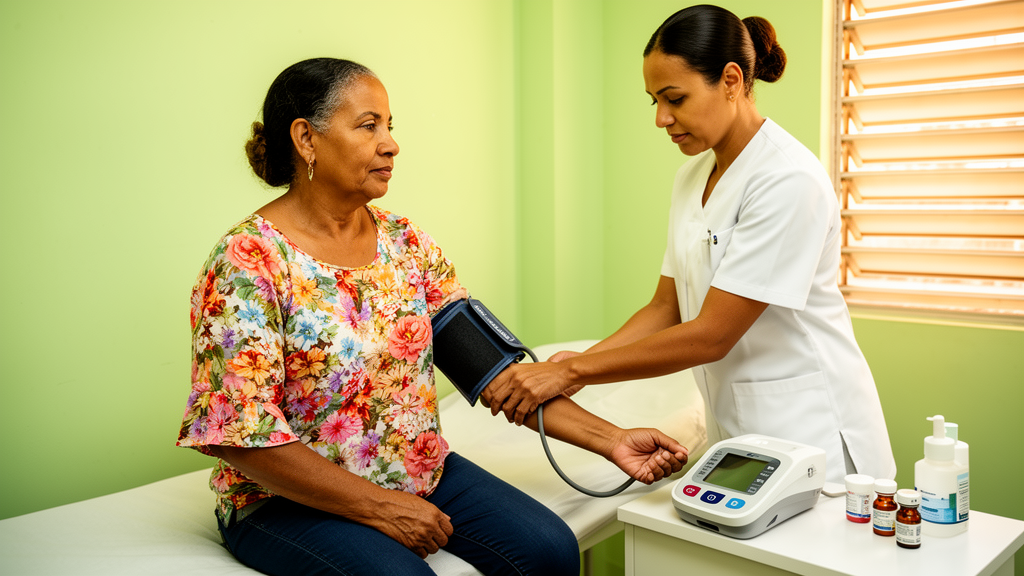
At a small non-profit diabetes clinic on the northern coast of the Dominican Republic, most patients are anything but sedentary. They cook, do laundry, haul shopping, and work long hours at physically demanding jobs. Yet when researchers measured their fasting blood glucose, the numbers told a troubling story: fewer than one in four patients had readings within the target range for controlled type 2 diabetes, and the men in the sample fared dramatically worse than the women. A new exploratory study, published in Frontiers in Clinical Diabetes and Healthcare, suggests that in resource-constrained settings, the sheer volume of daily physical activity may matter far less than its intensity — and that sleep, stress, and diet are quietly shaping glycemic outcomes in ways conventional care rarely addresses.
The study, led by Amerigo Rossi of the New York Institute of Technology together with colleagues at Brooklyn College, the Centro Regional Contra la Diabetes in Nagua, and Oklahoma State University, enrolled 65 adults with type 2 diabetes receiving care at the Nagua Regional Diabetes Center. The clinic serves a primarily urban, resource-constrained population, and the research team worked directly with clinic leadership and staff to design the evaluation. Data were collected in the summer of 2025 through interviewer-administered questionnaires delivered verbally in Spanish by a Dominican physician and nutritionist, covering sleep quality, perceived stress, diet quality, health-related quality of life, and physical activity. Fasting blood glucose was measured by a clinic nurse using finger-stick capillary testing with a point-of-care monitor — a pragmatic choice, made in consultation with clinic administrators who preferred to avoid additional blood draws, though one that carries known trade-offs in accuracy compared with standardized venous measurements.
The headline numbers are stark. Only 15 participants — 23 percent of the sample — had fasting blood glucose within the 80 to 130 milligrams per deciliter target range for people with type 2 diabetes. The group average sat at 189 milligrams per deciliter, well above target. And the sex difference was impossible to ignore: men averaged 243 milligrams per deciliter, compared with 170 among women, a gap large enough to survive rigorous statistical testing. Men were also significantly less physically active than women, expending roughly 2,035 kilocalories per week compared with 2,792 among the women in the sample. Only one of the 17 men in the study had a fasting glucose reading within the target range.
Beyond glucose, the behavioral and psychosocial profile of the patients was sobering. Ninety-eight percent reported poor sleep quality on the Pittsburgh Sleep Quality Index, with nearly 90 percent falling into the moderate-to-severe disturbance range. Ninety-seven percent reported moderate-to-high perceived stress, and only two participants qualified as low-stress. Diet quality scores pointed to low consumption of protective foods: nearly one-third of participants had eaten no fruits or vegetables in the previous day, and scores for fruits, vegetables, legumes, and whole grains were uniformly low. Health-related quality of life was also compromised, with participants reporting an average of 13 out of the past 30 days limited by poor physical or mental health, and not a single participant rating their general health as very good or excellent.
Physical activity, by contrast, was abundant — but not in the way diabetes guidelines typically envision. Using the Yale Physical Activity Survey, the researchers found that 95 percent of participants met or exceeded the American College of Sports Medicine recommendation of 500 to 1,000 MET-minutes per week, with 83 percent exceeding the higher threshold. But when the team broke down where that activity came from, the picture changed: 66 percent of total energy expenditure came from the work domain, dominated by food preparation, laundry, shopping, and heavy housework — all activities in the 2 to 4 MET range, meaning light intensity or the low end of moderate. Exercise contributed just 13 percent, recreation 11 percent, and yardwork 10 percent. In other words, these patients were moving constantly, but rarely at the intensities associated with the strongest metabolic benefits.
To untangle how these factors relate to one another, the researchers turned to network analysis — a statistical approach increasingly popular in behavioral medicine because it treats variables not as independent predictors lined up against a single outcome, but as a web of conditional associations. The team used a Graphical LASSO, a regularization technique that estimates sparse partial-correlation networks and helps minimize overfitting, then stress-tested the results with 200 bootstrap resamples. Only connections that appeared in at least 75 percent of bootstrap iterations were retained as stable edges. The result was a map of eight stable connections among ten variables, organized into four distinct clusters — and one variable sat at the center of it all.
Physical activity emerged as the most connected node in the network, with a degree centrality of 0.444, meaning it shared direct associations with more other variables than anything else in the model. Crucially, it was the only behavioral or psychosocial factor directly connected to fasting blood glucose, and the association was inverse: more activity, lower glucose. Physical activity was also inversely linked to male sex — reflecting the fact that men moved less — and positively linked to perceived stress, an intriguing signal suggesting that participants under more psychological strain were also more physically active, perhaps because much of their activity was obligatory labor rather than chosen exercise. The strongest single connection in the entire network, with a stability of 0.98, was between male sex and fasting blood glucose, reinforcing the pattern that men in this clinic were carrying a substantially heavier glycemic burden.
The authors are careful about what these findings do and do not mean. The cross-sectional design rules out causal claims, and the network associations are exploratory rather than evidence of independent effects — particularly because potentially important clinical and socioeconomic confounders, including medication dosage and adherence, comorbidities, and income, were not included in the model. The capillary glucose measurement, while feasible in this setting, introduces more variability than laboratory-based venous testing or glycated hemoglobin would, and it captures glycemic status at a single moment rather than over time. The sample, drawn from a single clinic and heavily weighted toward women, also limits generalizability. Still, the glucose values observed were broadly consistent with — and in some cases worse than — those reported in prior Dominican studies, lending the pattern real-world weight.
What makes the study compelling is the disconnect it exposes. Global diabetes prevalence is projected to climb from over 500 million people today to nearly 800 million by 2050, with middle-income countries like the Dominican Republic expected to see nearly double the prevalence growth rate of high-income nations. Across all low- and middle-income countries, fewer than 5 percent of people with diabetes receive all recommended treatments. In the Dominican Republic specifically, adult diabetes prevalence has surged from 3 percent in 2000 to 18 percent in 2024, and a rural study found that only about half of respondents had ever heard of the disease. Against that backdrop, the Nagua findings suggest that simply telling patients to
Subject of Research: Behavioral and psychosocial correlates of fasting blood glucose in a resource-constrained diabetes clinic in the Dominican Republic: an exploratory network analysis
Article Title: Behavioral and psychosocial correlates of fasting blood glucose in a resource-constrained diabetes clinic in the Dominican Republic: an exploratory network analysis
Article References: Rossi, A., Rossi, M. O., Jiménez, A. C., & Boolani, A. (2026). Behavioral and psychosocial correlates of fasting blood glucose in a resource-constrained diabetes clinic in the Dominican Republic: an exploratory network analysis. Frontiers in Clinical Diabetes and Healthcare, 7, Article 1978637. https://doi.org/10.3389/fcdhc.2026.1978637
Image Credits: AI Generated
DOI: 10.3389/fcdhc.2026.1978637
Keywords: Behavioral, psychosocial, correlates, fasting, blood, glucose, resource-constrained, diabetes, clinic, Dominican, Republic, exploratory
Cite Scienmag News
Ophelia Keating. (October 16, 2026). In a Dominican Diabetes Clinic, Housework Didn’t Lower Blood Sugar — but the Network Says It Should Have. Scienmag. https://scienmag.com/in-a-dominican-diabetes-clinic-housework-didnt-lower-blood-sugar-but-the-network-says-it-should-have/
Ophelia Keating. "In a Dominican Diabetes Clinic, Housework Didn’t Lower Blood Sugar — but the Network Says It Should Have." Scienmag, 16 October 2026, https://scienmag.com/in-a-dominican-diabetes-clinic-housework-didnt-lower-blood-sugar-but-the-network-says-it-should-have/. Accessed 16 October 2026.
Ophelia Keating. "In a Dominican Diabetes Clinic, Housework Didn’t Lower Blood Sugar — but the Network Says It Should Have." Scienmag. October 16, 2026. https://scienmag.com/in-a-dominican-diabetes-clinic-housework-didnt-lower-blood-sugar-but-the-network-says-it-should-have/


