


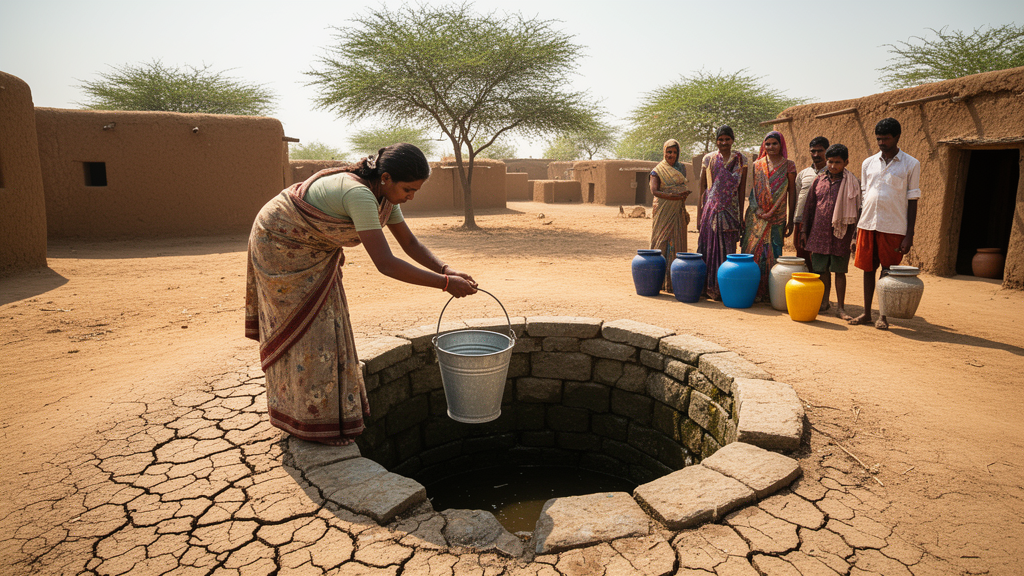
In the hard-rock uplands of Puruliya district in West Bengal, eastern India, the question of who gets water and who does not has never been answered by geology alone. A new study from the University of Burdwan, published in SN Social Sciences, argues that household water insecurity in this water-scarce region is not simply a product of dry aquifers and failing wells. Instead, it is co-produced by three interacting forces: environmental constraints that limit what the landscape can supply, socio-economic inequalities that determine which households can afford alternatives, and local water governance processes that decide how public provision is actually distributed on the ground.
The research, led by geographer Soumitra Saha with Namita Chakma, focused on Baghmundi Community Development Block, a rural administrative unit in Puruliya where crystalline basement rock underlies much of the terrain. Hard-rock aquifers of this kind are notoriously difficult. Unlike the porous sandstone or alluvial systems found elsewhere, fractured crystalline rock stores groundwater in narrow fissures, so well yields are erratic, drilling success is uncertain, and tube wells can fail without warning. The study documents how recurrent tube well failures, layered on top of pronounced seasonal stress, create a baseline of physical scarcity that every household in the region must navigate.
What makes the study distinctive is its insistence that this physical baseline is only the beginning of the story. Drawing on political ecology and hydrosocial scholarship, the authors treat water insecurity as a relational phenomenon, produced through the interaction of hydrology, money, institutions, and social norms. Water scarcity, in this framing, is never purely natural. The hydrosocial cycle concept, which the researchers invoke, holds that water and society remake each other continuously: infrastructure, governance decisions, and economic hierarchies reshape where water flows, while the resulting patterns of access reshape social relations in turn.
To capture this complexity, the team deployed a mixed-methods design. Quantitative data came from household surveys covering 240 households, analysed with descriptive and inferential statistical techniques to identify patterns and test associations in water access. Qualitative depth came from key informant interviews, focus group discussions, field observations, and follow-up investigations, all processed through thematic coding. The two strands were deliberately complementary: the statistics mapped the distribution of insecurity across households, while the interviews and discussions revealed the mechanisms and lived experiences behind the numbers.
The quantitative findings revealed significant inequalities in household water access across the study area. Households differed sharply in how reliably they could obtain sufficient water, and these differences tracked socio-economic position. Financial capacity emerged as a decisive factor: families able to invest in private wells, storage, or paid water arrangements could buffer themselves against seasonal shortages and pump failures, while poorer households remained dependent on public provision that could not guarantee supply. Reliance on public service provision, the study found, was itself a marker of vulnerability, because the reliability of that provision varied across villages and seasons.
Institutional support proved to be a second axis of differentiation. Where local institutions functioned well, maintaining infrastructure and mediating access, households experienced measurably less insecurity. Where institutional support was weak or unevenly distributed, the burden fell disproportionately on those with the least capacity to compensate. The researchers also documented water-related burdens, the labour and time households expend securing water, as an important dimension of insecurity in their own right, one that interacts with socio-cultural barriers to produce sharply different experiences even among neighbours facing the same hydrogeological conditions.
The qualitative strand of the study gave these patterns human texture. Interviews and focus group discussions showed how socio-cultural barriers, including the gendered division of water labour and caste-linked patterns of exclusion documented in prior Indian scholarship, shape who bears the daily costs of scarcity. This aligns with a broader body of work the authors cite, including research on Dalit access to water in rural India and feminist political ecology analyses showing that water insecurity is experienced through the body, with women and marginalized groups typically absorbing the heaviest burdens of collection, queuing, and conflict over scarce sources.
The central conclusion is stark in its implications: although hydrogeological constraints and recurrent tube well failures with seasonal stresses produce water insecurity, local governance processes and socio-economic inequalities largely determine how households differentially experience it. In other words, the physical environment sets the stage, but governance and inequality write the script. Two households drawing from the same stressed aquifer can inhabit radically different realities depending on their financial resources, their standing in the community, the responsiveness of local institutions, and the reliability of the public infrastructure they depend on.
This finding resonates with international evidence cited in the study. Research from Northeast Brazil has shown that infrastructure is a necessary but insufficient condition for eliminating inequalities in water access, and systematic reviews across low- and middle-income countries confirm that physical availability rarely translates directly into equitable access. Studies of handpump borehole functionality in Africa similarly demonstrate that physical factors explain only part of the story of rural water point failure, with management and governance playing decisive roles. The Puruliya study extends this insight into the hard-rock terrain of eastern India, where the interaction of fractured aquifers and layered social hierarchies produces insecurity that no single intervention can dissolve.
The authors argue that their results point toward three priorities: hydrogeologically informed planning that takes the realities of basement aquifers seriously, equitable service provision that does not leave the poorest households dependent on the least reliable sources, and adaptive, inclusive water governance capable of responding to seasonal stress and infrastructure failure. As climate variability intensifies across South Asia’s water-scarce uplands, the study’s core message grows more urgent. Solving rural water insecurity, the evidence from Baghmundi suggests, requires treating water not just as a resource to be drilled for, but as a social outcome to be governed, distributed, and defended.
Subject of Research: Co-production of household water insecurity by environmental constraints, socio-economic inequality, and local water governance in rural Puruliya, eastern India
Article Title: Co-producing household water insecurity: environmental constraints, socio-economic inequalities, and local water governance in rural Puruliya, Eastern India
Article References: Co-producing household water insecurity: environmental constraints, socio-economic inequalities, and local water governance in rural Puruliya, Eastern India. (n.d.). https://doi.org/10.1007/s43545-026-01660-w
Image Credits: AI Generated
DOI: 10.1007/s43545-026-01660-w
Keywords: household water insecurity, water governance, Puruliya, rural India, groundwater, political ecology, hydrosocial cycle, water inequality, tube wells, West Bengal, mixed methods, water access
Cite Scienmag News
Courtney Benton. (October 16, 2026). When Wells Run Dry: How Poverty and Politics Decide Who Stays Thirsty in Rural India. Scienmag. https://scienmag.com/when-wells-run-dry-how-poverty-and-politics-decide-who-stays-thirsty-in-rural-india/
Courtney Benton. "When Wells Run Dry: How Poverty and Politics Decide Who Stays Thirsty in Rural India." Scienmag, 16 October 2026, https://scienmag.com/when-wells-run-dry-how-poverty-and-politics-decide-who-stays-thirsty-in-rural-india/. Accessed 16 October 2026.
Courtney Benton. "When Wells Run Dry: How Poverty and Politics Decide Who Stays Thirsty in Rural India." Scienmag. October 16, 2026. https://scienmag.com/when-wells-run-dry-how-poverty-and-politics-decide-who-stays-thirsty-in-rural-india/


