


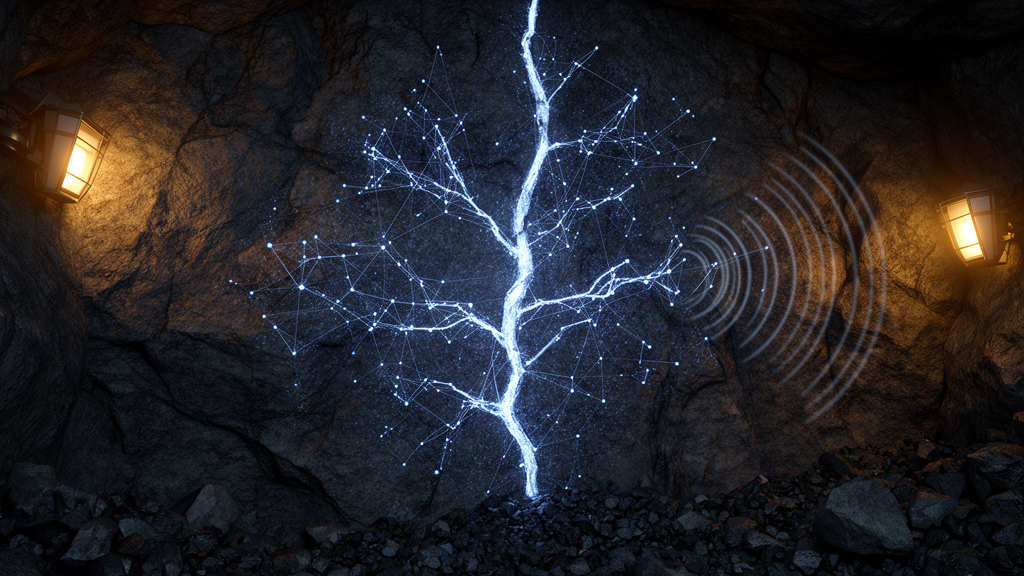
Deep underground, before a rockburst tears through a coal seam, the rock mass gives warning. It fractures microscopically, releasing faint seismic whispers that race through the surrounding strata to arrays of buried sensors. Capturing those whispers is the basis of microseismic monitoring, one of the most important tools for protecting miners from dynamic disasters such as rockbursts and coal and gas outbursts. But there is a catch: the underground is one of the noisiest acoustic environments imaginable, filled with the grinding of shearers, the rumble of conveyors and the hum of ventilation systems, all of which can bury the weak signals that matter most.
A team of researchers in China has now shown that a remarkably small artificial neural network can cut through that noise and pinpoint the onset of microseismic waves with unprecedented reliability for such a compact model. Writing in Frontiers in Signal Processing, Haichen Yin of the China University of Mining and Technology and Shandong Energy Group, together with colleagues from the China Coal Research Institute and other institutions, describe a lightweight convolutional neural network (CNN) that picks the first arrival of microseismic P-waves directly from noisy single-component waveforms recorded at a deep coal mine in Shandong Province.
The problem they tackled is a classic one in seismology. Every attempt to locate a microseismic event, and therefore to map where the rock is failing and where stress is concentrating, begins with picking the precise instant at which the first seismic energy reaches each sensor. Traditional algorithms, most famously the short-term average to long-term average ratio (STA/LTA) method and the Akaike Information Criterion (AIC), detect arrivals by scanning for jumps in sliding-window energy ratios or by matching waveform statistics. These methods work reasonably well in quiet conditions, but in a working coal mine they are easily fooled. When background noise itself produces energy spikes, threshold-based pickers can trigger early, latching onto noise bursts rather than true rock fracturing, and their accuracy depends heavily on hand-tuned thresholds.
Deep learning has transformed phase picking in global seismology. Networks such as PhaseNet, developed by Weiqiang Zhu and Gregory Beroza, and EQTransformer, introduced by S. Mostafa Mousavi and colleagues, now routinely detect earthquake arrivals with superhuman speed and impressive accuracy. But those models were designed for three-component seismic recordings sampled at around 100 hertz, and they typically contain millions of parameters. Coal mine microseismic data are a different beast entirely: usually recorded on single channels, sampled at much higher rates, and drowned in industrial noise. Running a heavyweight earthquake model on the resource-constrained monitoring hardware installed at a mine face is often impractical, and transferring a model trained on teleseismic data to mine waveforms suffers from severe domain mismatch.
The new network was designed specifically for this gap. Each 1,600-sample waveform trace, recorded at 500 hertz, is first converted into a two-dimensional time-frequency image using the short-time Fourier transform, with a 64-sample window and an 8-sample hop, and the logarithmic magnitude is normalized to zero mean and unit variance. The result is a 33 by 193 spectrogram in which a P-wave onset appears simultaneously as a jump in time and a rearrangement of energy across frequencies. This dimensionality-elevation strategy is the trick behind the model’s robustness: instead of relying only on amplitude changes in the time domain, which noise can mimic, the CNN can learn the characteristic spectral texture of a genuine rock-fracture onset.
The architecture itself is strikingly economical. Three convolutional blocks, with 16, 32 and 64 channels and kernel sizes of 5 by 5, 3 by 3 and 3 by 3, each followed by batch normalization, a rectified linear activation and max pooling, extract features hierarchically. The first, larger kernel acts as a smoothing filter that suppresses high-frequency random noise and captures broad waveform contours; the later, smaller kernels zoom in on the fine-grained local mutation that marks the arrival itself. An adaptive average pooling layer and three fully connected layers then output a single continuous number: the predicted first-arrival time. That regression strategy, rather than the per-sample classification used by networks like PhaseNet, eliminates the quantization error that classification methods introduce whenever an arrival is snapped to a discrete time window. The entire network contains just 58,529 trainable parameters, roughly 0.22 megabytes in 32-bit floating point, and requires only about 4.7 million multiply-accumulate operations per trace, making it genuinely suitable for real-time deployment on the edge hardware found in mine monitoring stations.
The training data came from an extraordinary natural laboratory. The Xinjulong Coal Mine lies in the deep Luxi Coalfield, where the No. 3 coal seam is buried 800 to 1,200 metres below the surface. It is a so-called three-soft seam, with a soft roof, soft floor and soft coal body, dipping at 15 to 30 degrees, and it is cut by the F311 fault, the largest in the mine’s history, with a throw of up to 16 metres. Where the working face approaches this fault, stress concentration coefficients reach 2.8 to 3.5 and microseismic event energy runs three to five times higher than in normal areas, making rockburst risk acute. Between June and October 2023, twelve underground triaxial accelerometers deployed around the 6305 working face recorded 3,963 microseismic events. From these, the researchers compiled 597 events with reliable manual P-wave labels, yielding 1,791 single-component waveform records that were split 60/20/20 into training, validation and test sets.
Trained with the Adam optimizer under a mean squared error loss and early stopping, the model achieved a mean absolute error of 45.61 sampling points on the test set, where one sample corresponds to just 2 milliseconds. The proportion of picks with errors not exceeding 100 milliseconds reached 80.27 percent. Against the traditional STA/LTA method, evaluated on 1,189 test samples, the CNN reduced overall picking error by about 15.7 percent, and the average relative error decreased by roughly 50 milliseconds, a systematic improvement visible as a distinct left-skewed shift in the distribution of error differences. The team also retrained a PhaseNet-style U-Net on the same data for a fair comparison; on the identical test set it and the classical AIC picker both lagged well behind, with accuracies within the 100-millisecond tolerance of only 66.3 and 65.2 percent respectively, compared with 78.0 percent in that analysis.
Perhaps most compelling is how the network behaves at the extremes of signal quality. In high signal-to-noise recordings, where traditional pickers drift slightly around the true onset due to local energy fluctuations, the CNN locks onto the beginning of the emergent waveform with near-perfect alignment to human labels, demonstrating its potential to replace subjective, fatigue-prone manual picking. In low signal-to-noise recordings, where shearer noise and conveyor vibration submerge the onset so thoroughly that the human eye struggles to find it, STA/LTA frequently fires early on noise bursts, while the CNN still produces predictions close to ground truth, apparently filtering the specific waveform patterns of P-wave arrivals out of the background clutter. The labelled dataset’s median signal-to-noise ratio of 17.5 decibels confirms that much of the data the model must handle is far from clean.
The implications reach well beyond one mine in Shandong. Accurate first-arrival picking is the foundation on which every downstream product of microseismic monitoring depends, from high-precision source localization to the identification of stress concentration zones and the early warning of rockbursts and outbursts. A picker this small can run continuously on distributed monitoring hardware, flagging hazardous rock fracturing in real time without bulky computing infrastructure. The authors caution that the residuals in their tests show no systematic early or late bias, which means the symmetric loss function does not skew located hypocentres, though coupling picking and location objectives in a single asymmetric loss remains future work. They plan to expand the dataset across diverse geological settings and further optimize the model for extreme operating conditions. As mining pushes ever deeper into stressed, fault-ridden ground, this study suggests that the quietest voices of the rock, once almost impossible to hear above the industrial din, can now be picked out by a neural network small enough to live underground alongside them.
Subject of Research: A lightweight convolutional neural network for automatic first-arrival picking of noisy coal mine microseismic data
Article Title: Seismic phase picking of coal mine microseismic data based on lightweight CNN
Article References: Yin, H., Zhang, X., Li, A., Zhu, W., Hou, Y., Chen, Y., & Lu, C. (2026). Seismic phase picking of coal mine microseismic data based on lightweight CNN. Frontiers in Signal Processing, 6, Article 1884114. https://doi.org/10.3389/frsip.2026.1884114
Image Credits: AI Generated
DOI: 10.3389/frsip.2026.1884114
Keywords: microseismic monitoring, convolutional neural network, coal mine safety, seismic phase picking, rockburst, deep learning, P-wave arrival, STA/LTA, Xinjulong Coal Mine, signal processing, regression prediction, edge deployment
Cite Scienmag News
Blake Davidson. (October 16, 2026). Tiny neural network reads rock-crack whispers buried in coal mine noise. Scienmag. https://scienmag.com/tiny-neural-network-reads-rock-crack-whispers-buried-in-coal-mine-noise/
Blake Davidson. "Tiny neural network reads rock-crack whispers buried in coal mine noise." Scienmag, 16 October 2026, https://scienmag.com/tiny-neural-network-reads-rock-crack-whispers-buried-in-coal-mine-noise/. Accessed 16 October 2026.
Blake Davidson. "Tiny neural network reads rock-crack whispers buried in coal mine noise." Scienmag. October 16, 2026. https://scienmag.com/tiny-neural-network-reads-rock-crack-whispers-buried-in-coal-mine-noise/


