

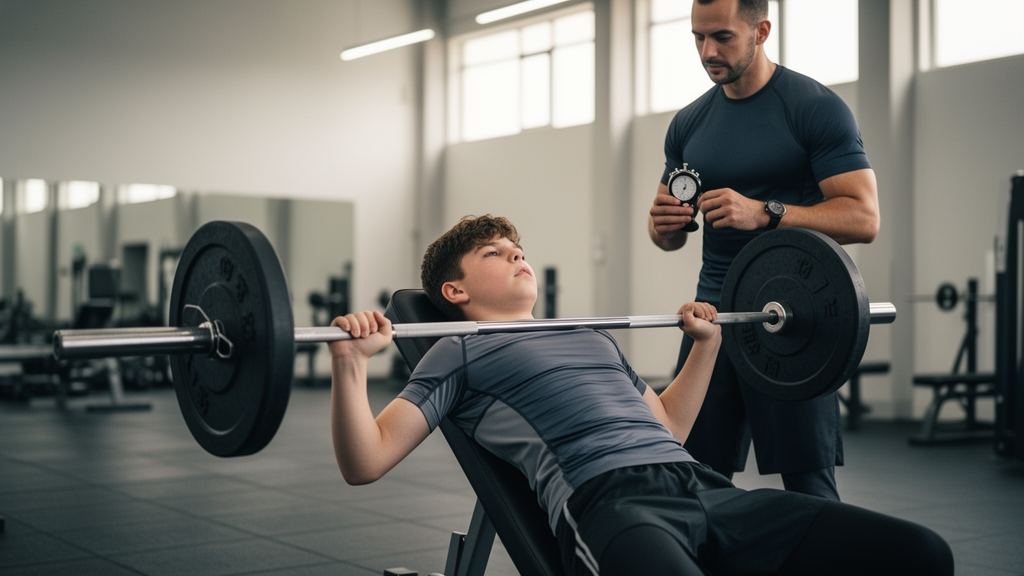
In a finding that could reshape how combat-sport athletes prepare their bodies for explosive performance, researchers have shown that the point at which a heavy bench press set is stopped can determine whether a boxer’s punches fly faster and harder afterward—or whether they sag under a veil of lingering fatigue. The study, published in Frontiers in Physiology, tracked elite adolescent boxers through a carefully controlled series of laboratory sessions and revealed a narrow, time-sensitive window in which carefully dosed heavy pressing appears to sharpen straight-punch output.
The research focused on post-activation performance enhancement, or PAPE, an acute phenomenon in which brief, high-intensity muscle contractions transiently improve subsequent strength, speed, or power. Physiologists believe the effect arises from heightened neuromuscular excitability, including more efficient motor unit recruitment and increased sensitivity of muscle fibers to calcium ions. But PAPE is a double-edged sword: the same conditioning activity that primes the neuromuscular system also generates fatigue, and performance only improves when potentiation outweighs that residual fatigue. The central challenge, therefore, is inducing sufficient activation while minimizing the fatigue that masks it.
To probe that balance, a team led by Penglin Diao of Wuhan Sports University and Ziyu Wang of the University of Canterbury recruited eighteen male boxers from the Shandong Provincial Boxing Team, aged 17.6 years on average. All held national second-class athlete certificates, had placed in the top three at provincial-level competitions, and trained roughly 27.8 hours per week. Each athlete completed four experimental conditions in a randomized, counterbalanced crossover design, separated by 72-hour washout periods: an active control involving two sets of ten light bench press repetitions below 30 percent of one-repetition maximum, and three heavy conditions at 85 percent 1RM in which each set was terminated when bar velocity dropped by 10, 20, or 30 percent relative to the fastest repetition in that set.
Velocity loss, the decline in bar speed within a set, served as the study’s regulatory dial. A linear position transducer monitored each repetition’s concentric velocity in real time, and the set ended the instant the prescribed threshold was reached. Because no fixed repetition number was prescribed, the threshold indirectly determined how much work each athlete performed: participants averaged about 4.6 total repetitions and a volume-load of roughly 339 kilograms in the 10 percent condition, climbing to about 5.9 repetitions and 433 kilograms at 20 percent, and 6.9 repetitions and 509 kilograms at 30 percent. Straight-punch performance—peak punch velocity measured with a wearable wrist sensor, peak punch force recorded by a force-sensing target at 1000 Hz, and an estimated punch-power index combining the two—was assessed at baseline and at 4, 8, 12, and 16 minutes after conditioning.
The results painted a strikingly time-dependent picture. At 8 and 12 minutes post-conditioning, both the 10 and 20 percent velocity-loss conditions produced significantly higher rear-hand punch velocity, punch force, and punch-power index, along with higher lead-hand punch-power index, than the active control, with standardized effect sizes ranging from 0.835 to 1.267—large by conventional criteria. In sharp contrast, the 30 percent condition backfired: it produced lower rear-hand punch velocity, lower lead- and rear-hand punch force, and lower rear-hand punch-power index than control at 4 minutes, with deficits persisting for selected outcomes through 8 to 12 minutes and effect sizes plunging as far as −2.439.
Direct comparisons among the three velocity-loss conditions added nuance. The 10 and 20 percent thresholds never differed significantly from each other at any time point for either hand or any outcome, suggesting that once the conditioning dose stays modest, the precise cutoff matters less than staying below the fatigue-inducing zone. Both lower thresholds, however, produced significantly higher values than the 30 percent condition for several outcomes at selected time points, with rear-hand punch-power index differences reaching an estimated 1281 watts. By 16 minutes, most between-condition differences had dissolved, indicating that the enhancement window is genuinely transient.
A curious asymmetry emerged between the hands. Favorable differences relative to control were descriptively more apparent for the rear-hand straight punch, which in boxing typically involves a longer acceleration path and generates greater peak force and velocity than the lead-hand jab. The authors speculate that when conditioning enhances neuromuscular activation, the potentiation effect may be more readily expressed during the rear-hand punch, whose extended force-production demands give the primed musculature more opportunity to demonstrate its enhanced output. The lead-hand punch, with its shorter trajectory and lower velocity outputs, showed less consistent enhancement, and lead-hand punch velocity in particular failed to exhibit a significant condition-by-time interaction.
The findings align with a broader literature on velocity-based training. Previous work has shown that greater velocity loss within a set is associated with higher blood lactate, greater perceived exertion, larger reductions in power output, and more neuromuscular fatigue that can impair subsequent explosive performance. Meta-analytic evidence suggests that recovery periods of roughly 7 to 10 minutes after high-intensity conditioning typically produce favorable enhancement, and that highly trained athletes may benefit from slightly longer intervals that allow fatigue to dissipate more fully before potentiation is expressed. The present study’s 8-to-12-minute sweet spot fits comfortably within that framework.
For coaches working with similarly trained male adolescent boxers, the practical message is concrete: allowing approximately 8 to 12 minutes of recovery between heavy bench press conditioning at 85 percent 1RM and subsequent explosive punching tasks may be a practically relevant window, and keeping velocity loss to 10 or 20 percent appears preferable to pushing sets to 30 percent. But the researchers are careful about how far the conclusions stretch. Because repetition volume was not matched across conditions—the higher thresholds simply permitted more repetitions—the findings cannot isolate the independent effect of the velocity-loss threshold from the accompanying differences in conditioning dose and fatigue exposure, and no optimal threshold can be established from these data.
Further caveats temper the excitement. The control condition was an active bench press protocol rather than a passive rest, and its exact loads were not retained, so the observed differences reflect comparisons between active pressing protocols rather than effects relative to a demonstrably non-fatiguing baseline. Biological maturation was not assessed, the sample was modest, no direct neuromuscular or metabolic measures of fatigue were collected, and the punch-power index was derived from force and velocity recorded by separate devices without waveform-level synchronization, making it an estimated force-velocity product rather than directly measured instantaneous power. The study examined only acute responses, and whether the same patterns hold for female boxers, older athletes, or chronic training adaptations remains unknown. Still, for a sport decided by milliseconds and newtons, the demonstration that a boxer’s warm-up can be tuned by watching a bar slow down offers an intriguing glimpse of performance science applied at the edge of the ring.
Subject of Research: Acute effects of velocity-loss-regulated bench press conditioning on straight-punch performance in adolescent boxers
Article Title: Acute effects of bench press conditioning performed with different velocity-loss thresholds on punch performance in elite adolescent boxers
Article References: Diao, P., Bao, J., Liu, X., Li, Z., Liu, Y., Liu, X., Jiang, Y., Zhang, Y., & Wang, Z. (2026). Acute effects of bench press conditioning performed with different velocity-loss thresholds on punch performance in elite adolescent boxers. Frontiers in Physiology, 17, Article 1973551. https://doi.org/10.3389/fphys.2026.1973551
Image Credits: AI Generated
DOI: 10.3389/fphys.2026.1973551
Keywords: boxing, adolescent athletes, post-activation performance enhancement, velocity loss, velocity-based training, bench press, punch performance, exercise physiology, combat sports, warm-up design, neuromuscular fatigue, strength and conditioning
Cite Scienmag News
Scienmag. (October 16, 2026). Velocity-Loss Thresholds in Bench Press Conditioning Shape Punch Performance in Elite Adolescent Boxers. https://scienmag.com/velocity-loss-thresholds-in-bench-press-conditioning-shape-punch-performance-in-elite-adolescent-boxers/
Scienmag. "Velocity-Loss Thresholds in Bench Press Conditioning Shape Punch Performance in Elite Adolescent Boxers." Scienmag, 16 October 2026, https://scienmag.com/velocity-loss-thresholds-in-bench-press-conditioning-shape-punch-performance-in-elite-adolescent-boxers/. Accessed 16 October 2026.
Scienmag. "Velocity-Loss Thresholds in Bench Press Conditioning Shape Punch Performance in Elite Adolescent Boxers." Scienmag. October 16, 2026. https://scienmag.com/velocity-loss-thresholds-in-bench-press-conditioning-shape-punch-performance-in-elite-adolescent-boxers/


