


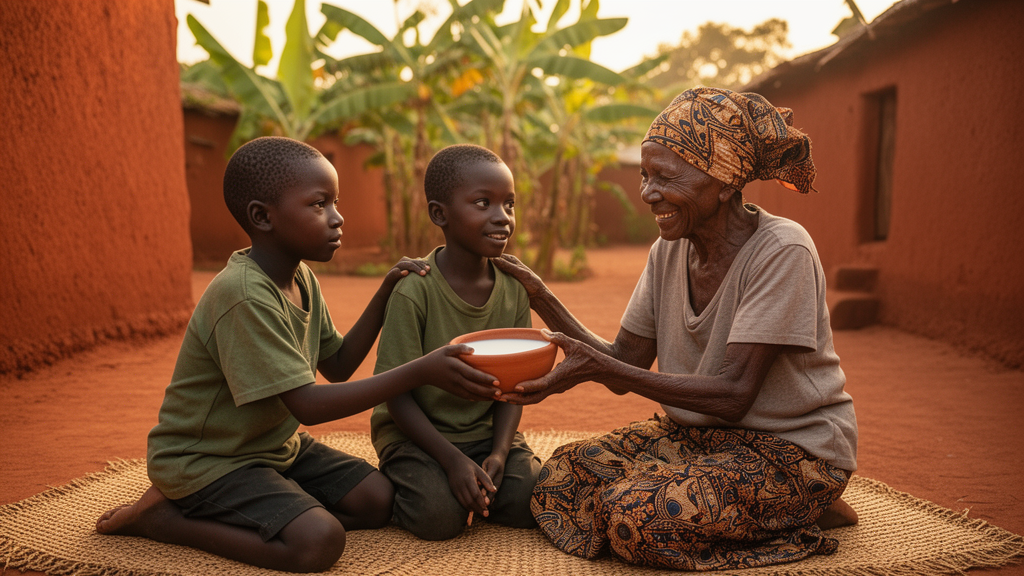
What does it mean for a four-year-old to be grateful? For decades, psychologists have answered that question largely through the lens of Western, educated, industrialized, rich, and democratic societies—the so-called WEIRD populations that dominate behavioral research. A new cross-cultural study, published in Frontiers in Developmental Psychology, turns that lens toward two communities in East Africa and finds that gratitude in early childhood is understood not simply as a polite thank-you, but as an innate capacity, a moral action, an expression of other virtues, and, strikingly, a feeling that connects children to both the human and the spirit world.
The research, led by Pamela Akinyi Wadende of Kisii University in Kenya and Missaye Mulatie Mengstie of the University of Gondar in Ethiopia, gathered the perspectives of 257 adolescents and adults from the pastoralist Turkana of northern Kenya and the agricultural Amhara of central Ethiopia. Using focus group discussions and key informant interviews conducted in the participants’ own languages, the team asked a deceptively simple pair of questions: how do community members define gratitude in children aged four to eight, and what observable behaviors reveal it? The answers, analyzed thematically, paint a picture of gratitude as far more than a momentary social nicety.
The methodological choices were deliberate. The researchers paired a phenomenological design—which centers participants’ lived experiences—with an Indigenous standpoint theoretical framework that foregrounds the ways of being, knowing, and values of the communities themselves. Research assistants recruited from the participating communities conducted the interviews in Ng’atrukana and Amharic, later translating transcripts into English. Sessions ran between 45 and 80 minutes, with interviewers matched to participants by gender and venues chosen by respondents themselves, from a chief’s camp in Lokichogio to school classrooms in Gondar. The team conducted two waves of data collection to reach saturation, and no respondents withdrew.
The communities involved face starkly different but equally demanding circumstances. The Turkana, who make up roughly 14 percent of Kenya’s population, live in an arid region prone to devastating droughts and floods; according to Kenya’s 2014 Demographic and Health Survey, Turkana County is the poorest of the country’s 47 counties, with approximately 88 percent of residents living below the national poverty line. The Amhara region of Ethiopia, meanwhile, contends with frequent interethnic conflict, crime, and unemployment. These are precisely the settings, the authors argue, where gratitude’s role as a protective virtue deserves scrutiny—prior research has linked gratitude to meaning-focused coping, distress tolerance, reduced anxiety symptoms, and even better sleep and glycemic control.
Across both communities, participants converged on a definition of gratitude as an innate, universal human capacity—a built-in mechanism that enables a person to respond appropriately to good deeds and to do what the community considers right. One Ethiopian early childhood teacher described it as a force that drives children toward expected behaviors, such as attending school. A Kenyan adolescent put it more strikingly: gratitude means that even when someone does you wrong, you tell them thank you. This framing aligns with international scholarship suggesting that gratitude comprises cognitive, emotional, and behavioral components that humans manifest within cultural contexts.
But the definitions diverged in revealing ways. Ethiopian participants tended to frame gratitude as a verbal response to a good deed—what researchers call simple verbal gratitude—while Kenyan participants extended the concept beyond humans entirely. For the Turkana, gratitude was a means of communing with both people and the spirit world: thanking God for a lost animal found, or responding to an unexpected stranger who provides food for one’s children. This spiritual dimension, the authors note, is the most distinctive element separating the two communities’ ethnotheories from much of the existing Western literature, though it resonates with religious traditions worldwide that treat gratitude as a doorway to communion and freedom from resentment.
Participants also emphasized that gratitude is inseparable from other virtues. A child who expresses kindness is deemed grateful; gratitude was described as an expression of charity, faith, love, humility, patience, diligence, and even patriotism. This echoes the Roman philosopher Cicero’s famous claim that gratitude is not only the greatest of virtues but the parent of all others, and it mirrors findings from the United Kingdom showing that gratitude and compassion may mutually reinforce each other in schoolchildren. In the developmental framework adopted by the researchers, gratitude is a cognitively mediated socio-emotional competence—learned gradually, like other human capacities, through the experiences children are exposed to in their earliest years.
When it came to observable behaviors, the picture was remarkably consistent across both countries. All participants agreed that gratitude in children is dispositional and enduring rather than a fleeting reaction to a single gift. Grateful children, they reported, are cheerful, contented, confident, motivated, and curious; they share what they have, welcome visitors, respect elders, forgive readily, and take on responsibility at home—sometimes behaving as if in charge of the family when parents are away. Teachers described smiley faces and a sharing spirit in the classroom; community elders spoke of maturity and love for parents. These manifestations—emotional dispositions, social interactions, moral values, and positive character traits—map closely onto correlates documented in prior research, including optimism, life satisfaction, and increased prosocial behavior in preschoolers.
The most frequent recurring theme, however, was gratitude as a relational skill—one deployed with both people and the spiritual world. That framing carries practical weight. The authors argue that programs designed to nurture positive virtues in children should be rooted in local cultural traditions and stress the values that communities themselves prioritize, rather than importing assumptions from WEIRD contexts, where generalizations risk ethnocentrism and errors of omission. With most gratitude research focused on adolescents and adults, and few studies anywhere examining children as young as four, this work helps fill a foundational gap in character development scholarship.
The researchers acknowledge limits: two communities in two countries cannot represent a continent of 55 nations, and adult and adolescent reflections on children’s behavior may carry bias that future studies could address by collecting data directly from children. Still, the study’s implications extend beyond academia. In a world gripped by climate change, conflict, forced migration, and the disruptive pressures of digitalization, the authors suggest that gratitude may be more than a courtesy—it may be a modifiable protective factor, one that communities in the Global South have long understood on their own terms, and one that global childhood programs would do well to learn from rather than lecture to.
Subject of Research: Cultural definitions and observable manifestations of gratitude in children aged 4 to 8 among the Turkana of Kenya and the Amhara of Ethiopia
Article Title: Gratitude in childhood: ethnotheories from the Turkana of Kenya and Amhara of Ethiopia
Article References: Gratitude in childhood: ethnotheories from the Turkana of Kenya and Amhara of Ethiopia. (n.d.). https://doi.org/10.3389/fdpys.2026.1841850
Image Credits: AI Generated
DOI: 10.3389/fdpys.2026.1841850
Keywords: gratitude, child development, Turkana, Amhara, cross-cultural psychology, Indigenous standpoint theory, East Africa, positive psychology, ethnotheories, qualitative research, social-emotional development, moral virtue
Cite Scienmag News
Glenn Wilkins. (October 16, 2026). How Two East African Communities Define Gratitude in Children. Scienmag. https://scienmag.com/how-two-east-african-communities-define-gratitude-in-children/
Glenn Wilkins. "How Two East African Communities Define Gratitude in Children." Scienmag, 16 October 2026, https://scienmag.com/how-two-east-african-communities-define-gratitude-in-children/. Accessed 16 October 2026.
Glenn Wilkins. "How Two East African Communities Define Gratitude in Children." Scienmag. October 16, 2026. https://scienmag.com/how-two-east-african-communities-define-gratitude-in-children/


