


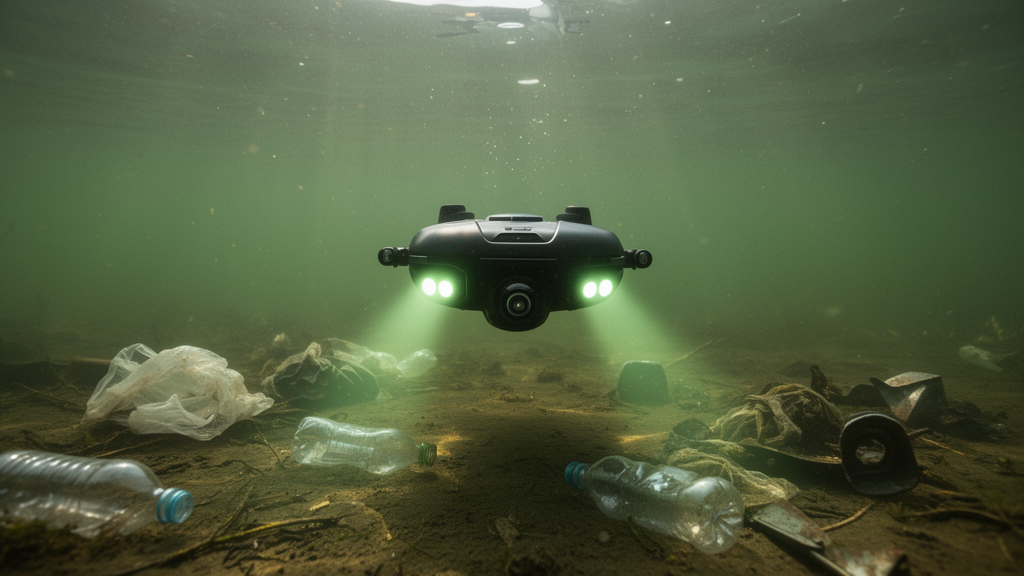
Freshwater ponds, lakes, and drainage channels sit close to where people live, which makes them disproportionately vulnerable to dumped waste and polluted runoff. Yet when researchers train artificial intelligence to spot trash underwater, almost all of the available training data comes from the open ocean. A team at Vellore Institute of Technology in Chennai, India, has now tackled that gap with two contributions: a new annotated dataset of submerged freshwater debris called PondDebris, and an attention-enhanced detection network named UWAD-Net that is tuned to the murky, low-contrast visual conditions of shallow ponds. The work, published in Frontiers in Water, offers one of the first dedicated benchmarks for freshwater underwater waste detection.
The problem the researchers set out to solve is fundamentally one of scarcity and visual difficulty. Deep learning detectors need large, well-annotated datasets, but collecting and labeling underwater imagery is labor-intensive and expensive. Existing resources such as Trash-ICRA19, with 5,720 images from marine remotely operated vehicle surveys, TrashCan 1.0 with 7,212 segmented images, UNO, CleanSea, and DeepPlastic all focus on marine, coastal, or deep-sea settings. Those environments differ substantially from shallow freshwater ponds in illumination, water clarity, object appearance, and background complexity, so models trained on them transfer poorly to pond conditions. The team also noted that prior freshwater-focused systems, such as camera-based floating plastic detectors and the YOLO-EcoFocus framework for inland waterways, target debris at or near the water surface rather than fully submerged waste on a pond floor.
PondDebris comprises 1,526 images and 3,224 bounding box annotations spread across two ecologically meaningful categories: biodegradable and non-biodegradable waste. Rather than simply sorting trash by material, the taxonomy reflects environmental persistence, a distinction that matters for automated waste management because biodegradable items such as fruit peels, vegetable matter, leaves, uncoated paper, and untreated wood will break down naturally within weeks to a few months, while plastic bottles, plastic bags, aluminum cans, polystyrene, and synthetic packaging will not. Under the annotators’ operational rule, treated or painted wood and coated paper counted as non-biodegradable because their surface treatments delay natural decomposition. The final tally included 1,537 biodegradable and 1,687 non-biodegradable instances.
The imagery was collected in a controlled laboratory aquarium designed to emulate the visual character of a shallow freshwater pond, complete with a sandy substrate, variable turbidity, changing illumination, water reflections, and partial occlusion of objects. A Crosstour CT8500 action camera recorded 4K UHD video across three sessions, the last under different artificial lighting to broaden visual diversity. Frames were extracted, screened to remove redundant or blurred shots, and resized to 512 by 512 pixels for training. The authors are explicit that this is a simulated proxy rather than an in-situ field dataset, a limitation they flag for future work, but the controlled setup allowed precise manipulation of debris placement and environmental variability while demonstrating that useful underwater benchmarks can be built with consumer-grade hardware.
Annotation quality received careful statistical treatment. Three annotators labeled the images in Roboflow, reviewed every annotation twice, and submitted a subset for independent verification by a faculty supervisor. On a stratified subsample re-annotated independently, class-level agreement measured by Cohen’s kappa reached 0.83, and bounding-box localization agreement, expressed as mean intersection-over-union, reached 0.87, both indicating substantial consistency. The dataset was split into 1,206 training, 183 validation, and 137 test images, and because the collection is modest in scale, the team supplemented the single split with five-fold cross-validation to guard against sampling variability. The dataset is released under a CC BY 4.0 license.
On the modeling side, UWAD-Net builds on YOLOv8s, the small variant of a single-stage detector that pairs a cross-stage-partial backbone with an anchor-free, decoupled head that separates classification from localization. YOLOv8s was chosen because it offered the best balance of accuracy and efficiency among six YOLO-family baselines evaluated, running at roughly 182 frames per second on an NVIDIA Tesla T4 GPU with about 11.17 million parameters. The key innovation is the integration of the Convolutional Block Attention Module, or CBAM, into the YOLOv8s architecture. CBAM applies channel attention and spatial attention in sequence: channel attention uses average and max pooling with a shared multilayer perceptron to learn which feature channels carry discriminative information, while spatial attention generates a two-dimensional map through a convolution that highlights informative regions and suppresses background clutter.
The placement of these attention modules was itself a design decision tested empirically. CBAM blocks were inserted after the P3, P4, and P5 feature pyramid levels produced by the YOLOv8s neck, immediately before the detection head, so that each scale receives refinement tuned to small, medium, and large objects respectively. In the ablation study, channel attention alone outperformed spatial attention alone, and inserting full CBAM at all three scales yielded the best overall configuration. The intuition is that underwater imagery suffers from wavelength-dependent light absorption, scattering, and turbidity, so channel attention can emphasize features that survive color degradation while spatial attention suppresses diffuse responses from suspended particles and substrate textures, sharpening the network’s focus on debris boundaries.
Trained for up to 150 epochs with the Adam optimizer, cosine learning-rate decay, and standard augmentations such as mosaic, horizontal flips, and color jitter, UWAD-Net achieved a mean average precision at IoU 0.50 of 0.7294, an mAP50-95 of 0.4517, precision of 0.8206, and recall of 0.6421 on the PondDebris test set, with five-fold cross-validation standard deviations of only a few thousandths, indicating stable performance across data partitions. The most consistent advantage over the YOLOv8s baseline was precision, which rose by 7.1 percentage points, meaning fewer false-positive detections, though the authors are candid that this came with a modest reduction in recall and slightly lower mAP, a precision-oriented trade-off rather than a uniform improvement. Against non-YOLO baselines, UWAD-Net outperformed Faster R-CNN with a ResNet-50-FPN backbone and the transformer-based RT-DETR on the same protocol, and the added attention machinery cost only a marginal increase in computation, keeping the model practical for resource-constrained edge deployment.
To probe generalization, the team fine-tuned a PondDebris-pretrained UWAD-Net on an external Underwater Debris Detection Dataset of 5,125 images spanning 15 litter categories, mapped onto the same two-class taxonomy. The transferred model reached an mAP50 of 0.6629 and precision of 0.7738 on the external test split, confirming that the learned underwater debris representations remain useful in a previously unseen environment, although recall dropped to 0.5724. The degradation reflects domain shift: the external data were captured at roughly 4 to 5 meters depth under medium turbidity, with irregularly shaped items such as wood and leaves proving harder to distinguish from the substrate than well-defined objects like bottles. The authors conclude that improving robustness will require larger, class-balanced datasets and domain-adaptation strategies, and that field-collected pond imagery is the natural next step for validating the framework in real freshwater ecosystems.
Subject of Research: Attention-enhanced deep learning for detecting biodegradable and non-biodegradable waste in freshwater pond environments
Article Title: UWAD-Net: attention-enhanced underwater waste detection in freshwater pond environments
Article References: UWAD-Net: attention-enhanced underwater waste detection in freshwater pond environments. (n.d.). https://doi.org/10.3389/frwa.2026.1923979
Image Credits: AI Generated
DOI: 10.3389/frwa.2026.1923979
Keywords: underwater waste detection, freshwater ponds, UWAD-Net, PondDebris dataset, CBAM attention, YOLOv8, object detection, computer vision, environmental monitoring, plastic pollution, transfer learning, deep learning
Cite Scienmag News
Blake Davidson. (October 16, 2026). Attention-Enhanced AI Network Spots Underwater Waste in Murky Freshwater Ponds. Scienmag. https://scienmag.com/attention-enhanced-ai-network-spots-underwater-waste-in-murky-freshwater-ponds/
Blake Davidson. "Attention-Enhanced AI Network Spots Underwater Waste in Murky Freshwater Ponds." Scienmag, 16 October 2026, https://scienmag.com/attention-enhanced-ai-network-spots-underwater-waste-in-murky-freshwater-ponds/. Accessed 16 October 2026.
Blake Davidson. "Attention-Enhanced AI Network Spots Underwater Waste in Murky Freshwater Ponds." Scienmag. October 16, 2026. https://scienmag.com/attention-enhanced-ai-network-spots-underwater-waste-in-murky-freshwater-ponds/


