


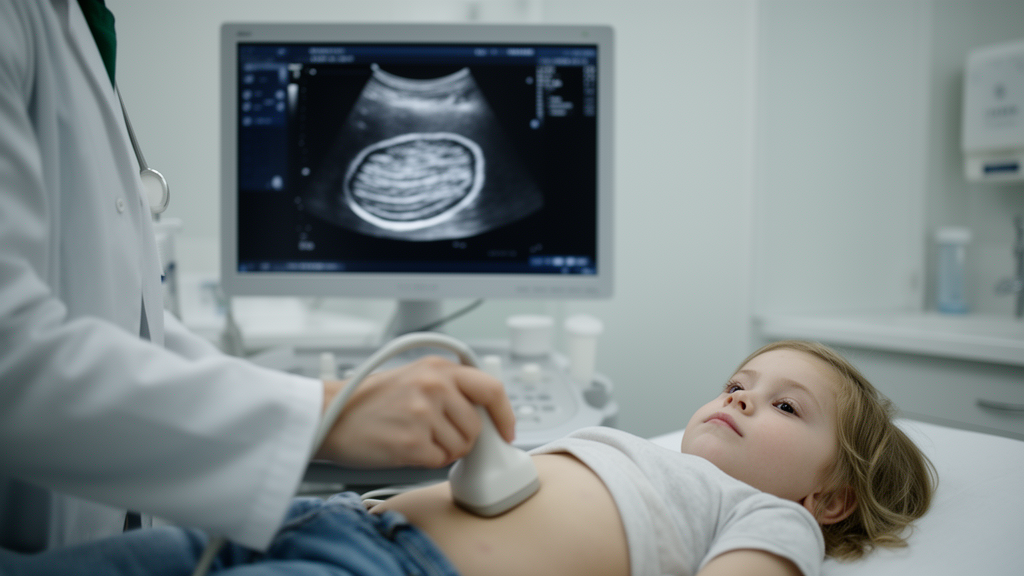
When a child arrives at the emergency department with sudden, severe abdominal pain, episodes of vomiting, and sometimes the alarming passage of stool mixed with blood, one diagnosis towers above all others in the minds of pediatricians and surgeons: intussusception. This condition, in which one segment of the intestine telescopes into an adjacent segment like a collapsing telescope, is the most common cause of intestinal obstruction in early childhood, and it can progress to bowel death within hours if it is not recognized and treated. Yet intussusception is not a single disease. It comes in two surgically and clinically distinct forms, and a new study published in BMC Pediatrics suggests that a routine bedside ultrasound scan, armed with a few carefully chosen measurements, can reliably tell them apart.
The two forms are small bowel intussusception, abbreviated SBI, and ileocolic intussusception, known as ICI. In small bowel intussusception, the telescoping occurs entirely within the small intestine, a segment of bowel that is mobile, thin-walled, and generally not the site of the dangerous pathological lead points that drive the more serious form of the disease. In ileocolic intussusception, by contrast, the intussusceptum, the segment that slides inward, travels through the ileocecal valve into the colon. This crossing of the valve is what makes ICI the classic, high-stakes presentation: it is more likely to be triggered by a pathological lead point such as a polyp, a Meckel diverticulum, or lymphoid hyperplasia, it is more likely to become irreducible, and it is the form for which surgical consultation and, in many centers, operative management are far more often required.
The management implications of this distinction are substantial. Many small bowel intussusceptions are transient, self-limiting phenomena that resolve spontaneously or can be managed conservatively once other causes of abdominal pain have been excluded. Ileocolic intussusception, on the other hand, typically demands urgent nonoperative reduction by enema, and when that fails or when complications such as perforation or necrosis are suspected, it demands surgery. A clinician who mistakes one for the other risks either overtreating a benign, self-resolving episode or dangerously underestimating a surgical emergency. That is precisely the diagnostic gap that a team of researchers from Mashhad University of Medical Sciences in Iran set out to close with a study built around a single, widely available tool: ultrasonography.
The research team enrolled 101 children who presented with clinical suspicion of intussusception. Of these, 55 were ultimately diagnosed with small bowel intussusception and 46 with ileocolic intussusception. The investigators systematically compared a broad panel of clinicoradiological characteristics between the two groups, spanning demographic features, presenting symptoms, and a series of quantitative ultrasound measurements of the intussuscepted bowel segment itself. To move beyond simple comparisons, they applied univariate logistic regression analysis to quantify the strength of the association between each variable and the type of intussusception, and they constructed receiver operating characteristic curves, the standard statistical framework for determining how well a given measurement discriminates between two diagnostic categories.
The clinical symptoms told a surprisingly limited story. Age, sex, vomiting, and diarrhea showed no statistically significant differences between the two groups, with P values above 0.05. In other words, a child with small bowel intussusception and a child with ileocolic intussusception could present with remarkably similar histories, and neither the child’s age nor the presence of vomiting or diarrhea could be relied upon to point the clinician in one direction or the other. Two symptoms did, however, carry discriminating weight: abdominal pain and the passage of bloody stool were both significantly more associated with ileocolic intussusception than with small bowel intussusception, a pattern consistent with the greater mechanical trauma and mucosal injury that occur when a longer segment of bowel is dragged through the ileocecal valve.
Where the study’s power truly emerged was in the ultrasound measurements. Several sonographic findings were significantly more frequent or more pronounced in ileocolic cases. Lymph nodes visible within the intussusception, a marker of the lymphoid hyperplasia that often serves as the pathological lead point in ICI, favored the ileocolic diagnosis. Free peritoneal fluid, which can signal serosal irritation and impending complications, was likewise significantly more common in the ICI group. But the most striking results came from the quantitative measurements, where the researchers calculated the area under the receiver operating characteristic curve, or AUC, a value that ranges from 0.5, equivalent to a coin flip, to 1.0, equivalent to perfect discrimination.
Three measurements stood out as the champions of the dataset. The lesion diameter, the maximum transverse width of the intussuscepted mass on ultrasound, achieved an AUC of 0.96, with a sensitivity of 91 percent and a specificity of 89 percent at a cut-off point of 25 millimeters. The length of the intussusception, measured along the long axis of the telescoped segment, reached an AUC of 0.94, with sensitivity and specificity both at 87 percent at a cut-off of 40 millimeters. And the core-to-wall index, a ratio that compares the diameter of the central invaginated core to the thickness of the outer bowel wall, delivered an AUC of 0.93, with a sensitivity of 91 percent and a specificity of 89 percent at a cut-off of 1.33. When the researchers simplified the core-to-wall index into a binary threshold greater than 1, the resulting test still achieved an AUC of 0.87, with a striking sensitivity of 93 percent and a specificity of 80 percent.
The remaining measurements, while less powerful, still contributed meaningfully to the diagnostic picture. The fat core diameter, which reflects the amount of mesenteric fat dragged into the intussusception along with the bowel, achieved an AUC of 0.91, with a sensitivity of 85 percent and a specificity of 84 percent at a cut-off of 7 millimeters. The outer wall thickness, measured at 5 millimeters, was the weakest discriminator, with an AUC of only 0.61, a sensitivity of 74 percent, and a specificity of 53 percent, values that fall far short of clinical utility on their own even though the difference between the groups remained statistically significant. Taken together, these findings paint a coherent picture: ileocolic intussusceptions are, on average, larger in diameter, longer in axial extent, richer in internal fat and lymphoid tissue, and more likely to be accompanied by free peritoneal fluid than their small bowel counterparts.
The clinical significance of this work lies in what it offers to the front-line clinician. Ultrasound is already the first-line imaging modality for suspected intussusception in children, prized for its lack of ionizing radiation, its widespread availability, and its high diagnostic accuracy for confirming the presence of the condition. What this study adds is a framework for using the same scan, the same probe, and the same examination to answer a second, equally important question: not just whether intussusception is present, but which type. A lesion diameter exceeding 25 millimeters, an intussusception length exceeding 40 millimeters, or a core-to-wall index above 1.33 should prompt the clinician to lean toward the ileocolic diagnosis and to escalate accordingly, involving surgical teams earlier and preparing for nonoperative or operative reduction rather than expectant management.
The authors conclude that ultrasound is a reliable tool with very high diagnostic utility in distinguishing small bowel from ileocolic intussusception, and that lesion diameter, intussusception length, and the core-to-wall index are the most useful variables for this purpose. Their findings suggest that ultrasound findings can assist clinicians beyond clinical symptoms and physical examination findings, supporting more effective diagnosis and management of intussusception and improving clinical decision-making. In an era when pediatric emergency departments worldwide are under pressure to triage rapidly and accurately, the idea that a few millimeters measured on a bedside screen could redirect a child away from an unnecessary operation, or toward a life-saving one, is a powerful reminder that sometimes the most transformative advances in medicine are not new machines at all, but new ways of reading the signals that familiar machines have been quietly producing all along.
Subject of Research: Using ultrasound measurements to differentiate pediatric small bowel intussusception from ileocolic intussusception
Article Title: Utility of ultrasonography in distinguishing pediatric small bowel and ileocolic intussusceptions: a clinicoradiological study
Article References: Velayati, M., Doostparast, A., Ghandhari, M., Sadeghpour, S., Ahmadi, A., Behforouz, A., & Rashed, M. M. (2026). Utility of ultrasonography in distinguishing pediatric small bowel and ileocolic intussusceptions: a clinicoradiological study. BMC Pediatrics. https://doi.org/10.1186/s12887-026-07629-1
Image Credits: AI Generated
DOI: 10.1186/s12887-026-07629-1
Keywords: intussusception, pediatrics, ultrasound, small bowel intussusception, ileocolic intussusception, ultrasonography, diagnostic accuracy, ROC curve, core-to-wall index, lesion diameter, emergency medicine, radiology
Cite Scienmag News
Ophelia Keating. (October 16, 2026). Ultrasound Measurements Can Tell Apart Two Dangerous Types of Childhood Intussusception. Scienmag. https://scienmag.com/ultrasound-measurements-can-tell-apart-two-dangerous-types-of-childhood-intussusception/
Ophelia Keating. "Ultrasound Measurements Can Tell Apart Two Dangerous Types of Childhood Intussusception." Scienmag, 16 October 2026, https://scienmag.com/ultrasound-measurements-can-tell-apart-two-dangerous-types-of-childhood-intussusception/. Accessed 16 October 2026.
Ophelia Keating. "Ultrasound Measurements Can Tell Apart Two Dangerous Types of Childhood Intussusception." Scienmag. October 16, 2026. https://scienmag.com/ultrasound-measurements-can-tell-apart-two-dangerous-types-of-childhood-intussusception/


