


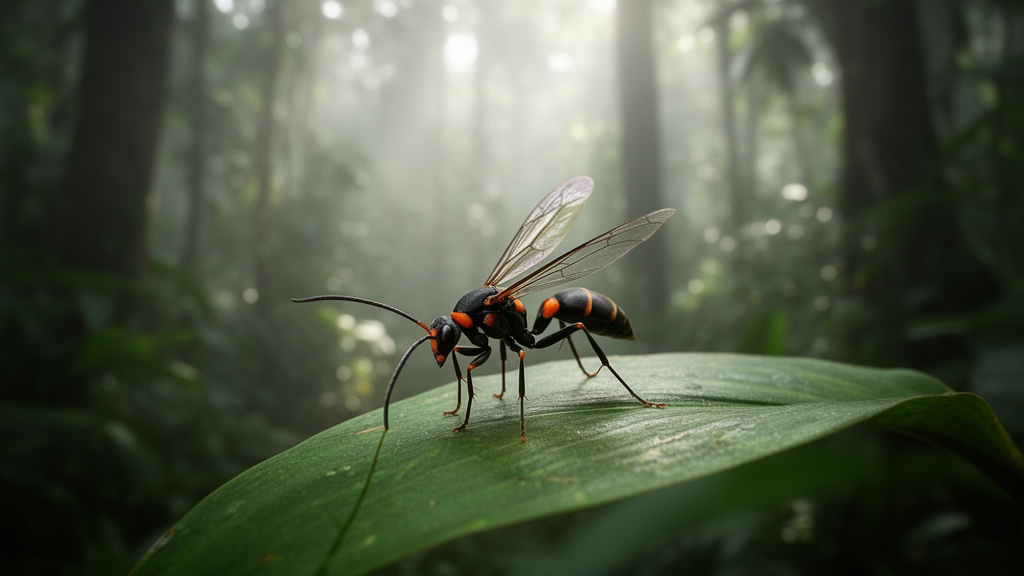
Deep in the rain forests of western Amazonia, a small, hunchbacked wasp with striking yellow-and-black markings has been quietly evading scientists for decades. Now, an international research team has pulled back the curtain on this elusive group, describing two brand-new species and revealing that the Neotropics harbor far more of these rare parasitoids than their African counterparts. The findings, published in the Journal of Hymenoptera Research, represent the most comprehensive look yet at Brachycyrtinae, a mysterious subfamily of Darwin wasps that has long flown under the radar of tropical biodiversity research.
The subfamily Brachycyrtinae contains just a single genus, Brachycyrtus, which until this study included 27 known species worldwide. These wasps are instantly recognizable to trained eyes: they are small, with a distinctly hunched mesosoma—the middle section of the body—and a characteristic yellow-black or orange-yellow-black coloration. A close examination of the fore wing reveals a diagnostic vein arrangement that confirms identification. Despite their distinctive appearance, these insects are so rarely encountered that almost all previous taxonomic work has relied on scattered museum specimens rather than systematic field collections.
What makes this new study particularly significant is the sheer scale of the sampling effort behind it. The researchers, led by Österman and Sääksjärvi from the University of Turku in Finland, analyzed material from long-term Malaise trap campaigns spanning more than 650 trap months across Peru, Ecuador, Uganda, and Côte d’Ivoire. In Peruvian Amazonia, traps operated across three different rain forest types—clay, loamy, and white sand soils—at Allpahuayo-Mishana National Reserve and Los Amigos Conservation Concession. In Uganda, 34 Malaise traps ran continuously for a full year across a gradient of habitats from primary forest to farmland in Kibale National Park. This unprecedented dataset finally allows meaningful comparisons between the two tropical regions.
The results are striking. Rarefaction analysis, which models how species accumulate per individual collected, revealed that the Peruvian sites harbor significantly more brachycyrtine species than the Ugandan site. Five species were collected in Peruvian primary forest during the 1998 and 2000 campaigns, with the species accumulation curve still rising at the end of sampling—a clear signal that more species await discovery. In contrast, Ugandan trapping peaked at just two species. This pattern mirrors broader biogeographic trends, as the Neotropics are generally recognized as more species-rich than the Afrotropical region across many taxonomic groups.
Among the most exciting outcomes of the study are the descriptions of two new species. Brachycyrtus granulatus, named for the granulate sculpture of its propodeum, was identified from specimens collected in Peru and Ecuador. It can be distinguished from all other Neotropical species by the combination of a granulate propodeum and the complete absence of the posterior transverse carina—a ridge-like structure on the propodeum that serves as a key taxonomic character. The second new species, Brachycyrtus politus, takes its name from the Latin word for polished, reflecting its smooth, shiny appearance. Known only from Peru, it features a polished propodeum with sparse punctures, a strong posterior transverse carina, and a distinctive C-shaped black band along the anterior margin of the mesopleuron.
The researchers also described the previously unknown males of two species—Brachycyrtus convergens and Brachycyrtus antoninoi—and made a significant taxonomic decision by synonymizing Brachycyrtus zani with Brachycyrtus xorix. This synonymization was based on careful examination of specimens from Colombia and Ecuador that showed a gradient in the development of the posterior transverse carina, from completely absent to fully present. The researchers concluded that what had been treated as two separate species actually represents intraspecific variation within a single species, highlighting the challenges of relying on potentially variable morphological characters for species delimitation.
Beyond taxonomy, the study yielded fascinating insights into the ecology of these elusive wasps. In Uganda, both Brachycyrtus cerrettii and Brachycyrtus antoninoi were collected primarily during the two dry seasons, at rates reaching about 0.01 individuals per trap per day. The researchers suspect this seasonal pattern is typical of idiobiont ectoparasitoids—parasitoids that kill or permanently paralyze their hosts—in the Ugandan ecosystem. In Peru, the two species with sufficient sample sizes, Brachycyrtus oculatus and Brachycyrtus veriatrix, showed no clear phenological pattern but were collected at higher rates, peaking at 0.04 individuals per trap per day. This means that even at peak abundance, researchers needed approximately 25 days of trapping to catch a single brachycyrtine wasp in Peru, and 100 days in Uganda.
Habitat preferences also differed between the regions. In Uganda, Brachycyrtus cerrettii was found mainly in primary and disturbed forest, never in clearcut plantation or farmland, suggesting it may prefer undisturbed forest habitats. Its congener Brachycyrtus antoninoi showed more flexibility, being collected across all habitat types except swampy primary forest. In Peru, the two well-sampled species were primarily collected in white sand forest—a rare and distinctive ecosystem in western Amazonia known for high endemism. This tentative preference for white sand forest is particularly intriguing, as these nutrient-poor forests may harbor unique communities of parasitoid wasps.
The biological role of Brachycyrtus remains poorly understood, but available evidence points to a fascinating lifestyle. Some species have been observed as solitary parasitoids of cocooned prepupae and pupae of green lacewings (Neuroptera, Chrysopidae). Their phylogenetic position and ovipositor morphology suggest they are idiobiont ectoparasitoids, meaning they lay eggs on or near their host, which the developing wasp larvae then consume from the outside. This ecological role places them within the complex web of trophic interactions that regulate insect populations in tropical forests, though much about their host associations remains to be discovered.
The study also revealed how severely undersampled both regions remain, particularly the Afrotropics. Only 81 Afrotropical specimens are known to science, with the majority collected during this study in Uganda. Three of the five known Afrotropical species are each known from just a single site, and the entire knowledge of Madagascan brachycyrtines rests on two individuals collected in the 1930s. The researchers emphasize that geographically more extensive sampling in both regions would not only uncover additional species but also enable more robust analyses of the biology, phenology, and conservation needs of these enigmatic wasps. As tropical forests face increasing pressure from deforestation and climate change, understanding the full diversity of even the rarest parasitoid wasps becomes an increasingly urgent priority for biodiversity science.
Subject of Research: Taxonomy, diversity, and ecology of the parasitoid wasp genus Brachycyrtus in the Neotropics and Afrotropics
Article Title: Local diversity of Afrotropical and Neotropical Brachycyrtinae ( Hymenoptera , Ichneumonidae ), with two new species from western Amazonia and keys to species
Article References: Local diversity of Afrotropical and Neotropical Brachycyrtinae ( Hymenoptera , Ichneumonidae ), with two new species from western Amazonia and keys to species. (n.d.). https://doi.org/10.3897/jhr.99.190905
Image Credits: AI Generated
Keywords: Brachycyrtus, Ichneumonidae, parasitoid wasps, Amazonia, new species, tropical biodiversity, Malaise trapping, Peru, Uganda, white sand forest, species richness, taxonomy
Cite Scienmag News
Margaret Porter. (October 16, 2026). Two New Parasitoid Wasp Species Unveiled from Amazonia as Scientists Map the Secret World of Brachycyrtus. Scienmag. https://scienmag.com/two-new-parasitoid-wasp-species-unveiled-from-amazonia-as-scientists-map-the-secret-world-of-brachycyrtus/
Margaret Porter. "Two New Parasitoid Wasp Species Unveiled from Amazonia as Scientists Map the Secret World of Brachycyrtus." Scienmag, 16 October 2026, https://scienmag.com/two-new-parasitoid-wasp-species-unveiled-from-amazonia-as-scientists-map-the-secret-world-of-brachycyrtus/. Accessed 16 October 2026.
Margaret Porter. "Two New Parasitoid Wasp Species Unveiled from Amazonia as Scientists Map the Secret World of Brachycyrtus." Scienmag. October 16, 2026. https://scienmag.com/two-new-parasitoid-wasp-species-unveiled-from-amazonia-as-scientists-map-the-secret-world-of-brachycyrtus/


