


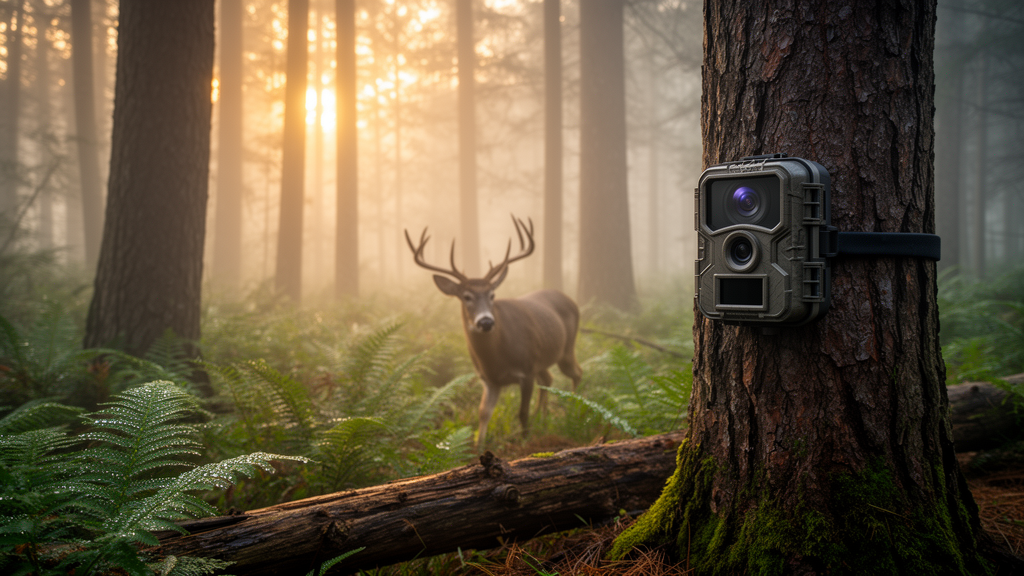
Deep in the forests of Svanøy Island, Norway, dozens of motion-triggered trail cameras quietly photograph red deer moving through dense woodland, often at night under infrared illumination. Those images are the raw material for a new computer vision framework called Hjort-YOLO, developed by researchers at Western Norway University of Applied Sciences together with colleagues at the Norwegian University of Life Sciences, SINTEF, and the Western Norway Research Institute. Published in Frontiers in Artificial Intelligence, the work is part of the WILDETECT project, which is funded by the Research Council of Norway and aims to reduce animal-vehicle collisions by detecting wildlife automatically from ground-based sensors.
The motivation is stark. Wild mammal populations have declined by more than 70 percent between 1970 and 2020 according to WWF figures cited in the study, and wild mammals now account for only about 6 percent of total mammal biomass, with humans and livestock making up the rest. At the same time, collisions between vehicles and animals are rising across Europe as ungulate populations and traffic density grow. In 2025 alone, more than 14,500 moose and deer were killed on Norwegian roads and railways. In the United States, an estimated 725,000 to 1.5 million animal-vehicle collisions are reported to police each year, while Canada records 4 to 8 animal deaths per day. Automated detection from roadside cameras could one day feed alert systems that warn drivers before an animal steps onto the road.
The core of Hjort-YOLO is a targeted re-engineering of YOLOv11n, the nano variant of the popular You Only Look Once family of single-stage detectors. Single-stage models predict object position and class in one pass, which makes them far faster than two-stage detectors such as Faster R-CNN, where regions of interest are proposed first and classified second. YOLOv11n was chosen as the baseline precisely because its low computational complexity suits real-time applications on resource-constrained edge devices. The team then modified the architecture in three coordinated ways: they replaced the C3k2 blocks in the lower backbone and neck with a refined cross-stage partial convolutional block called C2f-W, they swapped the Spatial Pyramid Pooling-Fast module for an area-attention block named A2C2f-W, and they removed one of the three detection heads.
Each modification addresses a specific weakness. The C2f-W block, inspired by the C2f design in YOLOv8, splits input features into two streams, passes one through bottleneck blocks, and concatenates the outputs, creating dense gradient paths that improve channel interaction and gradient propagation for higher-level representations. The A2C2f-W block, adapted from the YOLOv12 architecture, computes attention not pixel by pixel but over predefined areas of the feature map. This area-attention strategy captures mid-range contextual relationships while avoiding the heavy computational cost of full self-attention, which is crucial for identifying complex and partially occluded animals in cluttered forest scenes. The removal of the 80 by 80 pixel detection head, which normally handles small objects, reflects a deliberate design decision: camera traps and roadside sensors capture animals at relatively close range, so targets are large in the frame and the smallest-object head adds cost without proportional benefit.
The framework was evaluated on two datasets. The first is a custom Svanøy deer dataset of 3,183 images, comprising 1,432 daytime RGB images and 1,751 near-infrared monochrome images captured at night by Browning trail cameras with infrared flash, all labeled manually in Roboflow. The second is the public African Wildlife dataset of 1,504 RGB images covering four classes: buffalo, elephant, rhino, and zebra. Both datasets were split 80-10-10 into training, validation, and test sets, and all models were trained from scratch without pretrained weights under identical conditions on a Google Colab Tesla T4 GPU, using stochastic gradient descent with 300 epochs, early stopping patience of 20, and 640 by 640 pixel inputs.
The results show a favorable trade-off between accuracy and speed. On the Svanøy validation set, Hjort-YOLO achieved a mean average precision of 0.981, a precision of 0.975, a recall of 0.950, and an F1-score of 0.962, edging out the YOLOv11n baseline at 0.979 mAP. More striking are the efficiency gains: inference time dropped from 8.0 to 6.8 milliseconds per image, throughput rose from 21.98 to 24.98 frames per second, and computational complexity measured in GFLOPS fell 19 percent, from 6.4 to 5.1. The model has 2.90 million trainable parameters and a 6 MB weight file, only marginally larger than YOLOv11n’s 2.59 million parameters and 5.5 MB file, while the network was slimmed from 181 to 143 layers. Ablation studies confirmed that each component contributes: removing the third detection head alone cut GFLOPS from 6.4 to 4.6, and adding the C2f-W and A2C2f-W blocks restored accuracy while keeping complexity low. A variant retaining all three heads reached the highest mAP of 0.990 but required 6.8 GFLOPS, so the two-head design sacrifices less than one percentage point of accuracy for a 25 percent reduction in computation.
Training across ten repeated runs demonstrated robustness, with a mean mAP of 0.9804 plus or minus 0.004 and consistently small standard deviations across precision, recall, and F1-score. Notably, the combined RGB and infrared dataset outperformed models trained on either image type alone, with mAP of 0.979 compared to 0.969 for RGB-only and 0.961 for infrared-only, suggesting that visual diversity across illumination conditions improves generalization. On the African Wildlife dataset, Hjort-YOLO outperformed both YOLOv8n and YOLOv11n among lightweight models with an overall mAP of 0.922, achieving the best rhino mAP50-95 of 0.804, though zebra remained the hardest class, likely due to fewer training samples, smaller object size, and occlusion. Compared with the transformer-based RF-DETR Nano, which matched the mAP at 0.981 but required 31.5 GFLOPS, roughly five times the baseline, Hjort-YOLO stands out for delivering comparable accuracy at a fraction of the computational cost.
What distinguishes Hjort-YOLO from many lightweight detectors is its emphasis on explainability. The researchers integrated two explainable artificial intelligence tools as post-processing steps. Grad-CAM generates heatmaps from the final convolutional layer, highlighting which regions of the image most influence the prediction. Captum, a PyTorch-compatible interpretability library, applies attribution methods such as Integrated Gradients, GradientShap, DeepLift, and Occlusion to trace which pixels within the predicted bounding box drove the objectness score. Because the removed high-resolution detection head had contributed redundant gradients and background noise, the Captum heatmaps proved cleaner and more precise than Grad-CAM’s whole-image maps, revealing meaningful animal structures and helping identify irrelevant background features that could trigger false positives. This transparency matters for conservation applications, where understanding why a model fires can expose bias and guide architecture improvements.
The framework also pairs detection with segmentation. Hjort-YOLO’s bounding boxes serve as geometric prompts for the Segment Anything Model 2, or SAM2, which refines each detection into a pixel-accurate instance mask through a vision transformer and cross-attention decoder. This two-stage detection-segmentation pipeline isolates animals from background vegetation, reducing ambiguity and improving visualization. On the T4 GPU, the full end-to-end pipeline of detection, segmentation, and explainability took 607.61 milliseconds per image, with Hjort-YOLO itself consuming only 10.13 milliseconds of wall time, while SAM2 required 267.10 milliseconds and the XAI stage 321.69 milliseconds. The authors suggest that the heavy visualization stages could run on a connected edge device or cloud server, while the fast detector operates locally.
The researchers are candid about limitations. The model is tuned for large targets and may struggle with small animals; the training data comes from forested Svanøy Island rather than actual roadside scenes, so real-world deployment near roads remains untested; and benchmarking on physical embedded hardware such as Jetson Nano or Raspberry Pi is still needed to confirm real-time performance, memory footprint, and deployment overhead. Future work includes implementing the model on embedded devices as part of a driver alert system, exploring transformer-based architectures such as RF-DETR for further efficiency, and adding multi-frame object tracking combined with other detection modalities to improve reliability. For now, Hjort-YOLO demonstrates that carefully targeted architectural surgery, rather than sheer model size, can deliver real-time wildlife detection that is both accurate and interpretable on the kinds of low-power hardware where conservation technology actually lives.
Subject of Research: A lightweight, explainable YOLO-based computer vision framework for detecting wildlife in camera-trap images
Article Title: Hjort-YOLO: a lightweight and explainable computer vision framework for wildlife detection
Article References: Momin, M. A., Khan, M., Arghandeh, R., Bischof, R., Hegland, S. J., Moen, T., & Stølen, M. F. (2026). Hjort-YOLO: a lightweight and explainable computer vision framework for wildlife detection. Frontiers in Artificial Intelligence, 9, Article 1930016. https://doi.org/10.3389/frai.2026.1930016
Image Credits: AI Generated
DOI: 10.3389/frai.2026.1930016
Keywords: Hjort-YOLO, computer vision, wildlife detection, YOLOv11n, camera traps, deep learning, explainable AI, animal-vehicle collisions, object detection, edge computing, SAM2 segmentation, Norway
Cite Scienmag News
Margaret Porter. (October 16, 2026). Hjort-YOLO: A Leaner AI Spots Wildlife Faster in the Toughest Forest Scenes. Scienmag. https://scienmag.com/hjort-yolo-a-leaner-ai-spots-wildlife-faster-in-the-toughest-forest-scenes/
Margaret Porter. "Hjort-YOLO: A Leaner AI Spots Wildlife Faster in the Toughest Forest Scenes." Scienmag, 16 October 2026, https://scienmag.com/hjort-yolo-a-leaner-ai-spots-wildlife-faster-in-the-toughest-forest-scenes/. Accessed 16 October 2026.
Margaret Porter. "Hjort-YOLO: A Leaner AI Spots Wildlife Faster in the Toughest Forest Scenes." Scienmag. October 16, 2026. https://scienmag.com/hjort-yolo-a-leaner-ai-spots-wildlife-faster-in-the-toughest-forest-scenes/


