


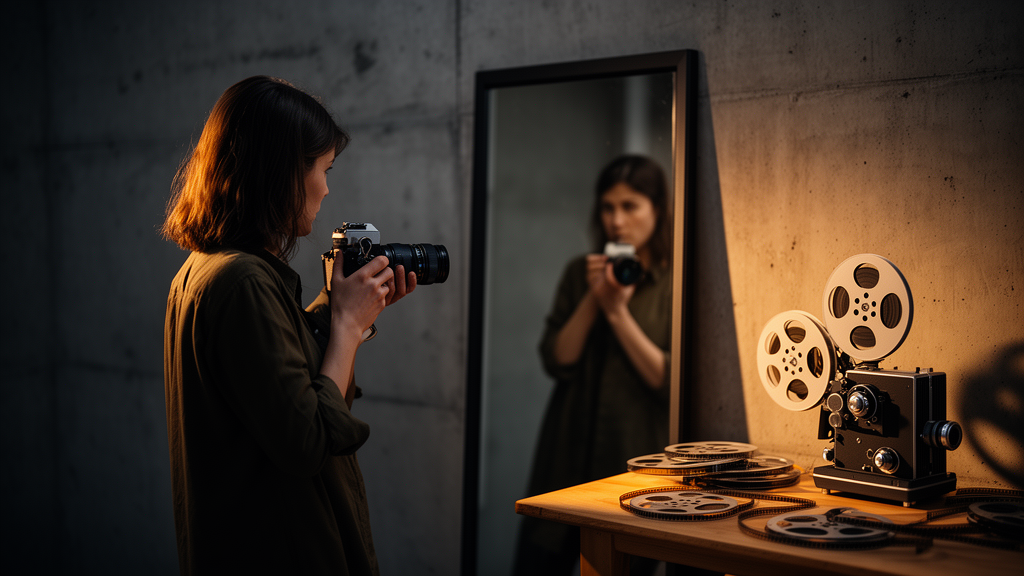
A new study published in Frontiers in Communication argues that some of the most radical challenges to how we think about bodies, gender, and power are not found in philosophy seminars but in the celluloid scratches, amplified heartbeats, and shared cameras of feminist experimental film and performance art. The research, conducted by Zhuoran Zhang of the University of Debrecen in Hungary, examines how female avant-garde artists deconstruct structuralist and postmodernist readings of the body, proposing that bodily autonomy is not a fixed attribute of a gendered subject but a relational capacity generated through specific, analysable formal mechanisms.
The study sits at the intersection of two fields: the exploratory practices of female experimental artists and the speculative extension of the female body in imagery and philosophical texts. Using textual analysis alongside close readings of visual works, Zhang reconstructed and critiqued structuralist and postmodernist interpretations to explore how the female body is deconstructed and reimagined across temporal and spatial dimensions in experimental film. The theoretical framework draws fundamentally on Michel Foucault and Gilles Deleuze, with significant reference to Rosi Braidotti, Judith Butler, Donna J. Haraway, and Giorgio Agamben, weaving together concepts of biopower, inscription, becoming, and the body without organs into a single analytical apparatus.
At the heart of the research lies a persistent problem in feminist theory: essentialism. Zhang argues that treating “woman” as a single, unified category of experience risks smoothing over the differences of culture, class, education, race, religion, and belief that are constitutive of bodily experience rather than incidental to it. The study therefore asks not whether feminist plurality is desirable, but whether particular experimental strategies for representing the body actually succeed, at the formal level, in enacting it. This distinction matters because, as Zhang notes, affirming plurality as a value does not by itself resolve the binary logics of subject and object, active and passive, natural and social, that essentialist accounts of the body tend to reproduce.
To operationalise these questions, the study developed a coding system applied to discrete scenes and gestures. Gender self-identification functioned as a coding category applied to authorial and subject position, recording whether the point of view, defined by camera position, framing, or narrational vantage, was aligned with a body that identifies as female within the work or with an external, unaligned position. Bodily experience and action patterns formed a second category, operationalised through identifiable formal indicators: point-of-view shots aligned with the artist’s own body, direct physical marking of the recording medium, live physiological signals amplified for the audience, and repeated or ritualised gesture. A third criterion, concerning the relation between body schemas and social networks, was reframed as an interpretive principle applied to each work’s internal formal structure rather than to external audience reception data.
The first major case study is Carolee Schneemann’s Fuses, a film made between 1964 and 1967 that documents the artist and her partner James Tenney having sex. Zhang’s analysis begins with a formal decision that much prior commentary treats as mere biographical detail: Schneemann and Tenney took turns operating the camera themselves for some scenes. In conventional erotic cinema, the camera occupies a fixed, external position through which a body is rendered visible, categorised, and made available to a structuring gaze. In Fuses, that apparatus circulates. Neither Schneemann nor Tenney holds a stable position as pure observer or pure observed. Zhang reads this shared camera as a formal refusal of the subject/object split on which disciplinary looking depends, invoking Foucault’s concept of inscription to name what would otherwise remain merely descriptive.
The film’s second, more radical gesture is material rather than compositional. Schneemann spent roughly three years marking the celluloid by hand, scratching it, painting it, baking it in an oven, and exposing it to storms, so that the images arrive already scored, layered, and abstracted through superimposition and marks etched directly into the film stock. Here Zhang finds Deleuze, rather than Foucault, doing the sharper interpretive work. Foucault’s model of inscription still assumes a surface that power writes on from outside, but what happens to the emulsion in Fuses is closer to Deleuze and Guattari’s concept of becoming and the body without organs: the film stock is not a passive surface receiving marks but an active material in continuous transformation, such that the bodies on screen and the physical body of the film itself become indistinguishable. The film does not represent two bodies merging; its material enacts a becoming at the level of the medium itself.
A third detail completes the reading. Schneemann conceived part of the film as seen through the eyes of her cat, Kitch, an observer she described as free of voyeurism and unstructured by moral judgment. Zhang argues that a non-human, non-specular observer cannot participate in an economy of looking structured by mirroring, since a cat has no stake in a logic of sameness. Kitch’s gaze is thus not a whimsical aside but a formal device staging an alternative to specular looking that philosophy has rarely been able to imagine from within its own terms. Crucially, applying the gendered-function coding category to Tenney’s body reveals that the hand-worked emulsion does not fall disproportionately on the female body; both bodies appear, at points, dissolved into the same superimposed, non-figurative marks, and the film’s central formal claim depends on his body being treated with the same formal seriousness as hers.
The study then turns to Marina Abramović and Ulay’s 1980 performance Rest Energy, in which Abramović holds a large bow while Ulay draws back the arrow, its point aimed directly at her heart, both leaning back against the tension of the string with microphones amplifying each of their heartbeats for the audience. Where Fuses distributes authorship by passing the camera between two bodies, Rest Energy distributes risk by making each body the condition of the other’s safety. Zhang finds that neither the Foucauldian vocabulary of inscription nor the Deleuzian vocabulary of becoming transfers cleanly here, since there is no camera to redistribute and no emulsion to transform; what transfers is the underlying structural question of what happens to the subject/object binary when survival cannot be located in either body alone but only in the live, reversible relation between them. The microphones do not privilege one heartbeat over the other, and the reciprocity of the bow-and-string mechanism makes any reading of Ulay as active aggressor and Abramović as passive target a misdescription of what is actually performed.
Jennifer Reeves’s 1993 film Monsters in the Closet stages yet another mode of becoming, closer to Deleuze’s account of the body without organs than to the camera-centred strategies of Fuses. The film mechanises repetitive bodily touch and layers it with the recurring motif of beetles frozen in place, producing a body that is not represented as threatened by an external organism but as continuous with it. Read through Haraway’s account of the cyborg and the reinvention of nature, this fusion is not a metaphor for the body’s vulnerability but a formal claim that the body’s natural materiality was never separable from other organic and technical forms in the first place. By contrast, Yoko Ono’s 1964 performance Cut Piece, in which Ono knelt motionless while audience members cut away pieces of her clothing with scissors, yields a different verdict. The asymmetry between acting subject and acted-upon object is not incidental to the work but constitutes its entire mechanism, and because the piece builds in no mechanism by which the object position circulates back to the audience, Zhang concludes that it models a less fully non-essentialist relation between bodies than the other works examined.
The study’s conclusion challenges a conflation that has long persisted in feminist film criticism: the equation of the position of the gaze with embodied subjectivity. Zhang argues that bodily autonomy, as enacted in moving-image works, is not an attribute of a gendered subject but the capacity to generate interactions of internalised perception through specific and analysable formal mechanisms, including shared apparatuses, material transformation, mutual risk-bearing, and organic fusion. Within these mechanisms, the natural body and the social body constitute one another rather than existing as mutually opposed categories. The research proposes a future state of self-awareness for the body that transcends gender-centricity, underscoring the significance of constructing social networks of embodied existence. Rather than making the sweeping claim that feminist experimental practices simply deconstruct the body, Zhang reconstructs a scene-level system of encoding that can be used to repeatedly generate highly differentiated networks of reality, offering innovative perspectives on the theoretical expression possibilities available to avant-garde female artists and on the multidimensional elements within philosophical practice texts.
Subject of Research: Deconstruction of the female body in feminist experimental film and performance through Foucauldian and Deleuzian theory
Article Title: Dynamic experiments: deconstructing the body in feminist experimental film and performance
Article References: Dynamic experiments: deconstructing the body in feminist experimental film and performance. (n.d.). https://doi.org/10.3389/fcomm.2026.1928028
Image Credits: AI Generated
DOI: 10.3389/fcomm.2026.1928028
Keywords: feminist experimental film, body theory, Carolee Schneemann, Marina Abramović, Yoko Ono, Foucault, Deleuze, biopower, body without organs, female gaze, performance art, posthumanism
Cite Scienmag News
Courtney Benton. (October 16, 2026). When the Camera Becomes the Body: How Feminist Experimental Film Rewrites Embodiment. Scienmag. https://scienmag.com/when-the-camera-becomes-the-body-how-feminist-experimental-film-rewrites-embodiment/
Courtney Benton. "When the Camera Becomes the Body: How Feminist Experimental Film Rewrites Embodiment." Scienmag, 16 October 2026, https://scienmag.com/when-the-camera-becomes-the-body-how-feminist-experimental-film-rewrites-embodiment/. Accessed 16 October 2026.
Courtney Benton. "When the Camera Becomes the Body: How Feminist Experimental Film Rewrites Embodiment." Scienmag. October 16, 2026. https://scienmag.com/when-the-camera-becomes-the-body-how-feminist-experimental-film-rewrites-embodiment/


