


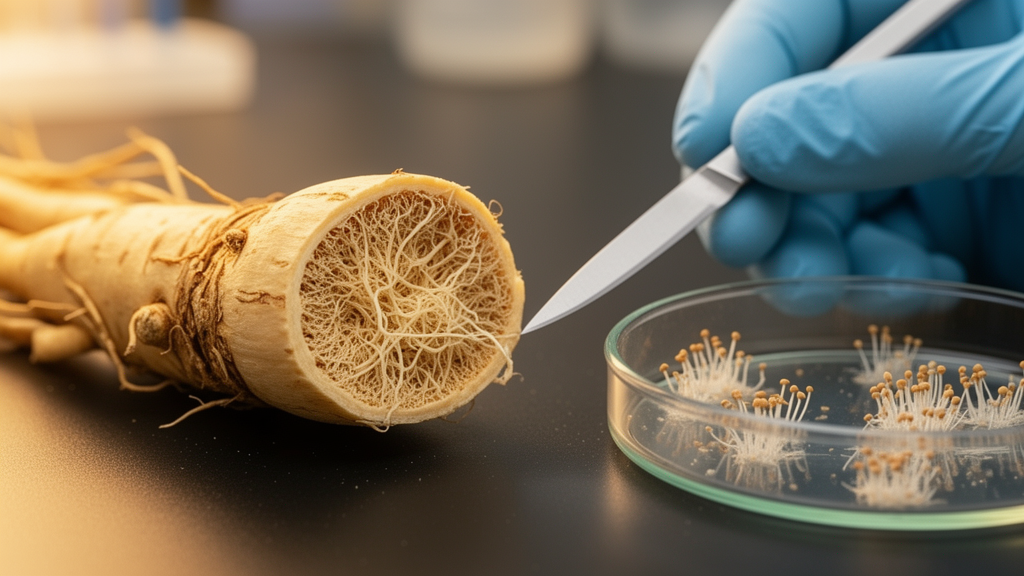
Deep in the forested hills of Wenshan Zhuang and Miao Autonomous Prefecture in Yunnan Province, China, one of traditional Chinese medicine’s most prized plants is quietly harboring a hidden world. Panax notoginseng, the celebrated herb known as sanqi or notoginseng, has long been valued for its saponin-rich roots, but a new study has revealed that when this plant is grown the old way—semi-wild, beneath a natural forest canopy—its roots host a fungal community far richer and stranger than scientists expected. By isolating fungi from the roots of 23 forest-grown plants, a research team recovered 188 endophytic fungal isolates, 70 of which belonged to the order Hypocreales. Within that collection, three previously unknown species were hiding in plain sight, and they have now been formally described in the journal MycoKeys.
The three newcomers are Trichoderma wenshanense, Clonostachys grandispora, and Thelonectria chlamydosporia, each representing a different family within Hypocreales: Hypocreaceae, Bionectriaceae, and Nectriaceae, respectively. All three were isolated from the roots of plants cultivated under an aerial seeding-based ecological system, in which seeds were sown and allowed to germinate and grow in a natural forest environment without artificial intervention. This forest-based, semi-wild cultivation model differs markedly from conventional farmland cultivation in light conditions, temperature, humidity, litter composition, and soil chemistry, which is precisely why researchers suspected it might harbor endophytic fungal assemblages found nowhere else. Their suspicion proved well founded: previous surveys had already hinted at numerous undescribed fungal taxa in the roots of this medicinal plant, and the new study confirms that the underground diversity remains largely unmapped.
Identifying a new fungal species today requires far more than a quick look under a microscope. The team used an integrative taxonomic approach that combined detailed morphological observation with multilocus phylogenetic analyses of DNA sequences. Root samples were surface sterilized, homogenized, and spread onto potato dextrose agar supplemented with penicillin and streptomycin to suppress bacterial growth. Colony characteristics were recorded on three different media—potato dextrose agar, synthetic low-nutrient agar, and oatmeal agar—after seven and fourteen days of incubation at 25 degrees Celsius. For strains that refused to sporulate under normal conditions, the researchers employed a clever trick: slide cultures irradiated with UVA light for roughly seven hours per day coaxed the fungi into producing the spores and reproductive structures needed for microscopic examination.
On the molecular side, the team extracted genomic DNA using a modified CTAB method and amplified a battery of genetic markers, including the internal transcribed spacer region (ITS), the large ribosomal subunit gene (LSU), and protein-coding genes such as rpb1, rpb2, tef1, actin, and beta-tubulin. Because the three candidate species belonged to different genera, different combinations of loci were used for each: a concatenated tef1 and rpb2 dataset for Trichoderma, a five-locus dataset for Clonostachys, and a six-locus dataset for Thelonectria. Maximum likelihood analyses run in IQ-TREE and Bayesian inference in MrBayes produced congruent tree topologies, and in every case the new isolates formed distinct, strongly supported lineages—bootstrap values of 100 percent and posterior probabilities of 1—separate from their closest known relatives.
Each species tells its own evolutionary story. Trichoderma wenshanense, named for Wenshan Prefecture, sits as a distinct lineage most closely related to Trichoderma floccosum, differing from that species by 3.6 percent of nucleotides in the tef1 gene and 1.3 percent in rpb2. Morphologically, it is set apart by subglobose to broadly ellipsoidal conidia and the complete absence of chlamydospores, thick-walled survival spores that its relative produces in abundance. Its colonies on potato dextrose agar are mostly vegetative at first, with grayish-green conidiation beginning at the center and a pale orange-yellow reverse lacking dark pigmentation. Four isolates belonging to this species were recovered, all genetically consistent with the ex-type strain designated KUNCC 11820.
Clonostachys grandispora wears its defining trait in its name: grandispora means large spore. Its ellipsoidal to short cylindrical conidia average 9.4 by 2.9 micrometers, markedly larger than the smaller, obovoid spores of its closest relative, Clonostachys hongkongensis, which measure about 4.8 by 3.1 micrometers. Across the five-locus concatenated dataset of 3,784 base pairs, the new species differed from C. hongkongensis by 102 and 103 nucleotide sites respectively—most strikingly a 5.8 percent divergence in rpb2—while the phylogenetic tree placed it as a strongly supported sister lineage. In culture it forms pale yellowish-brown colonies with distinct radiating folds on potato dextrose agar and velvety mycelium with a pale cream-yellow center on oatmeal agar, cultural quirks that further distinguish it from its Hong Kong relative.
The third species, Thelonectria chlamydosporia, is perhaps the most visually dramatic. Its conidia are enormous by fungal standards—long cylindrical to fusiform structures averaging 42.3 by 7.7 micrometers, occasionally reaching more than 55 micrometers—and it produces chlamydospores in profusion, occurring singly, in pairs, or in chains of three or four. Its closest relatives in the Thelonectria blackeriella species complex produce no or very few such spores under the same culture conditions, making this character an immediately diagnostic feature. The six-locus analysis of 3,884 base pairs showed the three isolates forming a monophyletic lineage sister to the blackeriella cluster, with nucleotide divergences from the ex-type strain of that species ranging from 1.1 percent in actin to 5.2 percent in ITS. The species name, fittingly, refers to these abundant chlamydospores.
Why does describing three small fungi from plant roots matter beyond the world of taxonomy? The answer lies in what their relatives can do. Endophytic fungi from P. notoginseng have already shown considerable potential in promoting plant growth, enhancing disease resistance, and mediating the biotransformation of bioactive compounds. Some strains synthesize plant hormones such as indole-3-acetic acid and gibberellins, which promote host growth. A Trichoderma gamsii strain isolated from the plant suppresses soil-borne diseases by releasing volatile organic compounds, while a Trichoderma asperellum strain from its rhizosphere inhibits the root-rot pathogen Fusarium solani and simultaneously enhances plant growth and saponin accumulation. Most intriguingly for medicine, certain Fusarium and Aspergillus endophytes appear involved in the biosynthesis of ginsenosides—the saponins Rb1, Rd, Rg3, and Re—suggesting fungi may help shape the very compounds that make the plant valuable.
This applied potential is exactly why accurate species-level identification is so critical. Previous surveys of P. notoginseng endophytes—recovering 158 strains in one study, 89 in another, and 24 in a third—identified many fungi only to the genus level, leaving species-level taxonomy unresolved and hindering functional exploration. Without knowing precisely which species is which, researchers cannot reliably connect a fungus to its effects on plant health or medicinal quality, nor can they safely deploy known biocontrol species without risking confusion with uncharacterized relatives. The three new descriptions provide a firm taxonomic foundation on which such functional studies can now be built, and the authors caution that these species represent only a subset of the Hypocreales diversity recovered from the host, with additional taxa likely awaiting description.
The broader message of the study is one of staggering, still-unknowable fungal diversity hiding in unexpected places. Fungi living quietly inside the tissues of plants—endophytes—remain among the least explored corners of the fungal kingdom, and medicinal plants grown under semi-wild ecological conditions may be especially rich sources of novel lineages. The specimens and living cultures from this work are preserved in the Cryptogamic Herbarium and Culture Collection of the Kunming Institute of Botany, ensuring that future researchers can revisit and study these organisms. As forest-based ecological cultivation of P. notoginseng expands as a sustainable alternative to conventional farmland, so too does the opportunity to chart the fungal partners that share its roots—and perhaps, one day, to recruit them in the service of better medicine and healthier crops.
Subject of Research: Taxonomy and phylogeny of new endophytic Hypocreales fungi from Panax notoginseng roots
Article Title: New endophytic species of Hypocreales ( Sordariomycetes , Ascomycota ) from the medicinal plant Panax notoginseng in China
Article References: Yang, S.-Y., Feng, X.-Y., Wei, C.-Y., Zeng, W.-B., Wang, Y.-B., Li, J.-P., & Wang, Z.-W. (2026). New endophytic species of Hypocreales (Sordariomycetes, Ascomycota) from the medicinal plant Panax notoginseng in China. MycoKeys, 141, 195-216. https://doi.org/10.3897/mycokeys.141.209682
Image Credits: AI Generated
DOI: 10.3897/mycokeys.141.209682
Keywords: endophytic fungi, Hypocreales, Panax notoginseng, new species, Yunnan China, Trichoderma wenshanense, Clonostachys grandispora, Thelonectria chlamydosporia, multilocus phylogeny, medicinal plants, forest-based cultivation, MycoKeys
Cite Scienmag News
Roger Howard. (October 15, 2026). Hidden Fungi Uncovered: Three New Species Discovered Inside the Roots of a Famous Chinese Medicinal Plant. Scienmag. https://scienmag.com/hidden-fungi-uncovered-three-new-species-discovered-inside-the-roots-of-a-famous-chinese-medicinal-plant/
Roger Howard. "Hidden Fungi Uncovered: Three New Species Discovered Inside the Roots of a Famous Chinese Medicinal Plant." Scienmag, 15 October 2026, https://scienmag.com/hidden-fungi-uncovered-three-new-species-discovered-inside-the-roots-of-a-famous-chinese-medicinal-plant/. Accessed 15 October 2026.
Roger Howard. "Hidden Fungi Uncovered: Three New Species Discovered Inside the Roots of a Famous Chinese Medicinal Plant." Scienmag. October 15, 2026. https://scienmag.com/hidden-fungi-uncovered-three-new-species-discovered-inside-the-roots-of-a-famous-chinese-medicinal-plant/


