


…
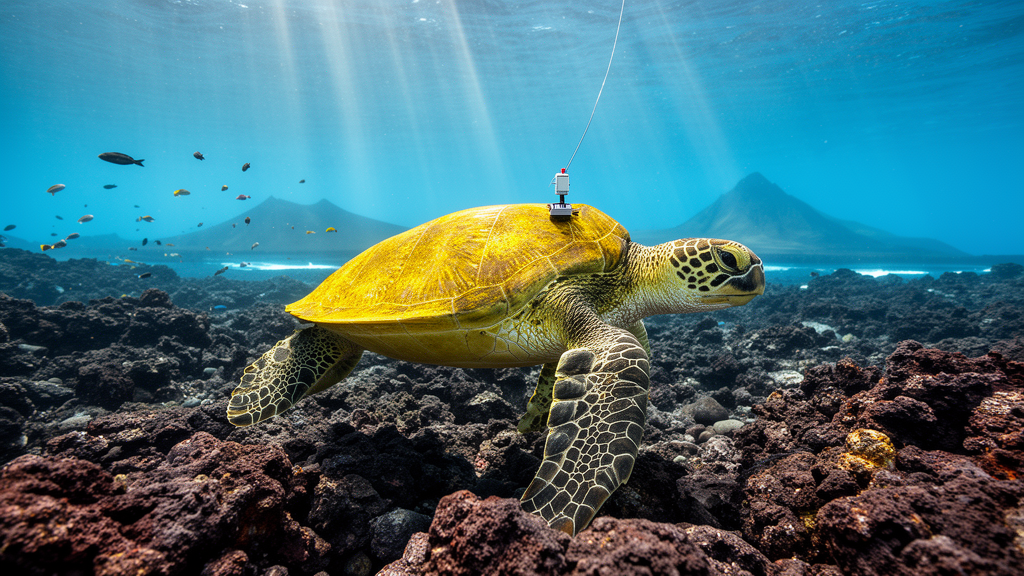
The finding that none of the nine tracked yellow-morphotype green turtles left the Galápagos archipelago during tracking periods that extended up to 418 days carries considerable weight for conservation planning, even though the sample size remains modest. Satellite telemetry studies of marine megafauna are inherently constrained by tag cost, battery life, and the logistical challenges of capturing adult turtles at sea, and the highly variable home range estimates reported here—spanning from individuals that remained tightly associated with a single island’s nearshore waters to others that moved tens of kilometers between islands—illustrate how individual behavioral plasticity can complicate efforts to generalize about a population’s spatial needs. This variability is not unusual among sea turtle populations. Green turtles elsewhere in the Pacific and Atlantic have repeatedly been shown to adopt a spectrum of movement strategies within the same foraging grounds, with some individuals behaving as nearshore residents while others undertake seasonal or opportunistic excursions. What makes the Galápagos result distinctive is that the entire tracked sample appears to fall within the resident end of that spectrum, with core use areas concentrated in shallow nearshore habitats rather than in the open ocean waters that surround the archipelago.
The shallow nearshore focus of these turtles aligns with what is known about green turtle foraging ecology more broadly. Adult and subadult green turtles at neritic foraging grounds typically graze on seagrasses and macroalgae in water depths of less than twenty meters, and their digestive physiology—adapted to a largely herbivorous diet—favors regular, sustained access to productive benthic forage. In the Galápagos, green turtles have been documented feeding on a variety of marine algae in coastal lava-rock and sandy-bottom habitats, and the archipelago’s nutrient-rich upwelling zones, driven by the interaction of the Equatorial Undercurrent with the island platform, support some of the most productive shallow-water algal communities in the eastern tropical Pacific. The strong site fidelity observed in this study is therefore consistent with the expectation that resident turtles anchor themselves to reliable forage patches. Site fidelity of this kind has important management implications: it means that localized habitat degradation—whether from coastal development, anchoring damage, pollution, or shifts in algal community composition driven by warming seas—could disproportionately affect the individuals that depend on those specific patches, rather than being diluted across a widely dispersed population.
The sex ratio of the tracked sample, with seven males and only two females, deserves particular attention given the broader context of sea turtle research. Across most sea turtle populations, movement data come overwhelmingly from nesting females, because they are the life stage most easily intercepted on land. Males, which do not come ashore after hatching, have historically been described as the neglected half of sea turtle population biology. The ability to capture and track adult-sized males in the Galápagos therefore fills a genuine knowledge gap, and the finding that males exhibit the same strong coastal fidelity as females suggests that the nearshore habitats of the reserve are important for both sexes throughout the year, not just during nesting seasons. This matters for population viability assessments, because male abundance and male habitat use influence effective population size and genetic connectivity in ways that female-centric data cannot capture. If males remain resident within the archipelago, mating opportunities and gene flow depend on the spatial arrangement of foraging grounds and the ability of individuals to move among islands during breeding periods.
Indeed, the inter-island movements documented in several individuals—spanning tens of kilometers across open water between islands—hint at how genetic exchange might occur within the archipelago even among resident turtles. Green turtles are capable of sustained swimming over such distances with relative ease, and the observation that some individuals crossed between islands while others remained island-bound suggests that the reserve functions as a network of connected habitat patches rather than a set of isolated islands. The Galápagos Marine Reserve, established in 1998, and the Hermandad Marine Reserve, created in 2022, together protect nearly 200,000 square kilometers of marine habitat, making this one of the largest marine protected areas in the world. Within that vast area, however, the effective protection of shallow nearshore corridors depends on zoning, enforcement, and the management of localized stressors such as boat traffic, fishing gear interactions, and coastal tourism, all of which intensify in the waters closest to inhabited islands.
The morphotype dimension of this study adds a layer of evolutionary and biogeographic interest that extends beyond the Galápagos themselves. The coexistence of two green turtle morphotypes within the same archipelago—one associated with the eastern Pacific and the other hypothesized to have western Indo-Pacific affinities—raises questions about how such differentiation is maintained in a species with such high dispersal capacity. Recent genomic work has identified candidate loci associated with thermoregulation, melanism, osmoregulation, diet, and reproduction that differ between the morphotypes, supporting the idea that ecological specialization in environmentally contrasting regions of the Pacific has driven adaptive divergence. If foraging grounds play a role in shaping phenotypic and adaptive variation, as morphometric and genetic studies suggest, then the Galápagos coastal habitats occupied by yellow-morphotype turtles may be more than simple foraging areas; they may be part of the ecological theater in which morphotype-specific adaptations are expressed and maintained. The observation that juvenile yellow-morphotype turtles grow faster than black-morphotype juveniles in the archipelago hints at physiological differences that could translate into different habitat preferences, thermal tolerances, or dietary niches, though the precise mechanisms remain unresolved.
Equally unresolved is the reproductive ecology of the yellow morphotype in Galápagos. Neither females nor males of this morphotype are known to nest in the archipelago, which raises the possibility that yellow-morphotype turtles found in Galápagos waters represent a foraging aggregation drawn from nesting rookeries elsewhere in the Pacific—perhaps from central or western Pacific islands—or that they constitute a resident population whose breeding grounds have simply not been identified. Mixed-stock genetic analyses, which assign individuals to likely source rookeries based on mitochondrial DNA haplotypes, have previously revealed that Galápagos green turtles connect with nesting and foraging areas along the continental Ecuadorian coast, Central America, and Mexico. Extending such analyses to yellow-morphotype individuals, combined with the kind of movement data generated here, could clarify whether these turtles are long-distance migrants that settled in Galápagos or residents of a self-sustaining local population. The answer would have direct conservation consequences, because a foraging aggregation drawn from distant rookeries depends on the health of both the Galápagos habitats and the distant nesting beaches, whereas a self-sustaining local population would be far more vulnerable to local threats.
The broader conservation context is also shifting. The International Union for Conservation of Nature recently reclassified the green turtle from globally Endangered to Least Concern, reflecting genuine population recoveries driven by decades of nest protection, fishery regulations, and bycatch reduction measures in many regions. That reclassification, however, applies to the species as a whole and does not necessarily capture the status of regionally distinct populations or morphotypes, particularly those whose ecology remains poorly characterized. The Eastern Pacific Regional Management Unit, to which Galápagos green turtles belong, encompasses populations that have experienced historical exploitation and continue to face threats including incidental capture in fisheries, coastal habitat loss, vessel strikes, plastic ingestion, and disease. Climate change adds further pressure: rising sand temperatures at nesting beaches skew hatchling sex ratios toward females in many populations, and ocean warming can alter the distribution and productivity of the algal and seagrass forage on which neritic green turtles depend. For a population that appears to be tightly tied to shallow nearshore habitats, as this study suggests, such changes could compress available forage into narrower bands of coastline and intensify competition among individuals.
The methodological approach of this study also merits reflection. Argos satellite telemetry, which relies on a constellation of polar-orbiting satellites to receive transmissions from platform transmitter terminals attached to the turtles’ carapaces, has been a workhorse of sea turtle movement research for decades, though it provides position estimates with varying degrees of accuracy and is limited by tag battery life and attachment duration. Tracking periods ranging from 45 to 418 days capture a meaningful slice of the annual cycle but may miss seasonal patterns that emerge over multiple years, such as responses to El Niño events, which periodically transform the Galápagos marine environment by suppressing upwelling and warming surface waters. During strong El Niño years, marine productivity in the archipelago declines dramatically, and green turtles—along with the archipelago’s other iconic marine herbivores—must cope with reduced forage availability. Whether yellow-morphotype turtles respond to such episodes by shifting habitats, moving among islands, or drawing on energy reserves remains unknown, and longer-term tracking or repeated sampling across climate cycles would be needed to answer that question.
The kernel utilization distribution approach used to estimate home ranges, which generates probability surfaces from the density of location fixes, is well suited to characterizing core use areas within a reserve, but the enormous standard error around the mean home range estimate in this study—nearly double the mean itself—reflects the small sample size and the genuine heterogeneity of individual behavior. Future studies with larger samples, ideally incorporating both morphotypes and both sexes across multiple islands and seasons, could test whether the patterns observed here hold more broadly. Complementary approaches such as acoustic telemetry, which can provide fine-scale positioning within receiver arrays near coastlines, or stable isotope and genetic analyses that integrate information over weeks to years, could add resolution that satellite tracks alone cannot provide.
Ultimately, the study’s central message—that the Galápagos Marine Reserve functions as a coherent system of coastal and inter-island corridors for yellow-morphotype green turtles—reinforces the value of large-scale marine protection while highlighting the importance of what happens at the finest spatial scales. A reserve of nearly 200,000 square kilometers protects turtles from the most diffuse threats, but the shallow nearshore patches where these turtles concentrate their activities are also the areas most exposed to anchor damage, coastal runoff, and human presence. Preserving the quality and connectivity of those local habitats, and understanding how the two green turtle morphotypes partition or share them, will determine whether the archipelago continues to support the full ecological and evolutionary diversity of green turtles that it harbors today.
Subject of Research: …
Article Title: Movements of yellow-morphotype green turtles (Chelonia mydas) in the Galápagos Marine Reserve
Article References: Muñoz-Pérez, J. P., Alarcón-Ruales, D. E., Tanabe, L. K., Hart, C. E., Heidemeyer, M., Steiner, T., Arauz, R., Valle, C. A., & Rowe, J. W. (2026). Movements of yellow-morphotype green turtles (Chelonia mydas) in the Galápagos Marine Reserve. Frontiers in Amphibian and Reptile Science, 4, Article 1837921. https://doi.org/10.3389/famrs.2026.1837921
Image Credits: AI Generated
DOI: 10.3389/famrs.2026.1837921
Keywords: Movements, yellow-morphotype, green, turtles, Chelonia, mydas, pagos, Marine, Reserve, scientific research
Cite Scienmag News
Gavin Prescott. (October 15, 2026). Satellite tags reveal Galápagos’ mysterious yellow green turtles rarely leave the archipelago. Scienmag. https://scienmag.com/satellite-tags-reveal-galapagos-mysterious-yellow-green-turtles-rarely-leave-the-archipelago/
Gavin Prescott. "Satellite tags reveal Galápagos’ mysterious yellow green turtles rarely leave the archipelago." Scienmag, 15 October 2026, https://scienmag.com/satellite-tags-reveal-galapagos-mysterious-yellow-green-turtles-rarely-leave-the-archipelago/. Accessed 15 October 2026.
Gavin Prescott. "Satellite tags reveal Galápagos’ mysterious yellow green turtles rarely leave the archipelago." Scienmag. October 15, 2026. https://scienmag.com/satellite-tags-reveal-galapagos-mysterious-yellow-green-turtles-rarely-leave-the-archipelago/


