


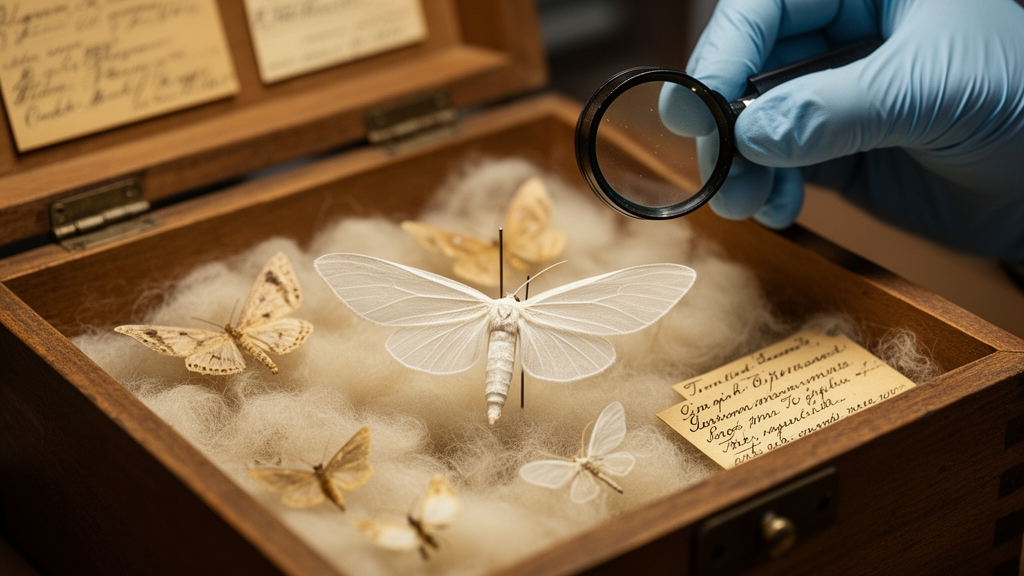
In the drawers of the Simon Janashia Museum of Georgia, three moths collected more than half a century ago have been quietly waiting to rewrite a chapter of Caucasus entomology. A new study published in the journal Caucasiana documents the first record of the genus Hepialus in Georgia, based on two males and a single female of the ghost moth species Hepialus humuli, collected in 1961, 1962 and 1970. The find is not merely a national first: it also represents the first documented occurrence of the genus anywhere in the South Caucasus, extending the known range of a familiar European moth into a region where its presence had long been suspected but never confirmed.
Ghost moths, together with their relatives the swift moths, make up the family Hepialidae, one of the most evolutionarily significant lineages in the entire order Lepidoptera. With 725 described species, Hepialidae is the most diverse family among the primitive moths, and it occupies a pivotal position in the butterfly and moth family tree. The family belongs to the infraorder Exoporia, which is the sister group to the Heteroneura, the vast assemblage that contains the overwhelming majority of living butterflies and moths. Together, these two lineages account for more than ninety percent of all extant lepidopteran species, making the ghost moths a living window into the early evolution of the order.
The biology of Hepialidae is as distinctive as their ancestry. Unlike most moths, whose caterpillars feed openly on leaves, the larvae of most ghost moth species live underground, feeding on the roots of woody or herbaceous plants or consuming fallen foliage in the soil. Another major feeding strategy involves boring into the stems and branches of trees and shrubs, where the larvae feed on callus tissue regrowing at wound surfaces or, in some species, on soft woody tissues. A smaller minority of species feed on plant detritus throughout their development. This subterranean, often cryptic lifestyle is one reason the family remains poorly surveyed in many parts of the world, including the mountainous Caucasus.
Geographically, Hepialidae are found on every major landmass except Antarctica, with notable regional absences in Madagascar, the Caribbean islands and tropical West Africa. Northern Eurasia currently hosts eight genera comprising 21 species, most of which are endemic to the region between Europe and the Caspian Sea or represented only there. The southern boundary of the group runs along the Mediterranean Basin and continues eastwards through Jordan, Türkiye, Georgia and northern Iran. This makes the Caucasus Mountains, which span Georgia, southern Russia, northeastern Türkiye, Armenia and Azerbaijan, a potentially crucial biogeographic frontier for understanding where the western Eurasian ghost moth genera begin and end.
Before the new study, the Hepialidae fauna of Georgia was thought to consist of just four species. Three of these are regional endemics or relics: Zenophassus schamyl, described in 1888, and two species of Triodia, T. laetus and T. mlokossevitschi, described in 1877 and 1884 respectively. The fourth, Korscheltellus lupulinus, is a more broadly distributed European species whose southern distributional limit falls in Georgia. The natural history of the endemic Triodia species remains poorly understood, and the taxonomic status of T. mlokossevitschi is itself uncertain, because its type specimen has never been dissected and described according to modern standards. Only Z. schamyl has been studied in any detail, largely because of its economic importance as a pest of grapevines, a problem documented by Soviet-era researchers in the early and mid-twentieth century.
The newly recognized specimens were all collected by E. Didmanidze and deposited in the Simon Janashia Museum of Georgia. The first, a female, was taken at Bakhmaro in the western region of Guria on 18 July 1961. A male followed from Martvili in Samegrelo-Zemo Svaneti on 4 July 1962, and a second male was collected at 1800 meters above sea level in Khevsureti, in the Mtskheta-Mtianeti region, on 12 July 1970, though without an exact locality. The three specimens span three different regions and three different years, suggesting that Hepialus humuli has been present in Georgia for at least 64 years while remaining almost entirely overlooked by collectors and researchers.
Why would such a conspicuous moth escape notice for so long? The answer likely lies in a combination of behavior and geography. Hepialus humuli is famous among European naturalists for its crepuscular habits: males fly at dusk in short, ghostly patrols, and the species is most active in the narrow window between sunset and full darkness. Combined with its occurrence in remote mountainous regions, this twilight lifestyle makes the species easy to miss with conventional daytime collecting. The species is nonetheless widespread across Europe, extending eastwards to central Siberia, and its known southern distributional limit in western Eurasia runs along the Pyrenees and north of the Mediterranean, along the European Alps, the Balkans and north of the Black Sea. A report of the species from North Ossetia, on the Russian side of the Greater Caucasus, had already suggested that its occurrence in northern Georgia was to be expected.
The biogeographic implications of the Georgian records extend well beyond a single species. The localized endemism of Hepialidae in the Caucasus is comparable to patterns observed in other montane regions along the northern margin of the Mediterranean Basin. Researchers have suggested that the diversification of the northern Eurasian ghost moth genera was shaped by tectonic history, particularly phases of geological uplift associated with the closure of the western Tethys Sea, the ancient ocean that once separated Eurasia from Africa and Arabia. As mountain ranges rose and climates shifted, ancestral populations were fragmented and isolated, giving rise to the endemic lineages that characterize the Caucasus today. Against this backdrop, confirming the presence of a widespread Eurasian genus like Hepialus in the South Caucasus helps to map the boundary zones where broadly distributed faunas meet highly localized endemics.
The distribution of ghost moth genera around the Caucasus is strikingly asymmetric. The western Eurasian genera Gazoryctra, Hepialus, Pharmacis and Phymatopus have previously published ranges lying north of the Caucasus, while Korscheltellus reaches its southern limit in Georgia. Only Triodia extends well south of the mountain chain, reaching as far as southern Israel and Jordan. Even there, however, taxonomy remains unsettled: the status of T. froitzhami from Israel and Jordan is uncertain because its type specimen has not been dissected and no clear external diagnostic differences have been established. The Georgian Hepialus record therefore raises a further question highlighted by the study’s authors: whether the species may also occur further south in Central Asia, particularly in Kazakhstan and adjacent countries, a possibility that had previously been difficult to evaluate without a confirmed South Caucasus occurrence.
The study also carries a practical message for biodiversity science. Museum collections assembled decades ago, sometimes by a single dedicated collector, can hold discoveries of continental significance, but only when they are re-examined with modern taxonomic knowledge. The three Georgian specimens were photographed with a Canon EOS 60D camera fitted with a macro lens, and image stacks processed with focus-stacking software now allow researchers worldwide to compare the Georgian material with European reference specimens. The authors express particular gratitude to the administration of the Simon Janashia Museum of Georgia for granting access to the collection. As systematic surveys of the Caucasus continue, the ghost moths of Georgia may yet yield further surprises, and the humble museum drawer has once again proven to be one of biology’s most productive frontiers.
Subject of Research: First record of the ghost moth genus Hepialus and the species Hepialus humuli in Georgia and the South Caucasus, based on museum specimens
Article Title: New Light on Old Ghosts: First Record of the genus Hepialus Fabricius, 1775 ( Lepidoptera , Hepialidae ) from Georgia
Article References: Japaridze, L.-G., Makharadze, G., Petrov, V., & Grehan, J. R. (2026). New Light on Old Ghosts: First Record of the genus Hepialus Fabricius, 1775 (Lepidoptera, Hepialidae) from Georgia. Caucasiana, 5, 25-29. https://doi.org/10.3897/caucasiana.5.e176387
Image Credits: AI Generated
DOI: 10.3897/caucasiana.5.e176387
Keywords: Hepialidae, Hepialus humuli, ghost moths, Georgia, South Caucasus, Lepidoptera, museum specimens, biogeography, Caucasus Mountains, new record, taxonomy, Simon Janashia Museum
Cite Scienmag News
Gavin Prescott. (October 15, 2026). Ghost Moth Genus Recorded in Georgia for the First Time, Hidden in Museum Drawers for Decades. Scienmag. https://scienmag.com/ghost-moth-genus-recorded-in-georgia-for-the-first-time-hidden-in-museum-drawers-for-decades/
Gavin Prescott. "Ghost Moth Genus Recorded in Georgia for the First Time, Hidden in Museum Drawers for Decades." Scienmag, 15 October 2026, https://scienmag.com/ghost-moth-genus-recorded-in-georgia-for-the-first-time-hidden-in-museum-drawers-for-decades/. Accessed 15 October 2026.
Gavin Prescott. "Ghost Moth Genus Recorded in Georgia for the First Time, Hidden in Museum Drawers for Decades." Scienmag. October 15, 2026. https://scienmag.com/ghost-moth-genus-recorded-in-georgia-for-the-first-time-hidden-in-museum-drawers-for-decades/


