


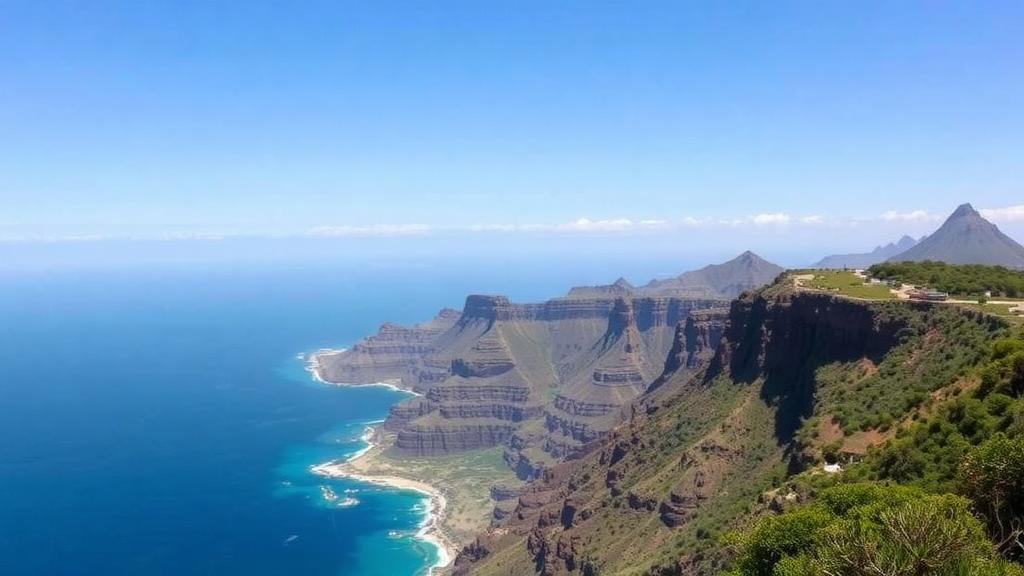
On the jagged volcanic cliffs of Cabo Verde, where sea spray hammers thin soils and salt-laden winds sweep across basalt platforms, an international team of vegetation scientists has completed the first systematic, numerically validated survey of the archipelago’s coastal cliff flora. The result is remarkable: a completely new vegetation class, described from the ground up using a novel optimization technique that relies on nothing more than which plants grow where. The study, published in Vegetation Classification and Survey, analysed 167 vegetation plots sampled on cliffs and coastal platforms across seven islands between 2013 and 2023, and revealed a flora so distinct from that of Mediterranean Europe that it shares not a single species with the classic cliff vegetation of that region.
The methodological heart of the study is TDV-optimization, an algorithmic approach to vegetation classification that searches for the partition of plots into community types that maximizes the Total Differential Value, a measure of how well differential species separate groups. Unlike many clustering methods, TDV-optimization works purely on presence-absence data, yet it succeeds in uncovering co-occurrence and co-absence patterns that carry genuine ecological meaning. In an era when machine learning classifiers often demand enormous, species-rich datasets, the demonstration that this approach works on a dataset with a mean of just 4.7 species per plot is striking. Forty-one percent of all possible pairs among the 167 plots shared no species at all, giving a Jaccard distance of 1, a scenario that would cripple most ordination and clustering techniques.
The researchers, led by a team working within the phytosociological tradition of Braun-Blanquet, developed a five-step procedure that blends old-school field judgment with new computational rigor. First, they grouped plots by physiognomy, meaning which species dominated the vegetation cover, using formal logic rules that could be translated into a dichotomous key. Nine physiognomic groups emerged, each defined by dominants such as Limonium brunneri, Limonium braunii, Gomphrena vermicularis, Polycarpaea gayi var. lycioides, Zygophyllum waterlotii, or Suaeda caboverdeana. Second, each group was subjected to TDV-optimization to detect floristically defined associations within the physiognomic framework, testing different numbers of clusters and inspecting the highest-scoring solutions graphically. This yielded seventeen preliminary associations.
Third came validation. The team computed the Internal Assignment Precision, or IAP, a measure of how unambiguously each plot is assigned to a single vegetation unit based on its species composition and the exclusive species of each unit. Across the raw cliff dataset, IAP was a modest 0.701, a predictable consequence of species-poor plots. But when the physiognomic framework from step one was incorporated, IAP rose to 0.958, with only seven species-poor plots left ambiguous. A synoptic table comparing the species pools of all seventeen preliminary associations achieved a perfect IAP of 1.00, confirming that differential species existed between every pair of units. This was decisive evidence that the units deserved formal recognition as associations in the phytosociological sense.
Fourth, in a genuine methodological innovation, the researchers applied TDV-optimization to a presence-absence version of the synoptic table itself, essentially letting the algorithm classify the classified communities. This revealed two higher-order groupings with unmistakable geographic and environmental signatures. One group, containing five communities and nine exclusive species, occurred on the islands of São Vicente and Santa Luzia, on coralline sandstone cliffs and platforms within hyperarid to ultrahyperarid climates. The other, with twelve communities and 43 exclusive species, thrived on weathered basaltic substrates across Santo Antão, São Nicolau, Brava, Fogo, and Santiago, within arid ombrotypes.
The fifth and final step tested whether these preliminary higher-rank units could be defended with characteristic species. To do this, the team assembled a second dataset of 484 plots, comprising all known vegetation relevés from Cabo Verde, and calculated the Differential Value index and its partial values, pDiffVals, for every species at every rank. Because pDiffVals inherently penalize species that occur across multiple vegetation units, they proved far more reliable than raw presence percentages for identifying species faithful to classes, orders, and alliances. Strict combinatorial rules were applied: a species was deemed characteristic of a class only if its highest pDiffVal fell within that class or if it met specific conditions in non-monotypic hierarchies. This produced clean sets of characteristic taxa: Frankenia caboverdeana and Frankenia pseudoericifolia for the class, Paronychia illecebroides, Limonium braunii, and Polycarpaea gayi var. lycioides for the basalt alliance, and Lotus bollei and Limonium brunneri for the sandstone alliance.
The formal outcome is a complete syntaxonomic synthesis: one class, Polycarpaeo lycioidis-Limonietea braunii, one order, two alliances, and thirteen formally described associations, plus several communities too poorly sampled for formal diagnosis. Many of the diagnostic species are endemic to Cabo Verde, including the saltbush relatives Frankenia caboverdeana and Suaeda caboverdeana, the endemics Limonium brunneri, Campylanthus glaber subsp. spathulatus, and Diplotaxis gorgadensis, and the charismatic Lotus bollei of the sandstone cliffs. Each new association was diagnosed with a type relevé, complete with coordinates, plot area, cover, altitude, and full species composition, following the International Code of Phytosociological Nomenclature.
Perhaps the most headline-grabbing finding is biogeographic. The Mediterranean and Atlantic coastal cliffs of Europe and North Africa belong to the class Crithmo-Staticetea, a well-established unit built around rock samphire and sea-lavender communities. The Cabo Verde cliffs, despite sharing genera such as Limonium, Lotus, Daucus, Frankenia, Launaea, and Tetraena, share no species whatsoever with that class. The authors interpret their new class as geovicarious with Crithmo-Staticetea, meaning it plays the same ecological role under an equivalent environment but on a different evolutionary stage, one enriched with Saharan, Sahelian, and Afrotropical elements rather than Mediterranean ones. This confirms, at the finest floristic resolution yet, that Cabo Verde belongs with the Warm deserts and semi-deserts subbiome and within the Tropical Sahara region of the Paleotropical Kingdom, not with the Holarctic floras of the Mediterranean basin.
The ecology of these communities is a study in extremity. The cliff plants, termed cremnophytes, are dwarf chamaephytes, nanophanerophytes, and hemicryptophytes enduring permanent salt spray, severe edaphic drought, oligotrophic soils, and relentless trade winds. One newly described association, Frankenio caboverdeanae-Limonietum jovibarbae, clings to the towering north-facing cliffs of São Nicolau, where springs emerging from volcanic rock cracks and shading from the high walls create locally humid microclimates that allow lush growth amid otherwise desertic surroundings. On São Vicente, the sandstone-derived cliffs at the base of the Viana volcano host Suaedo caboverdeanae-Limonietum brunneri on lava platforms dusted with coralline sand, in a climate classified as thermotropical ultrahyperarid.
The practical implications extend beyond taxonomy. By publishing the complete dataset of 484 relevés, together with header data, R code, and the auxiliary functions of the diffval package, the authors have made the entire classification pipeline fully reproducible, a rarity in vegetation science. They stress that previous syntaxonomic accounts of Cabo Verde, notably the influential 2017 overview by Rivas-Martínez and colleagues, were built on manual tabulations without numerical validation, and they call for similar computational scrutiny across Cabo Verdean and other African vegetation. With more than ninety percent of the archipelago classified as tropical desertic or xeric, and endemic species concentrated in precisely these narrow cliff habitats, an evidence-based syntaxonomy is not academic pedantry. It is the foundation upon which conservation priorities, habitat directives, and climate adaptation strategies for Cabo Verde’s unique coastal flora must be built. The cliffs have been mapped; now the challenge is to protect what grows on them.
Subject of Research: Numerical phytosociological classification of coastal cliff vegetation in the Cabo Verde archipelago using TDV-optimization
Article Title: TDV -optimization exemplified: Application to coastal cliff vegetation in Cabo Verde
Article References: Costa, J. C., Neto, C., Bioret, F., Gomes, I., Capelo, J., Duarte, M. C., Arsénio, P., & Monteiro-Henriques, T. (2026). TDV-optimization exemplified: Application to coastal cliff vegetation in Cabo Verde. Vegetation Classification and Survey, 7, 65-81. https://doi.org/10.3897/vcs.173501
Image Credits: AI Generated
DOI: 10.3897/VCS.173501
Keywords: Cabo Verde, TDV-optimization, vegetation classification, phytosociology, coastal cliffs, syntaxonomy, endemic plants, DiffVal index, biogeography, Sahara region, Braun-Blanquet, plant communities
Cite Scienmag News
Blake Davidson. (October 15, 2026). Algorithm Maps Cabo Verde’s Hidden Cliff Plant Communities and Reveals a New Vegetation Class. Scienmag. https://scienmag.com/algorithm-maps-cabo-verdes-hidden-cliff-plant-communities-and-reveals-a-new-vegetation-class/
Blake Davidson. "Algorithm Maps Cabo Verde’s Hidden Cliff Plant Communities and Reveals a New Vegetation Class." Scienmag, 15 October 2026, https://scienmag.com/algorithm-maps-cabo-verdes-hidden-cliff-plant-communities-and-reveals-a-new-vegetation-class/. Accessed 15 October 2026.
Blake Davidson. "Algorithm Maps Cabo Verde’s Hidden Cliff Plant Communities and Reveals a New Vegetation Class." Scienmag. October 15, 2026. https://scienmag.com/algorithm-maps-cabo-verdes-hidden-cliff-plant-communities-and-reveals-a-new-vegetation-class/


