


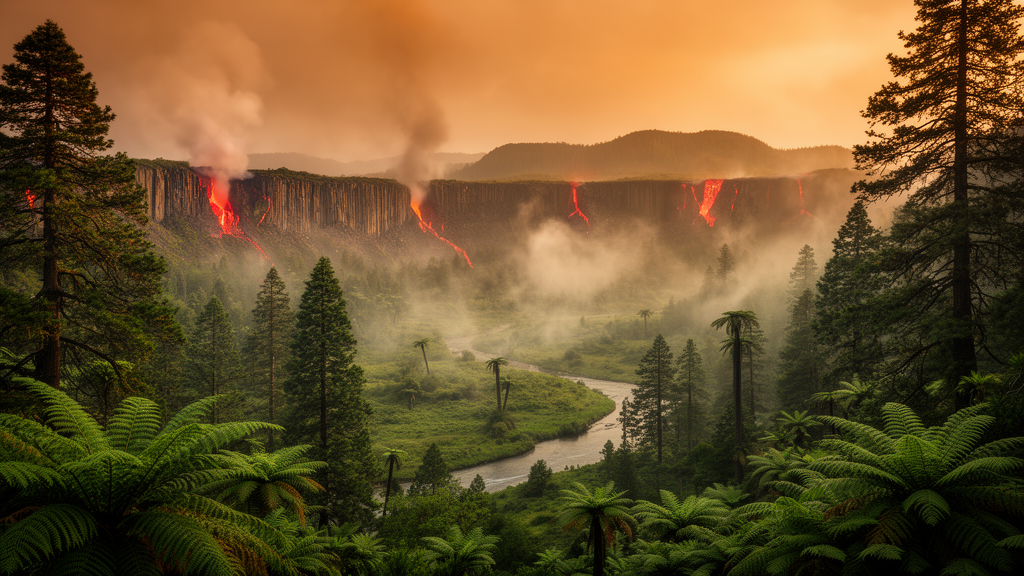
Some 183 million years ago, the Earth slid into one of the most severe greenhouse episodes of the entire Phanerozoic Eon, the span of time that stretches from the first proliferation of complex animals to the present day. The event, known as the Toarcian Oceanic Anoxic Event, or T-OAE, stamped itself into the rock record with a sharp excursion in carbon isotopes, evidence of widespread oxygen depletion in the oceans, and extensive burial of organic-rich sediments on a global scale. Scientists have long agreed that the event was triggered by an enormous input of carbon into the atmosphere and oceans, but the details have remained stubbornly uncertain. Where exactly did the carbon come from? How much of it was released? And how did the Earth system eventually claw its way back to a stable climate?
A new study led by Wenhan Chen and Chao Li of Chengdu University of Technology, together with colleagues including David B. Kemp of China University of Geosciences and Ying Cui of Montclair State University, published in Nature Communications, now offers some of the most quantitative answers yet. Rather than relying on isotope records alone, which can constrain the carbon isotopic signature of the emitted carbon but not its absolute mass, the team assimilated globally representative carbon isotope data and reconstructions of atmospheric carbon dioxide concentrations into an Earth system model. This dual constraint, matching both the isotope curve and the CO2 trajectory, allowed the simulations to disentangle the size, source, and timing of the carbon pulse in a way that previous single-proxy approaches could not.
The headline finding is striking in its magnitude. The simulations indicate that roughly 18,000 petagrams of carbon were injected into the ocean-atmosphere system over the course of the event. A petagram is a billion metric tonnes, so the total release amounts to some eighteen trillion tonnes of carbon, a figure that dwarfs the accessible fossil carbon reserves of the modern Earth and puts the perturbation on par with the largest carbon-cycle disruptions known from the geological past. Critically, the isotopic fingerprint of the majority of that carbon points to a predominantly magmatic origin, consistent with the enormous volumes of carbon-rich volcanic gases that would have been exhaled by large-scale volcanism during the emplacement of the Karoo-Ferrar igneous province in the southern hemisphere.
Yet the story is not simply one of volcanoes. According to the model results, the very onset of the event was characterized by an additional input of carbon from thermogenic or biogenic sources. Thermogenic carbon is generated when magma intrudes into organic-rich sedimentary rocks and bakes hydrocarbons out of them, while biogenic carbon would include methane released from destabilized gas hydrates or from the oxidation of organic matter. The study therefore paints a more nuanced picture than a purely volcanic trigger: the magmatic plumbing system beneath the Karoo-Ferrar province appears to have acted as a furnace, igniting surrounding sedimentary basins and priming the climate system before the bulk of the purely volcanic degassing took hold. This two-stage carbon economy helps explain isotope records that a single volcanic source struggles to reproduce.
The atmospheric consequences of such a release would have been dramatic. Reconstructed and modelled CO2 concentrations climbed steeply, driving a hyperthermal in which global temperatures rose well above the already warm Early Jurassic baseline. The warming set in motion a cascade of feedbacks: accelerated continental weathering, altered ocean circulation, and the expansion of oxygen-poor water masses across shelves and epicontinental seas. It is this anoxic expansion that gave the event its name, and it is also what makes the T-OAE a natural laboratory for understanding how the carbon cycle behaves when it is pushed far beyond its normal operating range, something researchers increasingly view as relevant to humanity’s own greenhouse experiment.
Recovery, however, is the second half of the story, and it is here that the new work makes a particularly important contribution. The simulations show that at least 6,800 petagrams of organic carbon were buried during the event, locked away in sediments as the anoxic oceans of the Toarcian became vast carbon sinks. When plankton and other organic material sink into oxygen-depleted waters, they are far less likely to be decomposed and their carbon can accumulate in seafloor muds, effectively removing it from the active exchange between the atmosphere, ocean, and biosphere. The burial of this organic matter drew down carbon and was a key mechanism nudging the climate back toward equilibrium, explaining the recovery of both CO2 levels and the carbon isotope record once the main input had tapered off.
Burial alone, the study finds, was not the whole story. The model also quantifies the role of silicate weathering, the slow-motion chemical thermostat of the Earth system. As CO2 rises and the climate warms, rainfall, soil acidity, and vegetation all accelerate the rate at which rocks dissolve, and the dissolved products ultimately combine with atmospheric carbon and carry it to the ocean, where it is precipitated as carbonate. The simulations indicate that this weathering feedback consumed an excess of roughly 6,000 petagrams of carbon during and after the event. Together, organic carbon burial and enhanced silicate weathering formed a two-pronged sequestration engine powerful enough to reverse a perturbation measured in the tens of trillions of tonnes, though over timescales far longer than any human-relevant interval.
What makes the result particularly valuable to Earth scientists is the way it resolves long-standing debates about the carbon budget of the T-OAE. Estimates based on isotope excursions alone have varied widely because the isotope signal is sensitive to assumptions about the isotopic composition of the source carbon. A light, methane-like source requires a smaller mass to produce the same isotope excursion than a heavier volcanic source. By forcing the model to simultaneously reproduce the isotope curve and independently derived CO2 estimates, the team effectively anchored the budget to physical reality rather than to assumptions about source composition, arriving at a massive total that is best satisfied by a dominantly magmatic source, with subordinate lighter contributions early on. The approach also yields sharper constraints on the tempo of the release, distinguishing the initial pulse from the prolonged main phase of degassing.
The T-OAE is one of several hyperthermal events scattered through the Phanerozoic record, and comparisons are inevitably drawn with the Palaeocene-Eocene Thermal Maximum some 56 million years ago, as well as with the modern Anthropocene. The parallels are instructive: rapid injection of isotopically light carbon, ocean acidification and deoxygenation, intensified hydrological cycling, and elevated organic carbon burial. But the scale is sobering. The Toarcian release unfolded over tens to hundreds of thousands of years, giving weathering and burial feedbacks time to operate, whereas human emissions are compressed into centuries. Understanding how a pre-human Earth absorbed an 18,000-petagram shock provides both reassurance about the resilience of the carbon cycle and a warning about the duration of the consequences, since full recovery in the Early Jurassic required the combined and protracted action of the planet’s slowest geochemical machinery.
The study, funded by the National Natural Science Foundation of China and other agencies, demonstrates how Earth system modelling can turn fragmentary geological archives into quantitative budgets with direct relevance to climate science. As more high-resolution isotope and CO2 records become available from sections around the world, similar assimilation frameworks are likely to be applied to other hyperthermals, refining the numbers further. For now, the Toarcian Oceanic Anoxic Event stands as a cautionary landmark: an era when volcanic carbon on an almost unimaginable scale destabilized the ocean-atmosphere system, and when the deep-time engines of organic burial and rock weathering, grinding away for millennia, eventually steered the planet back to cooler waters.
Subject of Research: Sources and sequestration of carbon during the Toarcian Oceanic Anoxic Event
Article Title: Massive release of predominantly magmatic carbon drove an Early Jurassic hyperthermal
Article References: Chen, W., Wu, Y., Kemp, D. B., Cui, Y., Pohl, A., Ruebsam, W., Zheng, D., & Li, C. (2026). Massive release of predominantly magmatic carbon drove an Early Jurassic hyperthermal. Nature Communications. https://doi.org/10.1038/s41467-026-77747-y
Image Credits: AI Generated
DOI: 10.1038/s41467-026-77747-y
Keywords: Toarcian Oceanic Anoxic Event, carbon cycle, magmatic carbon, hyperthermal, Early Jurassic, Earth system model, organic carbon burial, silicate weathering, carbon dioxide, volcanism, paleoclimate, ocean anoxia
Cite Scienmag News
Violet Maxwell. (October 15, 2026). Jurassic Super Greenhouse Fueled by 18,000 Billion Tonnes of Volcanic Carbon, Model Shows. Scienmag. https://scienmag.com/jurassic-super-greenhouse-fueled-by-18000-billion-tonnes-of-volcanic-carbon-model-shows/
Violet Maxwell. "Jurassic Super Greenhouse Fueled by 18,000 Billion Tonnes of Volcanic Carbon, Model Shows." Scienmag, 15 October 2026, https://scienmag.com/jurassic-super-greenhouse-fueled-by-18000-billion-tonnes-of-volcanic-carbon-model-shows/. Accessed 15 October 2026.
Violet Maxwell. "Jurassic Super Greenhouse Fueled by 18,000 Billion Tonnes of Volcanic Carbon, Model Shows." Scienmag. October 15, 2026. https://scienmag.com/jurassic-super-greenhouse-fueled-by-18000-billion-tonnes-of-volcanic-carbon-model-shows/


