


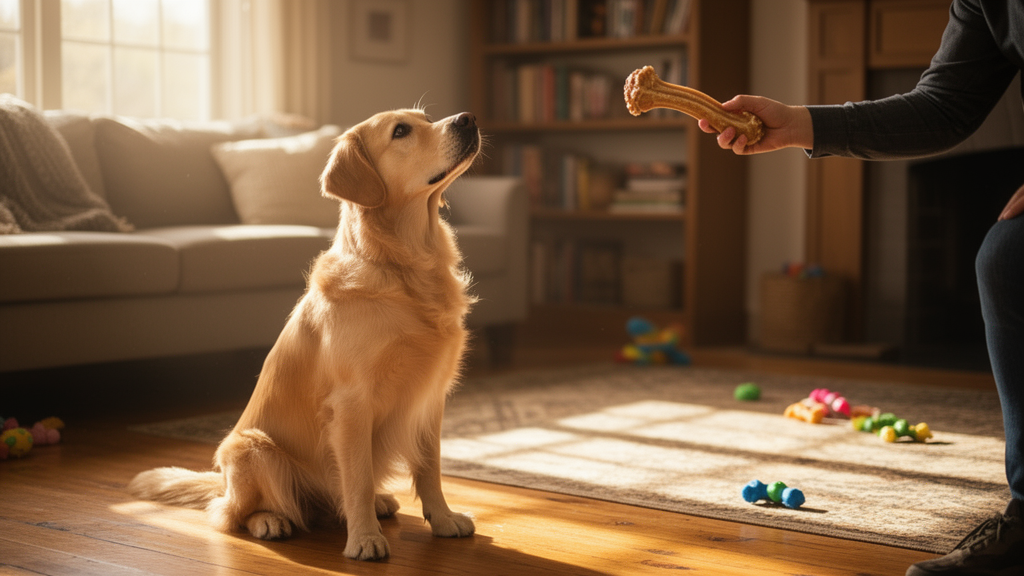
Every dog guardian knows the scene: a tennis ball carried possessively around the house, a favorite squeaky toy defended from a visiting dog, a bone buried with unmistakable ceremony. We casually describe these objects as the dog’s own, and a new opinion article argues that this everyday language may point to something scientifically profound. Writing in Frontiers in Ethology, psychologists Emily Sundby and Valerie Kuhlmeier of Queen’s University propose that the domestic dog, long overlooked in comparative ownership research, may be one of the best species available for testing whether property-like concepts exist beyond humans.
To understand the claim, it helps to grasp the distinction the researchers draw from prior work. Tibble and Carvalho, integrating evolutionary game theory, ethology, developmental psychology, and comparative cognition, separated possession from property. Possession means an individual maintains physical control over an object and others respect that control as a claim. Property, sometimes treated as true ownership, means an individual retains exclusive access to an object even without direct physical control, a state that likely demands more sophisticated social cognitive processing. Under these definitions, many species show possession-like behavior, but no clear empirical evidence shows that any non-human animal demonstrates property.
The evidence for possession is broad and well documented. Non-human primates avoid taking objects under another’s physical control, even when the controlling individual ranks below them in dominance hierarchies. Several primate species also show the endowment effect, valuing objects more highly once those objects are in their possession, although some findings are debated. Similar respect for possession appears in corvids, showing that the phenomenon is not exclusive to primates. From an evolutionary standpoint, possession can be understood as an evolutionarily stable strategy: a simple rule like respect whoever currently controls a resource minimizes costly conflicts and yields consistent fitness benefits. Once widely adopted, the strategy becomes self-reinforcing, because individuals who deviate by always challenging possession incur higher costs and are less likely to succeed.
Yet the prevailing conclusion that ownership is uniquely human may, Sundby and Kuhlmeier argue, reflect limitations in the species and contexts studied rather than a genuine absence of ownership-related cognition. If ownership depends on norm-governed interactions within a social institution, then species that regularly participate in complex cooperative social systems, including those involving humans, should be especially informative test cases. This is precisely where the domestic dog enters the picture, and the authors build their case from three converging angles: evolutionary ancestry, domestication history, and social cognition.
The first angle rests on canid sociality. The Canine Ancestry Hypothesis holds that dogs’ capacity for interspecific communication has evolutionary roots shared with wolves, which live in highly cooperative family groups where resource distribution and pup-rearing involve coordinated behavior. Research indicates that wolves respect possession of territory and food items; individuals that acquire small prey are typically allowed to retain it regardless of dominance status. This implies that foundational components of ownership, such as respect for possession, likely predate domestication. Domestication could then have elaborated these tendencies within human-controlled environments in ways no laboratory primate has experienced.
The second angle concerns what dogs were selected to do. Historically, dogs likely guarded human camps and resources, and features such as attention-grabbing barks and high alertness during rest may have been advantageous for signaling potential threats to property. If dogs were selected to help defend their guardians’ resources, the authors reason, sensitivity to distinctions such as mine, yours, and ours would confer adaptive benefits. At minimum, dogs would profit from distinguishing relevant from irrelevant threats when responding to potential violations of access. In other words, a dog that could not tell the difference between a stranger reaching for the household food supply and a household member simply moving an object would be a poor guard, and selection would have favored animals that made the distinction fluently.
The third and perhaps most compelling angle involves dogs’ remarkable social cognition. Dogs outperform primates on certain tasks involving human communicative cues, likely due to selective pressures during domestication. These abilities emerge early: dog puppies respond more readily to human gestures than hand-reared wolf puppies, with comprehension increasing alongside age and experience, suggesting species-typical adaptations elaborated by learning. Crucially for ownership research, dogs may not merely track human intentions and signals but internalize aspects of human-defined social rules about objects. Emerging work on norm psychology supports this possibility, proposing that norm-like processes may occur in highly social species such as canids, visible in the regulation of play fighting through signals like play bows and behavior calibrated to a partner’s size and age. Dogs can also flexibly follow social rules, even obeying instructions that conflict with their own knowledge of an object’s location.
What sets dogs apart from nearly every other species studied in this field is their embedding in heterospecific social environments where rules are explicitly taught and enforced, including rules governing access to food, toys, and spaces within the household. A recent survey found that North American guardians often attribute ownership-like states to their dogs, endorsing statements that the dog owns particular toys and items, which could actively shape dogs’ experiences and expectations. Multi-dog households offer especially rich ground: laboratory research indicates toy possession is strongly influenced by dominance relationships, but the authors stress that dominance and ownership need not be competing explanations, since human ownership norms are also constrained by power dynamics. Whether a dog respects another dog’s access to an object because of rank, prior possession, ownership, guardian intervention, or some combination remains an open empirical question that naturalistic multi-dog settings could help untangle.
The theoretical stakes are considerable. If human ownership reasoning constitutes a naive theory, a domain-specific knowledge system supporting causal explanation and prediction, then dogs participating in norm-governed interactions may acquire components of an ownership-like system through repeated engagement with human rules. The authors suspect dogs do not share the full human concept; instead, they may hold a partial or differently structured naive theory, allowing researchers to identify which components of ownership cognition depend on human-specific institutions and which arise more broadly. The authors outline two complementary research approaches. Observationally, dogs that follow behavioral rules, taking only certain items even in the owner’s absence and without physical control, or that show sensitivity to violations, such as returning an object to its first holder, would suggest encoded ownership norms. Experimentally, tasks could probe cognitive hallmarks known from humans, including attentional biases toward and increased valuation of owned objects, both robust findings in adult and child cognition. Free-ranging dogs, which retain sensitivity to human communication, gaze, and emotion but lack sustained exposure to household norms, would provide an instructive comparison group.
Practical payoffs may follow quickly. Evaluations of working and service dogs often measure persistence toward toys, focus, and object location memory to determine eligibility and job fit, yet the history of a dog’s relationship with those toys has never been systematically manipulated. Given that humans process owned objects differently from merely familiar ones in attention and memory, ownership biases could silently influence working-dog assessments and, ultimately, placement decisions and welfare. The authors’ broader conclusion is that it may be premature to declare ownership uniquely human; by studying the species sharing our sofas, science can refine theoretical accounts of ownership, separate its cognitive from institutional components, and potentially uncover shared principles of resource regulation across species, all while improving how we train and care for the animals that already treat our homes as shared territory.
Subject of Research: Ownership concepts and property cognition in non-human species, with domestic dogs as a comparative model
Article Title: Modeling ownership in non-human species: an argument for the domestic dog
Article References: Sundby, E., & Kuhlmeier, V. A. (2026). Modeling ownership in non-human species: an argument for the domestic dog. Frontiers in Ethology, 5, Article 1927786. https://doi.org/10.3389/fetho.2026.1927786
Image Credits: AI Generated
DOI: 10.3389/fetho.2026.1927786
Keywords: animal cognition, canine cognition, domestic dog, ownership, possession, property, social norms, domestication, comparative psychology, endowment effect, animal welfare, wolf sociality
Cite Scienmag News
William Thompson. (October 15, 2026). Why Your Dog Might Understand Ownership Better Than We Thought. Scienmag. https://scienmag.com/why-your-dog-might-understand-ownership-better-than-we-thought/
William Thompson. "Why Your Dog Might Understand Ownership Better Than We Thought." Scienmag, 15 October 2026, https://scienmag.com/why-your-dog-might-understand-ownership-better-than-we-thought/. Accessed 15 October 2026.
William Thompson. "Why Your Dog Might Understand Ownership Better Than We Thought." Scienmag. October 15, 2026. https://scienmag.com/why-your-dog-might-understand-ownership-better-than-we-thought/


