


In the coconut groves of Buton Regency, a remote corner of Southeast Sulawesi, Indonesia, researchers have uncovered a story that challenges one of economics’ most stubborn assumptions: that producers always chase the highest price. A new field study of nearly 700 coconut processors, traders, and institutional experts reveals that when it comes to choosing who to sell to, trust, cash-on-delivery certainty, and familiar relationships routinely beat the promise of bigger profits. The findings, published in Frontiers in Behavioral Economics, offer a rare window into how real people make real economic decisions in markets where information is scarce and intermediaries rule.
The research team, led by Wa Ode Dian Purnamasari of the University of Muhammadiyah Buton and colleagues at the University of Muhammadiyah Malang, spent September through December 2024 embedded in the coconut economy of seven producing districts. Their sample was substantial: 489 copra processors, 182 coconut shell charcoal producers, marketing intermediaries, and a panel of ten institutional experts drawn from government agencies, extension services, academia, and farmer organizations. Statistical power analysis confirmed the sample far exceeded the minimum of 146 respondents needed for a medium effect size. Crucially, the study observed naturally occurring market behavior rather than staging artificial experiments, giving the results an ecological validity that laboratory studies of economic decision-making often lack.
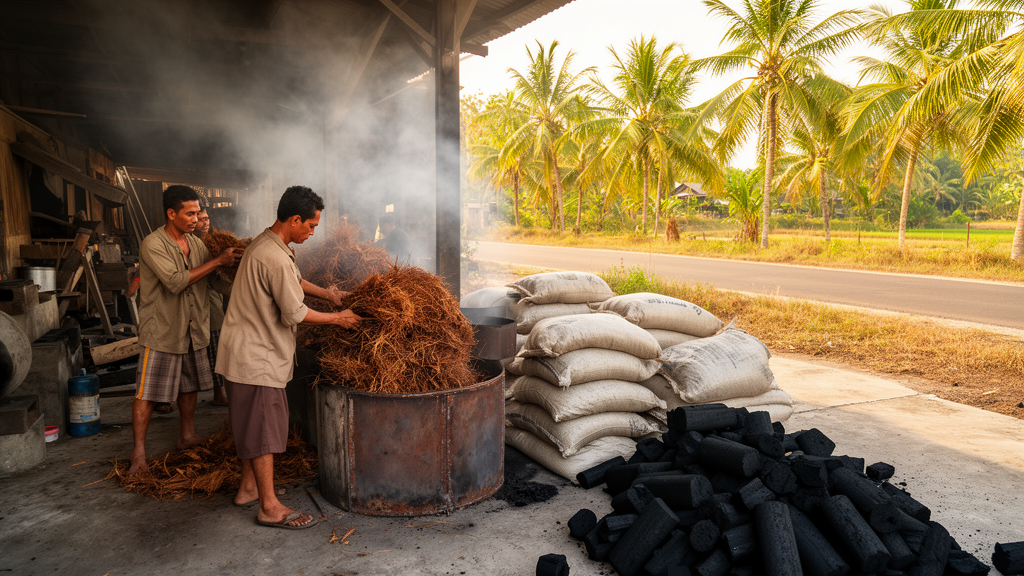
The economics alone are striking. Using the Hayami value-added framework, the team calculated that turning coconut shell waste, a by-product most producers simply discarded, into charcoal generated an average value of IDR 1,002.52 per kilogram of raw material, with a value-added ratio of 54.87 percent. In plain terms, more than half of the charcoal’s final worth came from the processing itself rather than from the underlying raw material. Profit rates averaged a remarkable 98.06 percent, though the researchers note that nearly all of this value accumulated as entrepreneurial profit rather than wages: labor compensation amounted to just IDR 19.39 per kilogram, or under two percent of the value added.
The conversion efficiency tells its own story. Each kilogram of coconut shell yielded roughly 0.31 kilograms of charcoal on average, while the labor coefficient of 0.0019 workdays per kilogram shows the process depends more on operational efficiency than on muscle power. Charcoal sold at IDR 6,000 per kilogram across all three districts studied, Lasalimu, South Lasalimu, and Kapontori, with value added remarkably consistent between IDR 996 and IDR 1,011 per kilogram. Yet despite this proven profitability, charcoal processing remained concentrated in only a handful of districts, a pattern the researchers attribute not to resource scarcity but to what behavioral economists call bounded rationality: producers stick with familiar, simpler copra production because new processing systems carry perceived risk, informational demands, and operational complexity.
The marketing analysis exposed an equally compelling paradox. Two channels dominated copra trade. In the longer channel, produce flowed from farmers through collectors and wholesalers before reaching industrial buyers, leaving producers with 75 percent of the final price and generating a cumulative margin of IDR 3,500 per kilogram. In the shorter channel, selling directly to wholesalers lifted the farmer’s share to 85.71 percent and cut the price-spread efficiency index from 25 percent to 14.29 percent. By every conventional measure, the shorter chain was better. And yet many producers stubbornly clung to collectors, accepting lower returns in exchange for immediate cash payments, informal credit access, supply aggregation, and flexible transaction arrangements that formal institutions failed to provide.
To understand why, the researchers turned to multicriteria decision analysis. Because the archived study record preserved only the final ordering of five marketing criteria rather than the original pairwise-comparison matrices, the team applied the rank-order centroid method, a transparent technique that converts rank positions into normalized weights. The results placed selling price first at 0.4567, followed by demand stability at 0.2567, accessibility at 0.1567, payment speed at 0.0900, and product absorption capacity at 0.0400. The researchers caution that part of the apparent dominance of the top two criteria reflects the mathematics of the rank-order centroid formula itself, which assigns declining weights by rank position, rather than a measured intensity of expert preference. Even so, the ordinal ranking was rock-solid: across twenty sensitivity scenarios perturbing each weight by up to twenty percent, not a single rank reversal occurred.
The strategic dimension came through a group-level SWOT-AHP synthesis. Strengths dominated the strategic landscape with a weight of 0.4658, followed by opportunities at 0.2771, weaknesses at 0.1611, and threats at 0.0960. Combining these groups into four classic TOWS orientations produced a clear winner: the aggressive Strength-Opportunity strategy, emphasizing value-added processing, institutional strengthening, technology dissemination, and market expansion, scored 0.3715. Strength-Threat strategies followed at 0.2809, then Weakness-Opportunity at 0.2191 and Weakness-Threat at 0.1286. All sixteen perturbation scenarios preserved this exact order, with Spearman rank correlations of 1.000 against the baseline, a level of local stability that few strategic assessments can claim.
The authors are refreshingly candid about the limits of interpretation. They stress that their behavioral conclusions are preference-based and conceptual rather than a psychometric validation of bounded rationality, institutional trust, or prospect theory, since no validated scales for those constructs were administered. The five criteria instead serve as observable proxies: price as monetary payoff, demand stability as uncertainty reduction, accessibility as transaction friction, payment speed as liquidity certainty, and absorption capacity as transaction-completion security. A further limitation concerns reproducibility, because the ten individual expert pairwise-comparison matrices were not retained in the archived record, meaning an equivalent reciprocal matrix reported in the paper reproduces the consensus vector mathematically but cannot recover original expert-level consistency or disagreement.
For policymakers, the implications are potentially transformative. The study suggests that simply opening shorter market channels or broadcasting better price information will not shift producer behavior unless institutions can replicate the non-price benefits, cash certainty, credit, and security, that intermediaries have long provided. Interventions that strengthen cooperatives, guarantee transparent payments, and reduce institutional uncertainty may outperform pure price incentives. Similarly, spreading coconut shell charcoal processing, a genuine waste-to-value opportunity, may require demonstration plots, peer mentoring, and gradual adoption schemes rather than technology handouts, because the barrier is behavioral as much as technical.
Perhaps the deepest lesson is methodological. Behavioral economics has long been criticized for building its edifice on laboratory games played by university students in wealthy countries. This study shows what the field gains when it ventures into rural markets where decisions are entangled in patron-client ties, liquidity constraints, and generations of social relationships. There, the rational actor model bends visibly: profitable opportunities go unexploited not because producers are irrational, but because certainty, familiarity, and trust are themselves valuable goods. In Buton’s coconut economy, the most efficient market structure on paper is not necessarily the one people will choose, and any reform that forgets this is likely to fail.
Subject of Research: Behavioral decision-making and marketing institution preferences in Indonesian coconut agroindustry development using SWOT-AHP and value-added analysis
Article Title: Behavioral decision-making and marketing institution preferences in coconut agroindustry development: evidence from SWOT-AHP and value-added analysis in Indonesia
Article References: Behavioral decision-making and marketing institution preferences in coconut agroindustry development: evidence from SWOT-AHP and value-added analysis in Indonesia. (n.d.). https://doi.org/10.3389/frbhe.2026.1900046
Image Credits: AI Generated
DOI: 10.3389/frbhe.2026.1900046
Keywords: behavioral economics, bounded rationality, coconut agroindustry, Indonesia, marketing institutions, SWOT-AHP, value-added analysis, rural development, marketing channels, coconut shell charcoal, farmer's share, Buton Regency
Cite Scienmag News
Reid Dalton. (October 15, 2026). Coconut Waste Cash: Charcoal Processing Doubles Rural Incomes While Trust Beats Price in Indonesian Markets. Scienmag. https://scienmag.com/coconut-waste-cash-charcoal-processing-doubles-rural-incomes-while-trust-beats-price-in-indonesian-markets/
Reid Dalton. "Coconut Waste Cash: Charcoal Processing Doubles Rural Incomes While Trust Beats Price in Indonesian Markets." Scienmag, 15 October 2026, https://scienmag.com/coconut-waste-cash-charcoal-processing-doubles-rural-incomes-while-trust-beats-price-in-indonesian-markets/. Accessed 15 October 2026.
Reid Dalton. "Coconut Waste Cash: Charcoal Processing Doubles Rural Incomes While Trust Beats Price in Indonesian Markets." Scienmag. October 15, 2026. https://scienmag.com/coconut-waste-cash-charcoal-processing-doubles-rural-incomes-while-trust-beats-price-in-indonesian-markets/


