


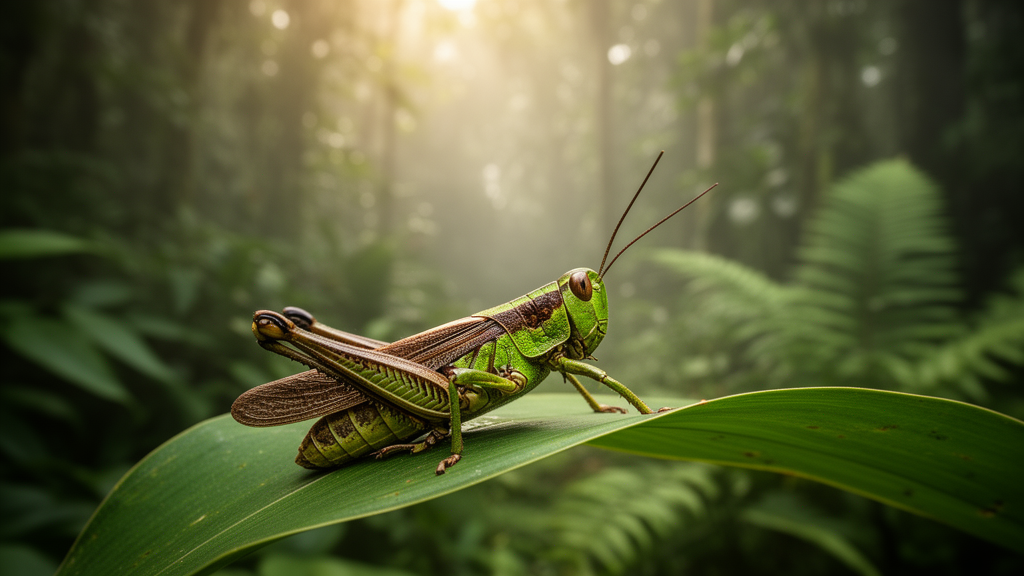
On the misty slopes of Mount Manengouba in western Cameroon, at an altitude of roughly 2,143 meters, researchers have documented a grasshopper species that scientists believed was confined to the far side of the African continent. Occidentosphena ruandensis, a wingless montane pyrgomorphid first described in 1914 from the shores of Lake Kivu in the Democratic Republic of Congo, had never before been confirmed anywhere in West or Central Africa. The discovery, published in African Invertebrates, stretches the known distribution of a genus once thought to be split neatly between the Albertine Rift and the Cameroonian highlands, and raises fresh questions about how montane insects disperse across Africa’s fragmented sky islands.
The finding came out of a systematic survey conducted between July 2025 and February 2026 on two peaks of the Cameroon Volcanic Line, a chain of mountains and islands running from the Gulf of Guinea inland through Cameroon that ranks among the most significant montane systems in West and Central Africa. The team, working under permit-free sweep-net protocols and targeting grasshoppers for sixty minutes per sampling day between mid-morning and late afternoon, collected a total of 22 individuals belonging to the genus Occidentosphena. Fourteen of them, nine males and five females, gathered in gallery forest on Mount Manengouba on 29 September 2025, turned out to be O. ruandensis. The remaining eight, collected on Mount Bamboutos at 2,440 meters in an agricultural field, represented the second species of the genus, O. uvarovi, confirming that thisCameroonian endemic still persists in the country more than a century after its type specimen was taken.
The biogeographic significance of the Manengouba record is difficult to overstate. Until now, O. ruandensis was known only from the Eastern Afromontane region around Lake Kivu and the Albertine Rift, with its holotype, a female deposited in the Museum für Naturkunde in Berlin, collected on Mount Niragongo in 1907. Its sister species, O. uvarovi, was believed to be restricted to the Cameroonian highlands until recent reviews of edible Orthoptera reported it from Congo and Gabon, hinting that the genus may be far more widespread than museum drawers suggest. The authors argue that the apparent restriction of O. ruandensis to the Albertine Rift may never have reflected a true biogeographic pattern at all, but simply the consequences of limited sampling across the poorly surveyed mountains of West and Central Africa.
Two scenarios could explain the new distribution map. The first is that O. ruandensis has always maintained a fragmented, disjunct range, with isolated populations clinging to separate montane blocks much as other Afrotropical orthopterans do. The second is that the species once occupied a broader continuous range that was later carved into refugia by climatic fluctuations, geological events, and, increasingly, by human activity. Agricultural expansion, pesticide use, and pastoralism are all transforming the grasslands of Mount Bamboutos, where gallery forests and mountain meadows have been largely converted into crop fields, eucalyptus plantations, and pastures. Comparable patterns of fragmentation driven by habitat destruction and natural habitat patchiness have been documented in other montane African katydids and grasshoppers, lending weight to the idea that Occidentosphena populations are relics of a once more connected fauna.
Beyond the range extension, the study delivers the first detailed descriptions of the male genitalia of both species, a technical milestone with real taxonomic consequences. Grasshopper systematists have long recognized that external morphology alone can be misleading when separating closely related montane taxa, and the genus Occidentosphena is a case in point. Both species were originally placed in the genus Parasphena on the basis of external characters, with O. ruandensis described from females in 1914 and O. uvarovi from males in 1942. Kevan’s 1956 revision of the African Pyrgomorphinae erected Occidentosphena and transferred both species into it, later synonymizing Chopard’s Parasphena granulata, described from female specimens, with Rehn’s O. uvarovi. Since then, identification within the genus has rested on shaky, incomplete comparisons.
The new material allowed the team to dissect and image the phallic complexes of both species under a high-resolution digital microscope, following established preparation protocols, and to formalize a suite of genital characters that reliably diagnose the two taxa. In O. ruandensis, the lophi of the epiphallus bear a bilobed apex, the apodemal plate of the cingulum is ovoid in lateral view with ventrally produced lobes ending in rounded tips, the valves of the cingulum are visible in ventral view and extend beyond the sheath of the ectophallus, the dorsal cleft of the cingulum is hidden beneath the aedeagal valves, the sheath’s apex is nearly straight, and the ventral process of the cingulum broadly covers the endophallic apodemes. O. uvarovi shows the mirror image of this constellation in several respects: lophi with an acute, unilobate apex, a rounded apodemal plate with acute ventral lobes, cingulum valves invisible in ventral view, a large dorsal cleft, a broad V-shaped ventral cleft, a sheath with a rounded apex, and a ventral process that entirely conceals the endophallic apodemes and even reaches the basal thickening of the cingulum.
External traits corroborate the genital differences. O. ruandensis is predominantly green in both sexes, with black eyes lacking the white banding seen in its relative; males have yellowish to bluish femora and blue to green tibiae, while females are green throughout with light green ovipositor valves tipped in yellow. O. uvarovi males are predominantly brown with whitish granules and grey eyes marked by two horizontal white bands, whereas females are light green with brown or burgundy fore and middle femora, greenish-yellow hind femora, and reddish hind tibiae and ovipositor. Morphometric analysis of ten body measurements, compared statistically between species for each sex separately, found only limited separation: significant differences emerged in male head length, pronotum length, and pronotum width, while females of the two species were statistically indistinguishable in nearly every measured trait, underscoring why genital anatomy is the more dependable key.
The ecology of both species adds another layer of intrigue. All O. ruandensis specimens were taken during the rainy season in an open herbaceous zone at the edge of a montane gallery forest beside a small permanent stream, suggesting that seasonal activity patterns may render the species nearly undetectable during drier months. No previous grasshopper survey had specifically targeted Mount Manengouba, so it remains unclear whether the species is genuinely rare there or simply evaded collection until now. O. uvarovi, by contrast, was found in an actively farmed field at 2,440 meters on Mount Bamboutos, a habitat far more disturbed than the forests its ancestors likely occupied, hinting at at least some ecological flexibility in a genus otherwise associated with specialized montane environments.
Both species share the hallmark adaptations of wingless montane grasshoppers: tegmina and wings are entirely absent, though a tympanum is present, and their thick, filiform antennae and slender hind legs suit life in dense herbaceous vegetation where flight would be a liability. Females are markedly larger than males, ranging from about 20.7 to 25.1 millimeters in body length compared with roughly 12 to 16 millimeters for males, and their long, compressed ovipositors with outwardly or inwardly curved valve tips provide further diagnostic cues. These traits, typical of flightless insects on isolated highlands, make Occidentosphena an excellent model for studying how mountain barriers shape diversification across the African continent.
The researchers emphasize that their work is a beginning rather than an end. The Cameroon Highlands are recognized centers of endemism, yet their orthopteran fauna remains astonishingly underexplored relative to the better-studied Eastern Afromontane hotspots. Future integrative studies combining extensive field sampling with morphological and molecular data are expected to reveal additional hidden diversity within Occidentosphena and to clarify how its two species came to be separated by thousands of kilometers of lowland forest and savanna. For now, the green grasshopper of Mount Manengouba stands as a reminder that even on well-mapped mountains, the smallest inhabitants can still redraw the map of African biodiversity.
Subject of Research: First record of the grasshopper Occidentosphena ruandensis in Cameroon and re-description of Occidentosphena uvarovi from the Cameroon Volcanic Line
Article Title: First record of Occidentosphena ruandensis (Rehn, 1914) in Cameroon, and re-description of Occidentosphena uvarovi (Rehn, 1942) ( Orthoptera , Pyrgomorphidae ) from the Cameroon Volcanic Line
Article References: First record of Occidentosphena ruandensis (Rehn, 1914) in Cameroon, and re-description of Occidentosphena uvarovi (Rehn, 1942) ( Orthoptera , Pyrgomorphidae ) from the Cameroon Volcanic Line. (n.d.). https://doi.org/10.3897/afrinvertebr.67.195122
Image Credits: AI Generated
DOI: 10.3897/afrinvertebr.67.195122
Keywords: Occidentosphena, grasshoppers, Pyrgomorphidae, Orthoptera, Cameroon Volcanic Line, Mount Manengouba, Mount Bamboutos, montane endemism, biogeography, male genitalia, taxonomy, Afromontane biodiversity
Cite Scienmag News
Gavin Prescott. (October 15, 2026). Rare African grasshopper turns up in Cameroon, rewriting its known range. Scienmag. https://scienmag.com/rare-african-grasshopper-turns-up-in-cameroon-rewriting-its-known-range/
Gavin Prescott. "Rare African grasshopper turns up in Cameroon, rewriting its known range." Scienmag, 15 October 2026, https://scienmag.com/rare-african-grasshopper-turns-up-in-cameroon-rewriting-its-known-range/. Accessed 15 October 2026.
Gavin Prescott. "Rare African grasshopper turns up in Cameroon, rewriting its known range." Scienmag. October 15, 2026. https://scienmag.com/rare-african-grasshopper-turns-up-in-cameroon-rewriting-its-known-range/


