


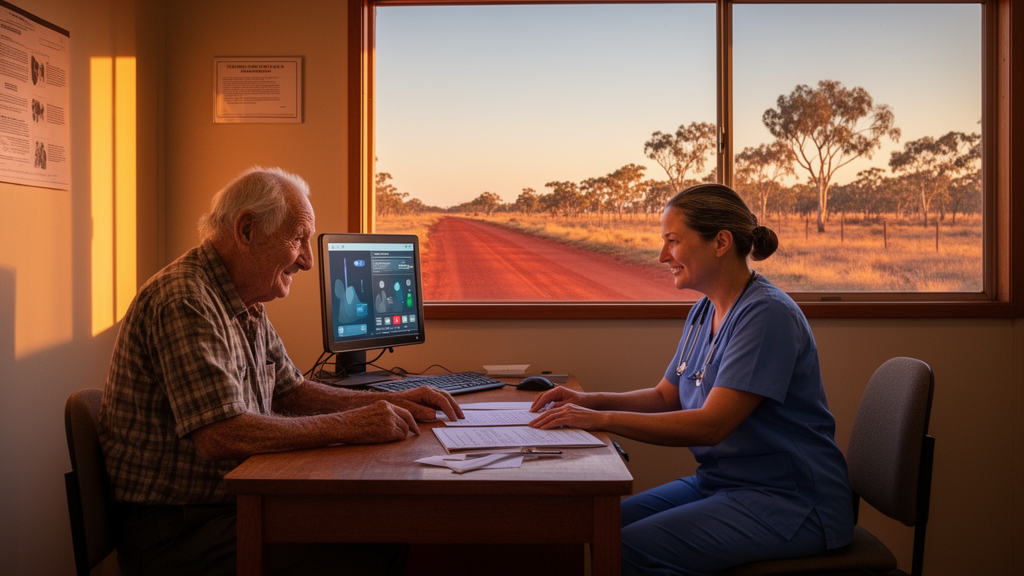
Australia has taken a significant step toward closing one of the most stubborn gaps in modern oncology: the survival divide between people who live in cities and those who live in the bush. In a Viewpoint published in eClinicalMedicine, a team led by Hannah Jongebloed and Anna Ugalde of Deakin University, working within the Equitable Cancer Outcomes across Rural and Remote Australia (ECORRA) research program, describes how the nation’s newest Optimal Care Pathway was built for people living in rural and remote areas with cancer. The document is more than a clinical guide; it is a detailed blueprint for how any health system can construct equity-focused care standards that actually reach the populations who need them most.
The stakes are high and well documented. People living in rural and remote areas experience poorer cancer-specific and all-cause survival compared with their urban counterparts, a disparity confirmed by systematic reviews and meta-analyses that adjusted for clinical factors, demographics and geographical remoteness. The reasons are complex and multifaceted: reduced access to cancer screening and primary care services, diagnostic and treatment delays, limited access to allied health services and clinical trials, and persistent health workforce shortages. A person may live hundreds of kilometres from a radiation oncology unit, may need to relocate temporarily for treatment, and may face fragmented follow-up once they return home. These structural realities mean that a pathway written as if every patient lives next to a metropolitan hospital will simply not translate into better outcomes.
Optimal Care Pathways are Australia’s nationally endorsed guides to best practice cancer care, outlining principles and key care steps for individual cancer types. They are endorsed by Cancer Australia, the national cancer control agency, and publicly available through Cancer Council Australia. With the 2023 release of the Australian Cancer Plan, the country’s equity-focused national cancer policy, ten priority groups experiencing disparities in cancer outcomes were identified, and the plan calls for Optimal Care Pathways to be developed for these population groups as well as for specific cancer types. The rural and remote pathway is one of the first fruits of that policy shift, and its development process offers a rare, transparent look at the mechanics of turning equity rhetoric into a usable policy instrument.
The prescribed development steps are set out in the Optimal Care Pathways Toolkit and the National Optimal Care Pathways Framework: form an expert working group, conduct a literature review, draft the pathway, run a public consultation, design the resources, secure national endorsement and translate the documents into relevant languages. What the new Viewpoint adds is a candid account of how those steps were operationalised in practice, and where standard approaches fall short. The authors frame their recommendations as transferable to any country developing cancer frameworks, guides or standards, whether or not the setting is oncology.
Governance was the first equity lever. More than 30 individuals were appointed to the expert working group, including three people with a lived experience of cancer. Recruitment ran through a national expression of interest circulated at professional meetings and via newsletters, using an online form that captured rurality, demographics, professional background and state or territory. Appointments deliberately reflected the diversity of rural and remote cancer care, and regional and metropolitan-based clinicians were both included, reflecting the importance of understanding referral flows across settings. Two co-chairs were appointed, a medical oncologist and a nurse practitioner, pairing medical and nursing leadership at the top of the process. Critically, the team embedded a reimbursement policy from the outset: members were compensated when participation occurred outside their usual role expectations or standard work hours, and where their organisations permitted payment. The authors argue that compensation functions as an equity lever, enabling the involvement of part-time clinicians, people who would otherwise lose income by participating, and people with lived experience of cancer who might otherwise be excluded by unpaid advisory structures.
The evidence base was assembled with deliberate technical rigour. The literature review was conducted by experts whose knowledge primarily relates to cancer care delivery, and it was structured to mirror the format of the pathway itself, allowing evidence on principles and steps to be integrated directly into the first draft. More than 300 references, predominantly Australian, were reviewed, and the full search strategy, including databases and search terms, was published as a worked example in the supplementary material. A targeted consultation supplemented the formal review: key organisations recommended by government partners and additional stakeholders identified by the project team were invited to reflect on essential considerations for rural and remote patients, recommend relevant resources, policies and programs, and suggest further groups to consult. This dual approach, structured searching plus snowball consultation, was designed to capture grey literature and program-level knowledge that academic databases miss.
Working group meetings themselves were engineered for productivity rather than endurance. Three online meetings were held, each capped at the recommended maximum duration of 2.5 hours: one to review the literature and draft the pathway, one for detailed discussion of key topics, and a third to decide on content following public consultation. An external facilitator coordinated preparation for each meeting, clear agendas were set, opening slides oriented participants to their position in the development process, and an online digital workspace supported real-time collaboration. Virtual breakout rooms enabled targeted small-group discussion, with outcomes reported back for consideration by the full group, and technical support was on hand throughout so meetings continued without interruption. The authors recommend exactly this kind of structured planning, arguing that clearly defined scope, purpose and decision-making objectives for each meeting reduce repetition and keep discussion anchored to policy-relevant decisions.
Two definitional and engagement choices stand out for their practical implications. First, the team adopted an inclusive, flexible definition of rural and remote, recognising that rurality is nuanced and variable: people can live in rural or remote areas yet travel to metropolitan centres for treatment, or stay with friends and family away from home during care. Rather than imposing narrow eligibility criteria, the pathway was designed with end users in mind, so individuals can identify and apply the components relevant to their own circumstances. Second, people with a lived experience of cancer were embedded throughout, not tokenistically: several representatives served on the working group with attention to diversity, dedicated meetings with those representatives were held as needed, and consumer organisations were specifically targeted during public consultation. The authors argue this strengthens the legitimacy, relevance and patient-centredness of the final document.
The public consultation was systematised in a way that other policy developers may find the most immediately transferable element. The consultation format combined closed and open questions, allowing each section of the draft to be rated for agreement while inviting identification of gaps and errors. Open feedback was then coded into four domains that successfully classified every comment received: for adoption, covering evidence-based improvements or removal of inaccuracies; out of scope, covering matters relevant to other priority groups or not focused on best practice care delivery; in scope but not appropriate, such as specific treatment recommendations already covered elsewhere in the pathway; and for discussion by the expert working group. The consultation also surfaced case studies demonstrating best cancer care for potential inclusion. The authors acknowledge an opportunity they did not fully realise: synthesising and publishing consultation outcomes in publicly accessible reports would enhance transparency and formally acknowledge stakeholder contributions.
Finally, the team invested deliberately in non-clinical expertise and in the unglamorous end of the policy pipeline. Independent, experienced facilitators ran the meetings; medical writers ensured a consistent tone and addressed minor feedback; a medical editor conducted a final review; a graphic designer formatted the documents; and professional multicultural translation companies handled translation into other languages, with languages selected based on those commonly spoken within the target population. Although external consultants incurred additional costs, the authors contend this freed the working group to focus on content and represented an efficient model of delivery. They also stress that a pathway is not finished when it is published: planned dissemination through communication strategies, budgeted promotion, structured implementation plans, attention to known barriers in rural health services, and involvement of implementation scientists are all essential to translation into practice. Appointing working group members with established networks and leadership roles, they note, adds further value in spreading the pathway through trusted professional channels. Alignment with measurement and evaluation systems is equally critical, since without indicators capturing adherence and outcomes across population groups, the impact of pathways on equity remains difficult to assess and delays along the care continuum hard to pinpoint.
The broader lesson is that equitable cancer care requires coordinated attention to governance, resourcing, implementation and evaluation, positioning care pathways as active policy instruments rather than static documents. Grounded in the Australian context, the recommendations are designed with the flexibility to be tailored across countries, healthcare systems, population groups and disease contexts. As national cancer plans worldwide increasingly prioritise equity, from the United Kingdom’s NICE guidelines to Canada’s national cancer standards, this account of how one pathway was actually built, who was paid to participate, how feedback was coded, and how meetings were structured, offers a practical template for ensuring that the next generation of care standards reaches the communities experiencing the worst outcomes, not just those closest to the capital cities.
Subject of Research: Development of an equity-focused national cancer care pathway for rural and remote populations in Australia
Article Title: Promoting equitable cancer care: learnings from the development of the Optimal Care Pathway for people living in rural and remote areas with cancer
Article References: Jongebloed, H., Bergin, R. J., Rodi, H., Chapman, A., Honeyball, F., O'Kane, C., Varlow, M., Whittaker, K., Keefe, D., Milch, V., Wright, C., Sergeant, L., Riva, S., Marshall, S., & Ugalde, A. (2026). Promoting equitable cancer care: learnings from the development of the Optimal Care Pathway for people living in rural and remote areas with cancer. eClinicalMedicine, Article 104248. https://doi.org/10.1016/j.eclinm.2026.104248
Image Credits: AI Generated
DOI: 10.1016/j.eclinm.2026.104248
Keywords: cancer care pathways, health equity, rural and remote health, Optimal Care Pathways, Australian Cancer Plan, health policy, public consultation, cancer survival disparities, implementation science, ECORRA, patient involvement, cancer control
Cite Scienmag News
Nathaniel Bowman. (October 15, 2026). How Australia Built a Cancer Care Pathway for Rural and Remote Patients. Scienmag. https://scienmag.com/how-australia-built-a-cancer-care-pathway-for-rural-and-remote-patients/
Nathaniel Bowman. "How Australia Built a Cancer Care Pathway for Rural and Remote Patients." Scienmag, 15 October 2026, https://scienmag.com/how-australia-built-a-cancer-care-pathway-for-rural-and-remote-patients/. Accessed 15 October 2026.
Nathaniel Bowman. "How Australia Built a Cancer Care Pathway for Rural and Remote Patients." Scienmag. October 15, 2026. https://scienmag.com/how-australia-built-a-cancer-care-pathway-for-rural-and-remote-patients/


