


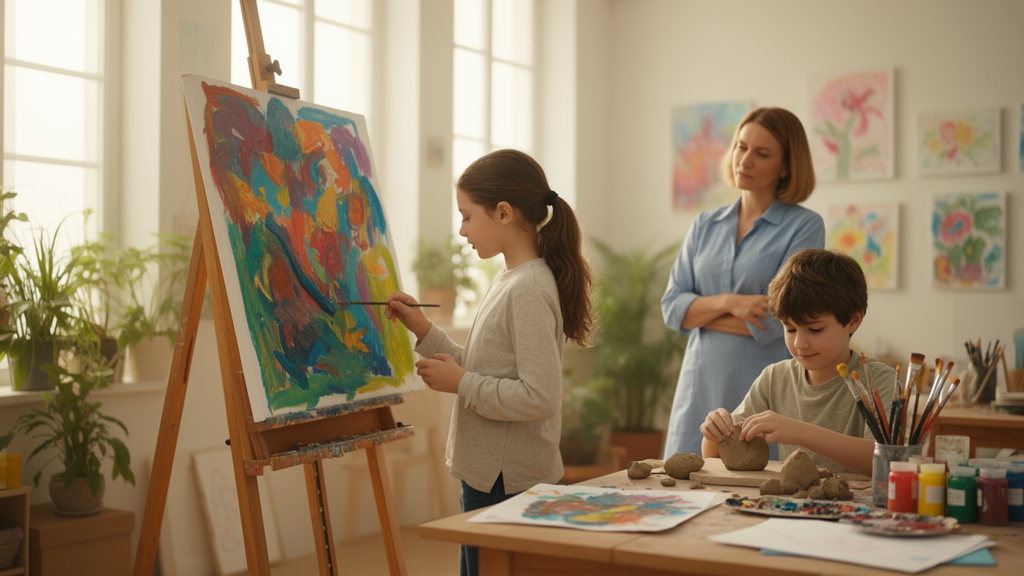
A growing movement in child and adolescent mental health care is turning to the paintbrush, the drum, the sand tray, and the stage as pathways into treatment, and a new collection of research is offering both encouragement and a sobering reality check. An editorial published in Frontiers in Health Services by Weifeng Han of Charles Darwin University and colleagues from Flinders University and the Black Dog Institute at the University of New South Wales synthesizes nine studies examining how visual art, music, movement, drama, play, and other creative forms might support wellbeing in young people. The central premise is deceptively simple: mental health care should not depend only on spoken language. Children and adolescents may have limited, developing, culturally shaped, or disrupted ways of communicating, and when communication difficulties intersect with emotional and behavioral concerns, services that rely heavily on talk can become barriers rather than bridges to help.
The editorial frames the collection around a question that has long divided clinicians and researchers: whether the arts can serve as genuine therapeutics or remain a pleasant but scientifically unproven add-on. The answer that emerges is deliberately cautious. The nine articles, drawn from mental health, education, speech-language pathology, expressive arts, and child development, collectively suggest that creative interventions can open channels of emotional expression, engagement, and relationship that direct verbal discussion often cannot reach. Yet they also reveal a field in which creative practice is expanding faster than the evidence needed to guide its use, with certainty of evidence rated low or very low for most measured outcomes.
Two systematic reviews anchor this cautionary note. Vasilopoulos and colleagues examined 34 studies of arts-inclusive programs for children aged six to twelve years and found that some structured programs showed promising results for stress, wellbeing, and general mental health. However, the certainty of evidence was low or very low for most outcomes, meaning that confidence in the reported effects is limited by study design, sample sizes, and methodological rigor. The review also identified plausible psychological, biological, and social pathways through which artmaking might produce benefit, but critically, none of the included studies formally tested whether these processes caused changes in outcomes. The mechanisms remain hypotheses rather than demonstrated causal chains.
Jankelowitz and colleagues reached strikingly similar conclusions in their review of sand-based therapy, an approach in which clients arrange miniature figures in trays of sand to externalize inner states that are difficult to verbalize. Traditional sand therapy showed promise, but the evidence base carried important design limitations. Perhaps most tellingly for a field racing toward digitalization, the authors found no empirical studies at all of digital sand therapy in children. A practice is migrating to screens and virtual environments before a single controlled trial has established whether the digital version retains the therapeutic properties of the tactile original. Together, these two reviews set a boundary for the entire research topic: enthusiasm is running ahead of evidence.
Why, then, do the editors argue that creative approaches matter despite these evidentiary gaps? Several studies in the collection illustrate what the arts accomplish in practice. Birnkammer and colleagues surveyed therapists in Germany and found that they frequently deployed creative techniques to support emotional expression, engagement, communication, and access to difficult experiences that clients could not otherwise approach. Notably, these techniques were usually associated with a single diagnosis, suggesting that creative methods are being folded into treatment protocols in a piecemeal way rather than understood as a coherent, transdiagnostic modality. The therapists’ experience points to a clinical reality: when words fail, materials, images, and sounds can carry the therapeutic conversation forward.
The perspectives of young people themselves reinforce this picture. Piché and colleagues studied children in an after-school arts program, many from low-income and rural communities, and found that participants valued a safe and supportive environment built through positive relationships with peers, facilitators, and program staff. Their accounts also pointed to three pillars familiar to developmental psychologists as basic psychological needs: autonomy, competence, and relatedness. Gilbert and colleagues reported parallel themes in a school-based program that combined artmaking with philosophical inquiry, where children described connection, collaboration, empathy, respect, and self-awareness. In these settings, art does not simply sit beside care as an enrichment activity; it functions as another route into communication, reflection, and relationships when direct verbal discussion is difficult or insufficient.
The collection also stretches the scope of creative interventions across a wider care continuum, from clinic to classroom to community. Grummitt and colleagues evaluated a whole-school partnership that combined creative expressive therapy for children affected by trauma with structured support for school staff. Students showed improved wellbeing over the course of the program, while teachers reported greater knowledge of trauma-informed practice, indicating that creative therapy embedded in a school system can benefit the surrounding adults as well as the children. Yet the evaluation also surfaced persistent concerns about staffing, cultural differences, and long-term sustainability, the unglamorous logistical questions that often determine whether promising programs survive beyond their pilot phase.
Educational settings in resource-constrained environments feature prominently as well. Jacob and colleagues examined a structured arts-based program for pupils with intellectual disability and reported improved attention after the intervention in their small quasi-experimental study, hinting that creative approaches may support participation and learning in addition to emotional outcomes. Law extends the school focus with a proposed model combining artmaking and human dignity education to support both student and teacher wellbeing. Golden and colleagues zoom out further, situating arts-based activity within the broader youth mental health service landscape and highlighting unequal access, the pivotal role of schools and communities, and the need to involve young people directly in the design of support services.
Equity emerges from the collection not as a side issue but as a central test. Piché and colleagues focus on children from low-income and rural communities; Jacob and colleagues work in a low-resource educational setting; Golden and colleagues document gaps in access and argue for culturally responsive services. Birnkammer and colleagues show that creative methods may help therapists work with racially minoritised young people, while simultaneously identifying clear gaps in racism-informed training. The editorial makes a pointed observation here: creative approaches are not culturally neutral simply because they rely less on speech. Their value depends on trust, cultural knowledge, practitioner skill, and the lived experience of the young people involved, all of which must be deliberately cultivated rather than assumed.
The ultimate message is a call for the field to mature. Moving from canvas to care, the editors argue, requires more than demonstrating that an activity is engaging or promising. Health services must determine who should receive these approaches, who should deliver them, what training is required, how they connect with existing care pathways, and how they can be sustained financially and organizationally. Researchers need to test longer-term outcomes, possible mechanisms, costs, access, and implementation across different cultural and service settings. Young people and families, the editors insist, should have a stronger role in those decisions and be meaningfully involved at all stages of research from conception to dissemination. The next phase of the field should move beyond asking whether the arts support mental health and instead ask for whom they help, through which processes, in which settings, at what level of need, and under what service conditions. That shift, the editorial concludes, is essential if creative practice is to become not only expressive but credible, equitable, and sustainable care.
Subject of Research: Arts-based interventions as multimodal therapeutics in child and adolescent mental health services
Article Title: Editorial: From canvas to care: artistic interventions as multimodal therapeutics in child and adolescent mental health
Article References: Han, W., Wadham, B., Boydell, K. M., Agnew, D., & Hamilton, A. (2026). Editorial: From canvas to care: artistic interventions as multimodal therapeutics in child and adolescent mental health. Frontiers in Health Services, 6, Article 2013940. https://doi.org/10.3389/frhs.2026.2013940
Image Credits: AI Generated
DOI: 10.3389/frhs.2026.2013940
Keywords: arts-based interventions, child and adolescent mental health, creative expression, mental health services, school-based mental health, sand therapy, expressive arts therapy, trauma-informed practice, health equity, evidence certainty, Editorial, canvas
Cite Scienmag News
Glenn Wilkins. (October 15, 2026). Arts-Based Therapies Show Promise for Youth Mental Health but Evidence Lags Behind Practice. Scienmag. https://scienmag.com/arts-based-therapies-show-promise-for-youth-mental-health-but-evidence-lags-behind-practice/
Glenn Wilkins. "Arts-Based Therapies Show Promise for Youth Mental Health but Evidence Lags Behind Practice." Scienmag, 15 October 2026, https://scienmag.com/arts-based-therapies-show-promise-for-youth-mental-health-but-evidence-lags-behind-practice/. Accessed 15 October 2026.
Glenn Wilkins. "Arts-Based Therapies Show Promise for Youth Mental Health but Evidence Lags Behind Practice." Scienmag. October 15, 2026. https://scienmag.com/arts-based-therapies-show-promise-for-youth-mental-health-but-evidence-lags-behind-practice/


