


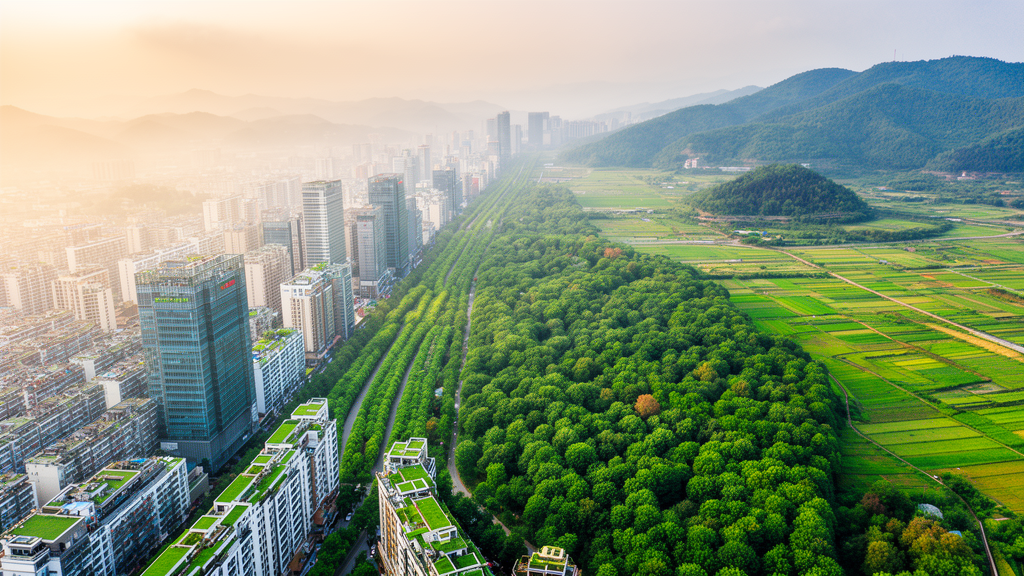
When China launched its National Forest City Construction program in 2004, the goal seemed straightforward enough: plant more trees, conserve forest resources, and weave green infrastructure into the fabric of rapidly expanding cities. Two decades later, more than two hundred cities have earned the National Forest City designation, and the program has become one of the largest urban greening experiments in history. But a fundamental question has lingered beneath the canopy. Does turning a city into a forest city actually make its economy greener and more efficient, or does it merely make it look greener? And perhaps more intriguingly, do the benefits of urban forests stop at municipal boundaries, or do they spill over into neighboring regions? A new study published in Frontiers in Forests and Global Change offers the most comprehensive answer yet, and its findings suggest that the true power of forest cities may lie in places that never planted the trees.
The research team, led by Yudan Wang and Wenlan Wang of Fujian Agriculture and Forestry University along with colleagues at Fujian Business University, assembled a balanced panel dataset covering 277 Chinese cities at the prefecture level or above, spanning nearly two decades from 2006 to 2024. Rather than simply counting trees or measuring air quality, the researchers focused on a more demanding metric: urban green production efficiency, abbreviated GPE. This indicator captures a city’s capacity to generate economic output while constraining both conventional pollutants and carbon emissions, given its inputs of capital, labor, and energy. To compute it, the team employed a slack-based measure directional distance function, a technique from the data envelopment analysis family that can handle so-called undesirable outputs. Real GDP served as the desirable output, while industrial wastewater, sulfur dioxide, smoke and dust, and carbon dioxide emissions entered the model as environmental losses to be minimized. Labor was proxied by year-end employment, capital by real capital stock estimated through the perpetual inventory method in constant 2006 prices, and energy by total electricity consumption. The result is a single efficiency score that rewards cities for producing more economic value while emitting less.
The methodological centerpiece of the study is its treatment of National Forest City Construction as a quasi-natural experiment. Because cities received the designation in different years, the researchers applied a multi-period difference-in-differences framework, comparing cities that earned the title with those that had not yet done so. Crucially, they went a step further by embedding this comparison within a spatial Durbin model, creating an SDM-DID specification that explicitly accounts for the fact that a city’s green production efficiency depends not only on its own policy status but also on that of its neighbors. Spatial econometric diagnostics, including significant Hausman, likelihood-ratio, and Wald tests, confirmed that this spatial specification was warranted. The data also told the same story: global Moran’s I statistics for GPE were positive and statistically significant in nearly every year of the study period, climbing to 0.2945 by 2024, evidence that green efficiency clusters geographically rather than distributing randomly across the urban landscape.
The headline result is clear. National Forest City Construction significantly improves green production efficiency, and the finding survives an unusually thorough battery of robustness checks. But the spatial decomposition of the estimated effects is what makes the study remarkable. The direct effect of the policy on designated cities was approximately 1.28 percent, significant at the 1 percent level. The indirect effect, however, the benefit accruing to spatially connected cities that did not receive the designation themselves, was roughly 3.33 percent, more than two and a half times larger than the local effect. The total effect across the connected urban system reached about 4.61 percent. In other words, most of the policy’s measured impact on green efficiency flows to neighboring cities, a finding that upends the assumption that urban environmental policy is a purely local affair.
The researchers identify three channels through which these spillovers operate. The first is ecological: forests and green spaces are spatially continuous, so improved forest resources, better-connected ecological corridors, and cleaner air in a designated city generate positive externalities that drift across administrative lines, easing environmental pressure in adjacent jurisdictions. The second is informational: forest city designation involves demanding criteria and ongoing assessments covering ecological planning, green infrastructure, and environmental governance, practices that neighboring cities can observe, learn from, and adapt. The third is economic: intercity industrial linkages, technology diffusion, and the mobility of skilled labor allow green development priorities to propagate through supply chains and labor markets. The spatial association term in the model was positive and highly significant, and when the researchers re-estimated the model with a one-year-lagged policy indicator, the indirect effect actually grew to about 4.05 percent, suggesting the spillovers strengthen over time.
Skeptics of quasi-experimental policy evaluation will appreciate the rigor of the robustness section. An event-study analysis confirmed the parallel trends assumption: pre-policy coefficients fluctuated around zero, with a joint test yielding F equals 1.173 and a p-value of 0.311, while effects turned positive and trended upward after designation. Because staggered treatment timing can bias conventional two-way fixed-effects estimates when policy effects are heterogeneous, the team also applied the Callaway and Sant’Anna estimator, obtaining an average treatment effect on the treated of 0.0275, significant at the 1 percent level. Five hundred placebo replications, in which treated cities were randomly reassigned, produced coefficient distributions centered on zero, with the true estimates landing at the 96th percentile or above. Propensity score matching, alternative spatial weight matrices based on geographic distance, exclusion of the four centrally administered municipalities, and controls for three concurrent environmental policies all left the core conclusions intact.
The study also probes the conditions under which the policy works best, and here the answers are more nuanced. Green technological innovation, measured through green invention patent applications, and industrial structure upgrading, proxied by the ratio of tertiary to secondary sector value added, both significantly strengthened the local effect of forest city designation on green production efficiency. Cities with stronger innovation capacity and more advanced industrial structures are better positioned to translate ecological governance requirements into energy savings, cleaner production, and improved resource allocation. Notably, however, neither moderator significantly shaped the spatial spillover effect. The diffusion of policy benefits across cities appears to depend more on ecological externalities and the spread of governance practices than on local technological or industrial conditions, which are deeply rooted in each city’s own economic base and difficult to transmit across boundaries in the short term.
Geography matters as well. In inland cities, both the local policy coefficient, estimated at 0.0185, and the spatially lagged coefficient were positive and significant, indicating that forest city construction delivers direct local gains as well as regional benefits. In coastal cities, the pattern flips: the local coefficient of 0.0035 was not statistically significant, but the spatial spillover was strong. The authors attribute this asymmetry to structural differences between the two regions. Coastal cities are more densely connected, with closer industrial ties, more frequent technology exchange, and greater factor mobility, so policy effects propagate readily across their networks. Inland cities, by contrast, often have greater headroom for improvement in green infrastructure and resource-use efficiency, so designation-driven investment translates more directly into local efficiency gains. The lesson is that the same policy can produce genuinely different geographies of benefit depending on regional connectivity and developmental starting points.
For policymakers in China and beyond, the implications are substantial. The evidence supports sustaining forest city programs and shifting their emphasis from sheer quantity of green space toward ecological quality, connectivity, and long-term maintenance. It also argues for pairing urban forestry with investments in green technology and industrial restructuring to amplify local returns, and for tailoring regional strategies: inland cities should deepen ecological infrastructure while coastal cities should leverage their dense intercity networks for coordinated planning and information sharing. Perhaps most importantly, the finding that indirect spillover effects exceed direct ones makes a compelling economic case for cross-regional collaborative governance, from shared ecological corridors to joint pollution prevention, since the benefits of any single city’s greening are enjoyed, measurably and significantly, by its neighbors. As cities worldwide grapple with decarbonization under tight fiscal constraints, China’s forest cities suggest that green investment may pay dividends across an entire urban system, not just within the municipality that makes it.
Subject of Research: Spatial spillover effects of China's National Forest City Construction policy on urban green production efficiency
Article Title: Spatial spillover effects of urban forest policy on urban green production efficiency: evidence from China’s National Forest City Construction
Article References: Wang, Y., Rao, W., Zheng, Z., Shi, Q., & Wang, W. (2026). Spatial spillover effects of urban forest policy on urban green production efficiency: evidence from China’s National Forest City Construction. Frontiers in Forests and Global Change, 9, Article 1941730. https://doi.org/10.3389/ffgc.2026.1941730
Image Credits: AI Generated
DOI: 10.3389/ffgc.2026.1941730
Keywords: urban forestry, green production efficiency, National Forest City, spatial spillovers, difference-in-differences, spatial Durbin model, China, green technological innovation, industrial structure upgrading, carbon emissions, ecological governance, urban sustainability
Cite Scienmag News
Sloane Callahan. (October 15, 2026). China’s Forest Cities Boost Green Efficiency Far Beyond Their Own Borders. Scienmag. https://scienmag.com/chinas-forest-cities-boost-green-efficiency-far-beyond-their-own-borders/
Sloane Callahan. "China’s Forest Cities Boost Green Efficiency Far Beyond Their Own Borders." Scienmag, 15 October 2026, https://scienmag.com/chinas-forest-cities-boost-green-efficiency-far-beyond-their-own-borders/. Accessed 15 October 2026.
Sloane Callahan. "China’s Forest Cities Boost Green Efficiency Far Beyond Their Own Borders." Scienmag. October 15, 2026. https://scienmag.com/chinas-forest-cities-boost-green-efficiency-far-beyond-their-own-borders/


