


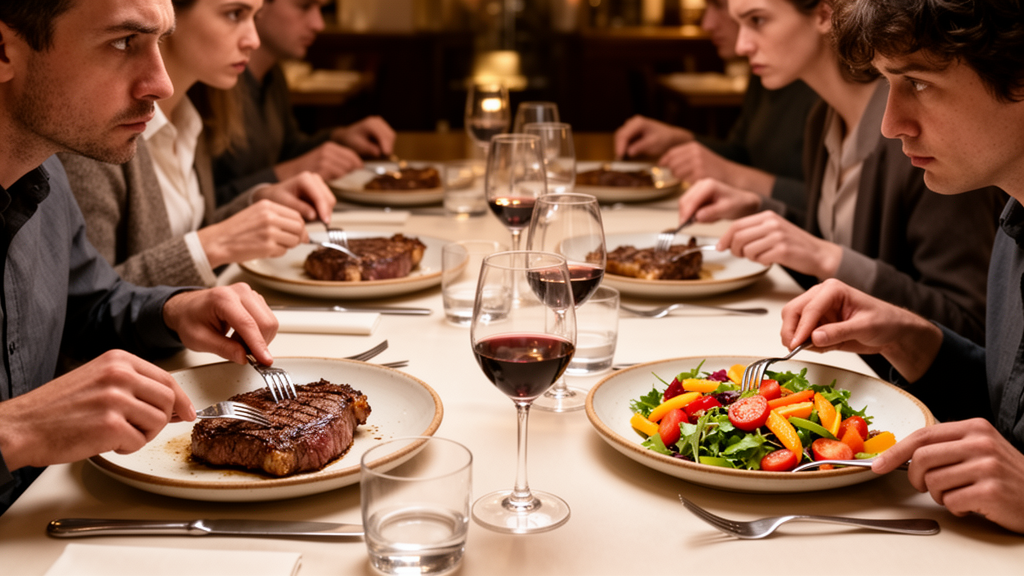
Conspiracy theories about vegetarians and vegans are no longer confined to the fringes of the internet. From claims of a so-called soy globalism supposedly engineered to weaken populations, to narratives that plant-based diets are part of a plot by global elites to control what ordinary people eat, suspicion of the meat-free movement has become a recognizable feature of contemporary culture wars. A new series of studies by psychologists at the Polish Academy of Sciences, published in Frontiers in Social Psychology, offers one of the first systematic attempts to explain why some meat-eaters interpret the growing popularity of vegetarianism and veganism through a conspiratorial lens while others simply disagree with it. The answer, the researchers report, lies in a defensive and insecure form of group identity known as collective narcissism.
The research team, led by Dominika Adamczyk together with Natalia Korczak and Marta Marchlewska, defined veg*n conspiracy beliefs as convictions that vegans and vegetarians secretly seek to manipulate and control individuals and societies by restricting meat consumption and imposing a single dietary ideology. This goes well beyond ordinary criticism. Someone might question the nutritional profile of a plant-based burger or debate the environmental footprint of different diets without invoking hidden actors. Conspiracy beliefs, by contrast, involve allegations of secret, coordinated actions by powerful and malevolent forces. The distinction matters, the authors argue, because the two phenomena likely have different psychological roots and different social consequences.
The theoretical starting point was collective narcissism, a construct first formalized in social psychology in 2009. Unlike secure group pride, collective narcissism is characterized by a belief that one’s group is exceptional and uniquely deserving of recognition, yet is chronically underappreciated and disrespected by others. Decades of research have linked this defensive identity to heightened sensitivity to intergroup threat, aggressive reactions to criticism, and endorsement of conspiracy theories portraying the ingroup as the target of hostile plots. National collective narcissism has been tied to beliefs that a 2010 plane crash in Poland was a Russian conspiracy, that climate science is fabricated by elites in France, and that the 2016 American election was stolen. The Polish team wondered whether the same mechanism operates around something as seemingly mundane as diet.
Food, after all, is far from apolitical. Dietary practices express values, connect people to communities, and serve as markers of social identity. Previous research has shown that vegetarians and vegans tend to be more liberal and egalitarian, less conservative, lower in right-wing authoritarianism and social dominance orientation, and higher in empathy than omnivores. Because morally motivated lifestyle choices can implicitly challenge the moral adequacy of the majority’s habits, meat-eaters often react defensively, perceiving vegans as judgmental or arrogant. Meat consumption is also symbolically linked to masculinity and dominance in many cultures, adding a gendered dimension to the perceived threat. In this charged context, the researchers hypothesized that people with a narcissistic attachment to meat-eaters as a group would be especially prone to seeing the plant-based movement as a coordinated, hostile enterprise.
To test this, the team conducted three studies among meat-eaters in Poland, using nationwide probability samples. The first study surveyed 1,011 participants and measured meat-eater collective narcissism with adapted items such as meat-eaters deserve special treatment, alongside ordinary meat-eater identification, a newly developed nine-item scale of veg*n conspiracy beliefs, national narcissism and identification, right-wing authoritarianism, and social dominance orientation. The conspiracy scale included items proposing that the vegan movement is striving to take control of the food production system, that restricting access to meat is part of a broader strategy to control societies worldwide, and that covert dietary indoctrination targets children from meat-eating families in schools. The scale proved highly reliable, and factor analysis supported a single underlying dimension.
The results were striking. Meat-eater collective narcissism predicted veg*n conspiracy beliefs even after accounting for ordinary identification with meat-eaters, national narcissism, national identification, authoritarianism, and social dominance orientation. Crucially, plain meat-eater identification showed no unique effect once narcissism was controlled. In other words, it is not simply belonging to the dietary majority that fuels conspiratorial suspicion; it is a defensive, entitled version of that belonging. Interestingly, secure national identification was negatively associated with the conspiracy beliefs, hinting that non-narcissistic forms of group attachment may actually protect against conspiratorial interpretations of social change.
The second study moved from correlation to experiment. Roughly 800 participants were randomly assigned to read one of two fabricated articles. The experimental article framed meat consumption as natural, socially important, and unfairly criticized, emphasizing that meat-eaters are increasingly portrayed negatively despite representing a historically normal and healthy way of life. The control article described how eating habits are diverse and shaped by many factors, without any identity-boosting content. The manipulation worked: participants who read the boosting article reported higher meat-eater collective narcissism, and, critically, they also endorsed veg*n conspiracy beliefs significantly more strongly than the control group. This experimental finding suggests that inflating defensive group pride can causally increase conspiratorial thinking about the dietary outgroup, not merely accompany it.
The third study, with 569 participants, extended the analysis to a darker outcome: blatant dehumanization. Using the Ascent of Man measure, in which participants rate how evolved they consider various groups on a visual scale from ape to modern human, the researchers assessed how far vegans and vegetarians were pushed down the evolutionary ladder. Meat-eater collective narcissism predicted dehumanization of vegns, and this relationship was partially mediated by vegn conspiracy beliefs. The indirect effect held even after controlling for general conspiracy thinking, authoritarianism, social dominance orientation, and national identity measures. The pattern suggests a psychological pathway in which defensive identity threat gives rise to narratives of a secret, malevolent movement, which in turn license seeing members of that movement as less than fully human.
The authors are careful about the limits of their claims. All three studies were conducted in Poland, a society where meat consumption remains dominant, so generalization to other cultural contexts is an open question. The mediation model in the third study is theoretically grounded but cross-sectional, meaning alternative explanations, such as conspiracy beliefs and dehumanization being parallel outcomes of collective narcissism, cannot be ruled out. The experimental study also suffered from a high exclusion rate due to failed attention checks, a known challenge of online survey research. Future work, the team suggests, should test whether similar mechanisms operate among vegans themselves, whether masculinity threat amplifies the effect, and whether interventions that strengthen analytical thinking or highlight shared superordinate identities can dampen the conspiratorial response.
Even with those caveats, the findings carry a broader message about how social change is received. When food becomes a marker of group identity, disagreements over what people eat can extend far beyond personal preference and become a source of conspiracy thinking and intergroup hostility. The researchers note that history offers abundant examples of dietary practices becoming symbols of larger conflicts, from religious prohibitions to political battles over food production. Their results suggest that advocates of dietary change face a delicate challenge: promoting new norms without triggering the perceptions of intergroup threat that transform disagreement into paranoia. Understanding that conspiracy beliefs about vegans may function as a defensive shield for a threatened identity could help design communication strategies that reduce hostility rather than deepen the divide between the dinner-table camps of modern society.
Subject of Research: Psychological links between meat-eater collective narcissism, vegan conspiracy beliefs, and dehumanization of vegetarians and vegans
Article Title: Another one bites the dust? Threatened meat-eater identity and veg*n conspiracy beliefs
Article References: Adamczyk, D., Korczak, N., & Marchlewska, M. (2026). Another one bites the dust? Threatened meat-eater identity and veg*n conspiracy beliefs. Frontiers in Social Psychology, 4, Article 1899432. https://doi.org/10.3389/frsps.2026.1899432
Image Credits: AI Generated
DOI: 10.3389/frsps.2026.1899432
Keywords: collective narcissism, conspiracy beliefs, veganism, vegetarianism, meat consumption, social identity, dehumanization, intergroup relations, right-wing authoritarianism, social dominance orientation, dietary identity, Poland
Cite Scienmag News
Daisy Hatcher. (October 15, 2026). Why Some Meat-Eaters See Vegans as Part of a Secret Plot. Scienmag. https://scienmag.com/why-some-meat-eaters-see-vegans-as-part-of-a-secret-plot/
Daisy Hatcher. "Why Some Meat-Eaters See Vegans as Part of a Secret Plot." Scienmag, 15 October 2026, https://scienmag.com/why-some-meat-eaters-see-vegans-as-part-of-a-secret-plot/. Accessed 15 October 2026.
Daisy Hatcher. "Why Some Meat-Eaters See Vegans as Part of a Secret Plot." Scienmag. October 15, 2026. https://scienmag.com/why-some-meat-eaters-see-vegans-as-part-of-a-secret-plot/


