


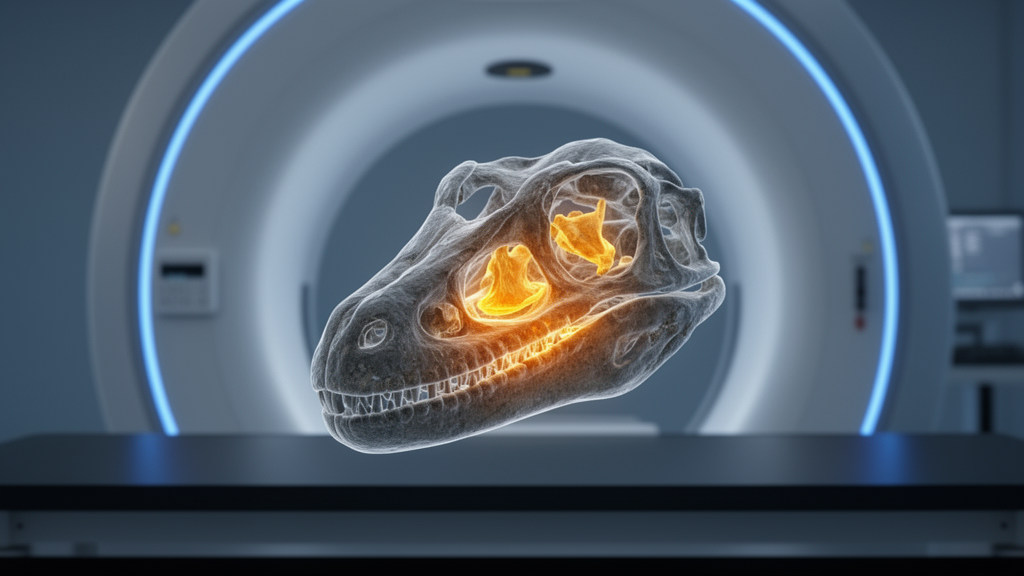
Deep in the Karoo rocks of South Africa, a single fossil skull has been quietly holding a secret about how mammal-like animals learned to breathe and chew at the same time. Now, high-resolution CT scans of that specimen have revealed it in unprecedented detail, and the findings show that one of the most important innovations on the road to mammals evolved more than once, by different anatomical routes.
The fossil belongs to Choerosaurus dejageri, an enigmatic therocephalian therapsid that lived roughly 259 million years ago during the late Permian period. Therocephalians are close relatives of cynodonts, the group that gave rise to mammals, and baurioid therocephalians in particular evolved strikingly mammal-like features. Yet while their Triassic descendants have been studied extensively, the Permian members of the clade remain poorly known, and Choerosaurus has not received a detailed anatomical description since it was first briefly characterized in 1929.
A team led by Alessandro Gigliotti of Humboldt-Universität zu Berlin and the Museum für Naturkunde Berlin, working with colleagues from Princeton University, the North Carolina Museum of Natural Sciences, and the University of the Witwatersrand, has now changed that. The researchers CT-scanned the holotype specimen, SAM-PK-8797, housed at the Iziko South African Museum in Cape Town, using a Phoenix VTomeX L240 system with an isotropic voxel size of just 0.050 millimeters. That resolution allowed them to digitally segment and reconstruct bones that had previously been obscured by matrix or crushed beyond recognition, including the previously obscure palatal region at the roof of the mouth.
Choerosaurus is a strange animal even by therocephalian standards. Uniquely among its kind, it sports exaggerated hemispheric bosses on its cranium and lower jaw, structures that earlier CT-assisted work suggested were used in display behavior or low-energy combat, possibly covered by a cornified sheath and deployed in intimidation or ritualized sexual behavior. The new reconstruction confirms these bosses consist of two distinct types of spongy bone, a cancellous hollowed core and a denser outer layer traversed by radially oriented canals, and that their surfaces are perforated by numerous foramina likely associated with branches of the infraorbital nerve, supporting a tactile role in display.
But the real headline concerns the palate. The secondary palate, the bony shelf that separates the nasal passage from the oral cavity, is a hallmark of mammals, allowing simultaneous mastication and respiration. Within synapsids, the broader group that includes mammals and their extinct relatives, a closed secondary palate evolved independently multiple times: once in anomodonts, several times in therocephalians, and again early in cynodont history. The new study shows that Choerosaurus captures a crucial transitional stage in the therocephalian version of this story.
In Choerosaurus, the vomer, a midline bone of the snout, plays the role of an important bracing element in the palate. It forms a long sutural connection with the medially projecting shelves of the maxilla, a structure the researchers call the maxillo-vomerine bridge, which extends from the level of the upper canine to around the level of the third upper postcanine. This differs markedly from the early cynodont condition, where the palate is built instead from the medial projections of the maxillae and palatines, with the vomer excluded from the external palatal surface. The contrast highlights that therocephalian and cynodont secondary palates have different evolutionary origins despite their similar function.
The team also found that the palatal morphology of Choerosaurus closely resembles that of Lycideops longiceps, another lycideopid baurioid, supporting the hypothesis of a close relationship between the two taxa. Lycideopidae currently includes just four species, and the family is of particular importance because it exemplifies the evolutionary trajectory of non-cynodont therapsids across the Permo-Triassic boundary, showing a trend toward smaller body sizes and more delicate skulls, an instance of the so-called Lilliput Effect following the end-Permian mass extinction.
The functional significance of the palate may explain why it kept evolving independently. The researchers argue that similar selective pressures likely underpinned its origin in different lineages: strengthening the snout, providing an enhanced surface for food processing, and maintaining respiratory function during food intake. In predatory forms, trends toward palatal closure may have been tied to increasing bite force or prey handling techniques like lateral head shaking. In herbivorous forms, such as the bauriid therocephalians that were the only successful Triassic radiation of the group, a more resistant palatal surface may have helped process high-fiber forage. Notably, in cynodonts the secondary palate is also considered a prerequisite for innovations such as higher metabolic rates, endothermy, and suckling behavior, but this level of physiological integration did not occur in therocephalians or anomodonts, which went extinct during the Triassic.
The description of the Choerosaurus palate is a contribution to understanding the initial evolutionary history of synapsid secondary palate development, building on recent comprehensive sampling of the earliest cynodonts. The authors note that future CT-assisted descriptive research targeting other early baurioids and non-dicynodont anomodonts, along with more functional and paleoecological studies, will be needed to understand the selective pressures underlying these changes. For now, a single crushed skull from the Karoo has shown that the road to the mammalian palate was paved more than once, and by different bones each time.
Subject of Research: Paleontology
Article Title: Cranial anatomy of the baurioid therocephalian Choerosaurus dejageri with comments on secondary palate convergence in therocephalians and cynodonts
Article References: Gigliotti, A., Pusch, L. C., Kammerer, C. F., Benoit, J., & Fröbisch, J. (2026). Cranial anatomy of the baurioid therocephalian Choerosaurus dejageri with comments on secondary palate convergence in therocephalians and cynodonts. Frontiers in Mammal Science, 5, Article 1869886. https://doi.org/10.3389/fmamm.2026.1869886
Image Credits: AI Generated
DOI: 10.3389/fmamm.2026.1869886
Keywords: therocephalian, Choerosaurus dejageri, secondary palate, convergent evolution, CT scanning, Permian, therapsids, Lycideopidae, paleontology, Karoo, Cranial, anatomy
Cite Scienmag News
Gavin Prescott. (October 15, 2026). CT scans reveal how a bizarre 259-million-year-old beast built its palate differently from mammals’ ancestors. Scienmag. https://scienmag.com/ct-scans-reveal-how-a-bizarre-259-million-year-old-beast-built-its-palate-differently-from-mammals-ancestors/
Gavin Prescott. "CT scans reveal how a bizarre 259-million-year-old beast built its palate differently from mammals’ ancestors." Scienmag, 15 October 2026, https://scienmag.com/ct-scans-reveal-how-a-bizarre-259-million-year-old-beast-built-its-palate-differently-from-mammals-ancestors/. Accessed 15 October 2026.
Gavin Prescott. "CT scans reveal how a bizarre 259-million-year-old beast built its palate differently from mammals’ ancestors." Scienmag. October 15, 2026. https://scienmag.com/ct-scans-reveal-how-a-bizarre-259-million-year-old-beast-built-its-palate-differently-from-mammals-ancestors/


