


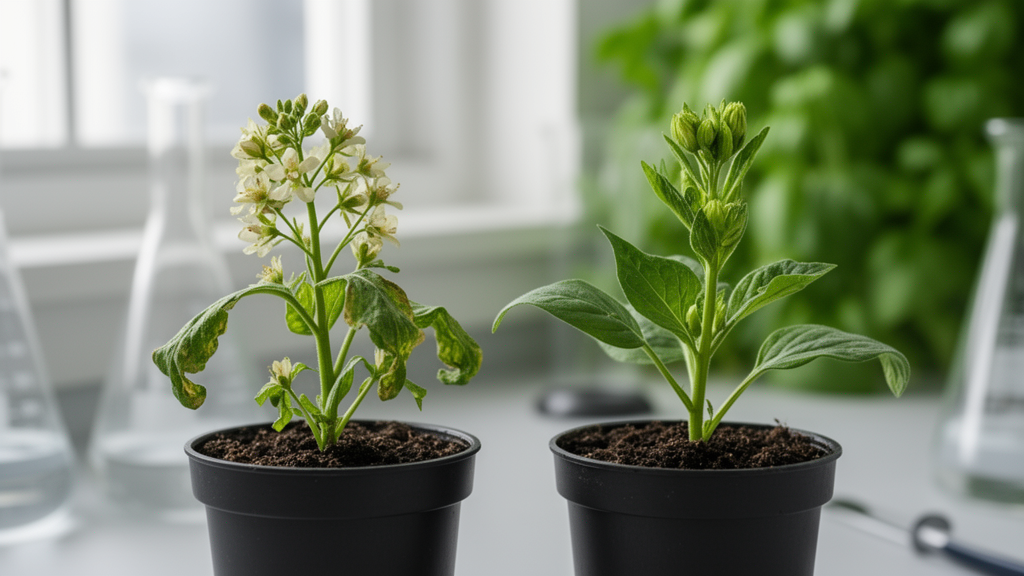
In the quiet war between plants and their environment, one of the most overlooked battle lines runs straight through the sexes. Roughly six percent of all flowering plants are dioecious, meaning individual plants are either male or female, and a sweeping new review argues that the way these sexes divide up scarce resources under drought, heat, salinity, and shade is far more intricate, and far more context-dependent, than decades of textbook generalizations have suggested. Writing in Frontiers in Photobiology, botanist Yash Mangla of Kirori Mal College, University of Delhi, synthesizes evidence from willows and poplars to sea buckthorn and aquatic tape-grass, showing that sexual dimorphism in plants is not a fixed trait but a shifting strategy sculpted by the abiotic world.
The logic begins with reproduction itself. Male and female plants fulfil fundamentally different functions: males invest heavily in flowers and pollen to maximize dispersal, while females channel resources into fewer flowers, seeds, and fruits to guarantee successful seed set. Because fruiting is so expensive, females carry a higher reproductive cost, and this biased partitioning of carbon, nitrogen, phosphorus, and water gives rise to differences in morphology, physiology, and life history that scientists call sexual dimorphism. Under optimal light and water conditions, these differences may barely register. But the moment stress appears, the sexes diverge sharply in photosynthetic efficiency, stress tolerance, and growth, and those divergences can determine whether a population survives.
Water is the clearest case study. Across species from dwarf willow to sea buckthorn, females cluster in mesic, nutrient-rich habitats while males dominate xeric, nutrient-poor sites, a pattern known as the spatial segregation of sexes that reflects niche specialization. In Salix glauca, both sexes grow more slowly at dry sites, but female growth rates fall significantly below those of males, suggesting that limited water diminishes nutrient uptake and photosynthesis especially in females, forcing a trade-off between vegetative growth and reproduction. In Pistacia lentiscus, females facing summer drought retain older leaves and reduce new leaf production compared with males, conserving resources for fruit formation in a water-limited environment. Yet the pattern is not universal: in box elder, drought favors females, whose deeper roots access groundwater and produce female-biased sex ratios, while in Populus cathayana females are more drought-sensitive than males. The direction of the response is species-specific.
Light tells an equally nuanced story. Because taller plants capture most of the light, scarcity triggers shade-avoidance responses driven by a lowered red-to-far-red ratio, and competition for light is asymmetrical in a way that water competition is not. In the annual herb Mercurialis annua, higher density reduced plant length, biomass, and reproductive allocation in both sexes, but the reduction hit females harder, reflecting a greater trade-off as they prioritize carbon acquisition and seed maturation. In Pistacia lentiscus, males show higher quantum yield and carbon assimilation than females only under low irradiance, while in Amaranthus palmeri the sexes are physiologically identical under ambient light but diverge under high intensity, where females possess lower chlorophyll content and flower earlier to maximize reproduction. Even the Mediterranean dwarf palm Chamaerops humilis shows sex-specific photoinhibition only during warm-dry summers, with females suffering higher photoinhibition and lower leaf water content while supporting their reproductive phase.
Aquatic plants add a surprising twist. In the dioecious macrophyte Vallisneria, photosynthesis actually increases with water depth, because shallow water causes light inhibition rather than scarcity. Females display more phenotypic plasticity than males across depths, adjusting leaf length, spathe number, and flowering ramets, while males maintain constant reproductive allocation. Both sexes invest equally in clonal propagation through tubers and stolons, but the trade-off with sexual reproduction is evident only in females, who reserve carbon for seed and fruit production. The review notes that this mirrors the differential plasticity documented in woody and herbaceous land plants, suggesting that female reproductive assurance strategies operate even underwater.
Nutrient currencies sharpen the picture. Carbon is generally considered the best currency for assessing allocation in limiting environments, and females rely heavily on carbon, nitrogen, and water for fruit and seed production, while males invest more nitrogen in pollen, making carbon less limiting for male reproduction. In Rubus chamaemorus, female flowers have lower dry mass and nutrient content than male flowers, yet the nitrogen and phosphorus content of fruit is many times that of male flowers. Salix glauca females show roughly four times higher phosphorus allocation than males, and female Amaranthus palmeri accumulate more nitrogen, phosphorus, potassium, and magnesium in stems than males. These patterns support the generalization that higher allocation in females demonstrates the higher cost of reproduction and a female-specific strategy for seed filling and fruit formation.
Temperature and salinity complicate matters further. Elevated temperature increases males in the herbaceous Valeriana edulis but females in the woody Populus cathayana, effects that are species-specific and even variable within a genus. In Populus tomentosa, females adapt better to high temperatures than males, while Populus trichocarpa shows no intersexual differences at all. Under combined salinity and water stress, female Populus tomentosa suffer greater reductions in leaves, stems, biomass, and total leaf area than males, and female Populus deltoides show lower reactive oxygen species scavenging ability. Yet in Salix linearistipularis the pattern reverses: female cuttings exhibit higher superoxide dismutase and peroxidase activities, higher photosynthetic capacity, lower hydrogen peroxide content, and lower sodium accumulation in leaves, making them more salt-tolerant than males. The review emphasizes that combined stresses may be far more pronounced than each acting independently, changing the magnitude of physiological specialization between sexes.
Perhaps the most provocative section asks whether stress is even necessary for physiological specialization to appear. In Amaranthus palmeri, Salix glauca, and Populus tomentosa, sex-specific responses in chlorophyll content, stomatal conductance, and photosynthetic nitrogen-use efficiency emerge only under drought, high light, or nutrient deficiency, suggesting that specialization is a stress-induced strategy rather than an intrinsic trait. But contrasting studies exist: in Pistacia lentiscus, females show higher water-use efficiency under stress despite lower photosynthetic rates, and in Clusia hilariana, a tree growing under extreme solar irradiance, wind, and heat in coastal Brazil, leaf parameters do not vary between sexes at all. Even Populus tremula shows no evidence of sexual dimorphism in non-reproductive traits. The review proposes that the stage of dioecy evolution may matter, with weak dimorphism reflecting early evolutionary stages, though this hypothesis remains untested.
Competition adds another layer. Although it is a biotic factor, competition interacts intimately with abiotic gradients, and the review shows that competitive ability is sex-specific and context-dependent. In Populus cathayana, females show higher growth rates and outcompete male seedlings under intersexual competition, accumulating more biomass and showing higher photosynthetic capacity. But in Osyris quadripartita, competition is asymmetrical and males are inhibited by neighboring females, while in Mercurialis annua both intra- and intersexual competition affect male aboveground growth but not female growth. Under light limitation and intersexual competition, females trade vegetative allocation for reproductive allocation, reiterating their attempts at successful reproduction. Warming even reverses intersexual interactions in mulberry, shifting from competition to facilitation in mixed-sex plantings.
The review’s conclusion is a caution against overgeneralization. Sexual dimorphism in plants manifests at multiple levels, from sex-specific physiological specialization to skewed sex ratios and clonality, yet its extent is so species-specific that broad generalizations are unsuitable. Generalizations made today may not hold tomorrow, because the plasticity responses exhibited by dioecious plants are themselves context-dependent and likely to shift under climate change. The author highlights crucial lacunae: underground structures such as roots, runners, and suckers remain understudied, anatomical and ultrastructural investigations have been largely neglected, and the genetic and molecular bases of resource allocation in relation to abiotic factors have not been examined in detail. For conservation strategies, agroforestry restoration, and weed management, the message is clear: the sexes of a dioecious species must be understood as distinct ecological entities, each with its own adaptive strategy, and any management plan that treats them as interchangeable risks misreading the very biology that keeps these species alive.
Subject of Research: Plant Biology
Article Title: Sexual dimorphism and pattern of resource allocation under variable abiotic factors
Article References: Mangla, Y. (2026). Sexual dimorphism and pattern of resource allocation under variable abiotic factors. Frontiers in Photobiology, 4, Article 1914724. https://doi.org/10.3389/fphbi.2026.1914724
Image Credits: AI Generated
DOI: 10.3389/fphbi.2026.1914724
Keywords: sexual dimorphism, dioecy, resource allocation, abiotic stress, drought, plant physiology, ecology, climate change, Sexual, dimorphism, pattern, resource
Cite Scienmag News
Gavin Prescott. (October 15, 2026). Why Male and Female Plants Fight Stress Differently. Scienmag. https://scienmag.com/why-male-and-female-plants-fight-stress-differently/
Gavin Prescott. "Why Male and Female Plants Fight Stress Differently." Scienmag, 15 October 2026, https://scienmag.com/why-male-and-female-plants-fight-stress-differently/. Accessed 15 October 2026.
Gavin Prescott. "Why Male and Female Plants Fight Stress Differently." Scienmag. October 15, 2026. https://scienmag.com/why-male-and-female-plants-fight-stress-differently/


