


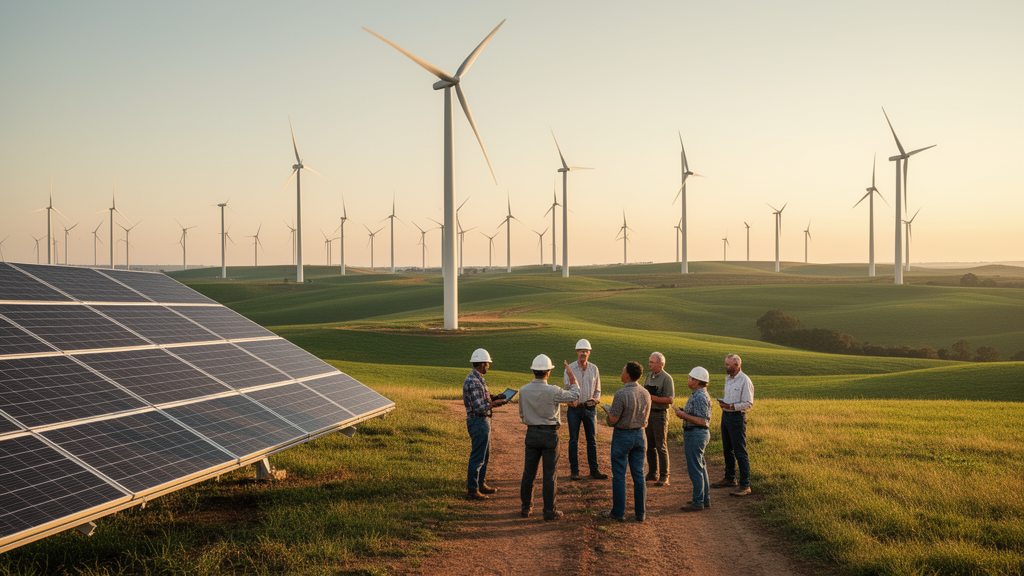
For more than a decade, policymakers have treated the green, digital and just transitions as three strands of a single, self-reinforcing project: decarbonize the economy, digitize its infrastructure, and make sure nobody is left behind. A new review published in Frontiers in Sustainable Energy Policy argues that this comfortable narrative hides an uncomfortable truth. Drawing on 28 real-world cases from across the globe, a team at the AIT Austrian Institute of Technology in Vienna shows that the triple transition is riddled with tensions—between speed and fairness, between centralized planning and local realities, between what models predict and what communities actually experience—and that the way researchers study those tensions determines which ones get seen, and which get ignored.
The study, led by Vitaliy Soloviy and colleagues at AIT’s Center for Innovation Systems and Policy, is unusual in its method. Rather than championing a single discipline, the authors deliberately assembled a team spanning innovation studies, sociology, economics, political science, engineering, cognitive science and the arts, then asked how each tradition would diagnose the same problem: the frictions that arise when green, digital and just transition priorities collide in real energy systems. Their answer is a map of five distinct research perspectives, each with its own vocabulary, assumptions and blind spots.
The first perspective, which the authors call constructing realities, draws on political ecology, critical geography and ontological politics. From this vantage point, tensions emerge at the most basic level of what counts as reality and whose realities matter. The case studies are stark. In northern Norway, Sámi reindeer herders resisted wind farms because the state’s division of land into cultivated and outlying categories simply did not match the Sámi concept of meahcci—a living landscape of humans, animals and tasks unfolding in place and time. In California, the Colorado River Indian Tribes watched a 250-megawatt solar project on their traditional lands deliver rushed procedures, performative consultations and intertribal conflict instead of the promised jobs and infrastructure. In Portugal, lithium mining for batteries has been advanced, researchers found, through social engineering, deception and counterinsurgency tactics—a clash, in the authors’ words, between ecologies of commoning and an extractivism that drives depletion and exclusion.
The second perspective, governing transitions, comes from sustainability transitions scholarship and institutional theory. Here, tensions are not ontological clashes but problems of steering: how new technologies such as smart grids force established institutions and emerging actors to renegotiate rules, roles and beliefs. The cases show how this plays out. In Antwerp, Belgium, researchers embedded for eighteen months in a living lab of shared solar projects found a paradox at the heart of energy justice governance: the pursuit of inclusivity was paired with the deliberate exclusion of some groups to avoid overwhelming them with participation demands. Studies of smart city initiatives in Singapore, Finland, Spain and Colombia revealed how digital platforms can expand formal participation while concentrating data flows and decision-making power in the hands of incumbents—utilities, grid operators and platform providers already well positioned in energy markets.
The third perspective, negotiating meanings, treats transition itself as a contested word. Concepts like green, digital and just can function as floating signifiers whose meanings shift with context, and actors compete to fix or deliberately keep open what they mean. In Germany’s coal exit, one study traced how labor unions deployed the language of a slow and responsible just transition to reinforce the status quo, while climate movements invoked urgency—leaving the transition stalled between competing justice claims. In Spain’s coal regions, media analysis showed the meaning of justice shifting from justice is coal to justice is time to justice is money as unions lost bargaining power and the pace of renewables expansion accelerated. And in Ireland, peat workers who lived through the closure of two major power plants experienced just transition as political rhetoric: retraining programs that rarely met their needs, and new renewable-energy jobs in their region to which they had no access.
The fourth perspective, reasoning by numbers, is the one most familiar to science-policy interfaces: quantitative modeling, optimization and statistical analysis. The review shows that models are never neutral. In Australia, a modeling framework built on six equity factors found that pacing fossil-fuel plant closures to benefit vulnerable communities produced a different sequence of shutdowns than a standard cost-curve approach—and that adding equity parameters shifted preferred options in some locations from solar to wind. In Uganda, a multi-objective optimization of the national power system showed that the cheapest path would leave some areas behind and worsen existing disparities, while improving equality would raise costs by only about 3 percent and diversify the technology mix. In the United States, coupling a national power-sector model with community-level air pollution data revealed that Black communities face higher pollution exposures, and that resolving this requires variables beyond cost optimization. Even pay-as-you-go energy access in sub-Saharan Africa, the review notes, turns quantification into a mechanism that moderates who gets electricity: credit-scoring algorithms can leave the poorest households trapped in cycles of intermittent service.
The fifth perspective, reimagining transitions, is the most unconventional: art-based research, speculative design and storytelling. The authors argue that grief, pride and loss—the emotional textures of transition—are rarely given space in policy debates, even though they matter deeply to those affected. In Oakland, California, artistic activism within the anti-coal movement—from singing and poetry to clothes design—gave the movement an identity, increased engagement, and brought less-represented groups into decision-making. In Latin America, artistic storytelling projects advanced energy sovereignty and territorial autonomy, framing energy as a relational phenomenon rather than a mere commodity. And drone imagery combined with computer visualizations, one study found, can give Indigenous communities in Native America and Australia a visceral way to counter corporate narratives about renewable development on their lands.
Comparing across the five perspectives, the authors identify recurring contestation axes that cut through all of them. There is reinforcement versus reconfiguration: every actor wants to preserve something, whether traditional livelihoods, nuclear power or gas dependence. There is spatio-temporal contestation: politicians think in electoral cycles, investors in payback periods, residents in the texture of everyday life, and ecosystems in recovery timescales that dwarf all of them. There is the tension between center and periphery, where centralized actors impose standardized solutions—wind farms, reskilling programs—that may overlook local knowledge and vulnerabilities. And there is the generic versus the specific: tensions acquire particular meaning only in the contexts where they unfold, embedded in distinct social relations and institutions.
The review also catalogs strategies for navigating tensions, grouped into four orientations: defensive, offensive, flexible and collaborative. The same strategy can serve opposite ends. Participatory monitoring can mitigate emerging tensions or manufacture an illusion of participation. Delaying transitions can protect land, ecosystems and culture—or protect capital and incumbent power structures. Transparent modeling can build trust, while opaque modeling can mislead. Even pluriversal and transdisciplinary approaches designed to include multiple worldviews can be captured and manipulated by incumbents. The authors’ point is not that any strategy is inherently good or bad, but that context determines whether resistance comes from communities resisting injustice or from incumbents resisting change—and that effective navigation requires a flexible, modular repertoire rather than a single playbook.
The deeper message of the study is about how knowledge itself is legitimized. Each perspective tends toward certain forms of legitimation—expert judgment for modelers, emotional resonance for artists, argumentation for discourse analysts—and each brings certain tensions to the surface while obscuring others. The authors argue that science-policy interfaces, which tend to prioritize a narrow set of methods and vocabularies, should instead treat tensions as constitutive features of transformation rather than failures of policy design. Shifting between perspectives, recombining and sequencing them, they suggest, can be used proactively to achieve more just and collectively desirable outcomes. For researchers, the invitation is to expand their theoretical and methodological apparatus; for policymakers, it is to engage productively with multiple types of knowledge when comparing strategic options. The energy transition, on this reading, is not a problem to be solved with either-or choices, but a landscape of competing realities, meanings and futures—one that demands reflexive, inclusive and imaginative navigation.
Subject of Research: Energy transitions research reveals five distinct disciplinary perspectives on the tensions within the triple transition agenda
Article Title: Leveraging tensions of the triple transition for future-fit energy pathways: Interdisciplinary analysis and response strategies
Article References: Soloviy, V., Haindlmaier, G., Kubeczko, K., Knöbel, S., Bernstein, M. J., & Dinges, M. (2026). Leveraging tensions of the triple transition for future-fit energy pathways: Interdisciplinary analysis and response strategies. Frontiers in Sustainable Energy Policy, 5, Article 1686783. https://doi.org/10.3389/fsuep.2026.1686783
Image Credits: AI Generated
DOI: 10.3389/fsuep.2026.1686783
Keywords: energy transition, triple transition, just transition, digitalization, interdisciplinary research, energy policy, sustainability science, Leveraging, tensions, triple, transition, future-fit
Cite Scienmag News
Sloane Callahan. (October 15, 2026). Five Ways of Seeing the Energy Transition: Why the Green, Digital and Just Agendas Collide—and What to Do About It. Scienmag. https://scienmag.com/five-ways-of-seeing-the-energy-transition-why-the-green-digital-and-just-agendas-collide-and-what-to-do-about-it/
Sloane Callahan. "Five Ways of Seeing the Energy Transition: Why the Green, Digital and Just Agendas Collide—and What to Do About It." Scienmag, 15 October 2026, https://scienmag.com/five-ways-of-seeing-the-energy-transition-why-the-green-digital-and-just-agendas-collide-and-what-to-do-about-it/. Accessed 15 October 2026.
Sloane Callahan. "Five Ways of Seeing the Energy Transition: Why the Green, Digital and Just Agendas Collide—and What to Do About It." Scienmag. October 15, 2026. https://scienmag.com/five-ways-of-seeing-the-energy-transition-why-the-green-digital-and-just-agendas-collide-and-what-to-do-about-it/


