


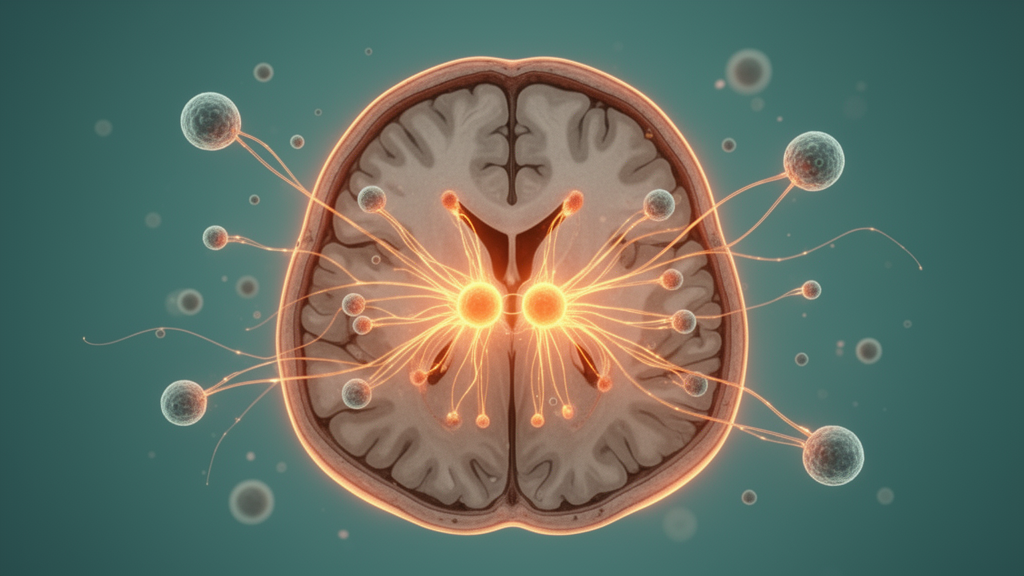
Deep in the floor of the brain’s third ventricle, a thin layer of cells called tanycytes has long been known as a gatekeeper of metabolism. These ependymoglial cells line the mediobasal hypothalamus and extend processes into the arcuate nucleus and median eminence, a circumventricular organ where the blood–brain barrier is unusually permeable. Tanycytes sense circulating hormones and nutrients, remodel the local vasculature, and regulate the access of metabolic signals to hypothalamic circuits that govern fertility, energy balance and endocrine output. Now, a study published in Nature Metabolism by Sreekala Nampoothiri, Vincent Prevot and colleagues at Univ. Lille, Inserm and collaborating institutions across France, Germany and Spain reveals that these cells carry out another, unexpected job: they act as an immune interface, mounting a cyclic interferon response that rises and falls with the ovarian cycle and reaches out to shape the composition of the circulating immune system.
The team built its case on single-cell transcriptomics. Using both single-cell and single-nucleus RNA sequencing, the researchers generated a high-resolution cellular map of the mouse and human mediobasal hypothalamus, then integrated the two datasets computationally in a shared latent space to compare tanycytes across species. The integration workflow, based on deep generative models and probabilistic label transfer, allowed them to annotate eight tanycyte subclusters in the human tissue that correspond to subclusters defined in the mouse. Among these, one subcluster stood out. In both species, the T8 tanycyte state was enriched for genes associated with innate immunity, showing robust activation of interferon-α and interferon-γ response pathways and expression of downstream interferon-stimulated genes. In other words, a cell type conventionally classified as glia carries a transcriptional programme that resembles an immune cell state, and this programme is conserved between mouse and human hypothalamus.
What makes the finding striking is its dynamics. In female mice, the abundance and activity of this immune-associated tanycyte state changed across the oestrous cycle. The researchers captured sex-, oestrous cycle- and high-fat diet-dependent transcriptomic shifts in tanycytes, and found a cyclic expression of the gene encoding interferon regulatory factor 7 (Irf7), a master transcription factor of the interferon signalling family, together with downstream interferon-stimulated genes such as Cxcl10, a chemokine that recruits leukocytes. Spatial validation by RNAscope fluorescent in situ hybridization showed that Irf7 mRNA transcripts concentrated in defined ventricular regions of the arcuate nucleus and median eminence, and that regions containing CD45-high infiltrating leukocytes spatially coincided with zones of elevated Irf7 and Cxcl10 expression. In physiological males, by contrast, Irf7 expression in tanycytes remained stable and markedly lower, suggesting that cycling females mount a distinct pattern of immune activation in the brain that is tied to the changing hormonal milieu of the cycle, particularly oestradiol.
The mechanistic thread connecting oestradiol to interferon signalling runs through kinases. Upstream kinase analysis of oestradiol-regulated phosphosites in tanycytes identified TBK1 and IKKε, the canonical kinases that phosphorylate IRF7, as top hits with negative kinase statistics and high specificity scores, indicating that oestradiol treatment suppresses the activity of these IRF7-activating kinases. At the same time, imaging of NF-κB reporter mice revealed that κ-EGFP-positive tanycytes in the arcuate nucleus and median eminence increased at oestrus compared with diestrus, and that vimentin-stained tanycyte processes contacted κ-EGFP-positive microglia and CD45-positive immune cell complexes near vessels. Oestradiol thus appears to engage both the NF-κB and interferon regulatory signalling axes in tanycytes and in the immune cells of the median eminence, positioning these glial cells as integrators of endocrine and inflammatory signals at the brain’s metabolic gateway.
To test whether this cyclic immune programme matters functionally, the team manipulated oestrogen and interferon signalling in tanycytes. Ovariectomy with and without oestradiol replacement altered serum oestradiol levels and changed tanycytic IRF7 activity and leukocyte infiltration into the median eminence. The data support a model in which balanced, cyclic leukocyte infiltration into the median eminence may have a role in maintaining the oestrous cycle itself. This is a provocative idea: rather than viewing immune cell traffic across the permeable median eminence as pathological inflammation, the study suggests that a controlled, hormone-gated influx of leukocytes could be part of the physiological machinery that supports reproductive cycling, with tanycytes orchestrating the timing through interferon-dependent chemokine release.
The reach of tanycytic IRF7 extends beyond the brain. By selectively depleting Irf7 in tanycytes using an adeno-associated viral vector carrying an Irf7 short hairpin RNA, delivered into the lateral ventricle with a Dio2 promoter-driven Cre recombinase that restricts recombination to tanycytes, the researchers generated mice with tanycyte-specific Irf7 knockdown. RNAscope quantification confirmed the reduction of Irf7 mRNA transcripts in the knockdown animals. Flow cytometry of circulating blood then revealed that Irf7 in tanycytes modulates the proportions of circulating monocytes, the classical, intermediate and non-classical subsets that patrol vessels and migrate into tissues. Neutrophils, eosinophils, natural killer cells and T cell populations were unchanged, indicating a selective effect on the monocyte compartment. The finding provides direct evidence of brain-to-immune system communication through tanycytes, echoing earlier work showing that hypothalamic sensing of metabolic state regulates circulating monocytes.
How could glial cells lining a brain ventricle influence the blood immune compartment? The most plausible route lies in the anatomy of the median eminence, where tanycytes form the blood–hypothalamus barrier and contact both the portal vasculature and the cerebrospinal fluid. Tanycytes release chemokines such as CXCL10 in an interferon-dependent manner, and their processes extend toward vessels and immune cell complexes in the arcuate nucleus. Signalling through this interface could alter the cytokine milieu that reaching monocytes encounter, or modify endothelial and perivascular cues that determine monocyte egress from the bone marrow and patrolling behaviour in the bloodstream. The study also documented cyclic cytokine responses, with serum concentrations of inflammatory cytokines measured across the oestrous cycle, and found that interferon-γ pathway components, including Ifng, Tbx21 and the interferon-γ receptor subunits, were expressed in the mediobasal hypothalamus, providing potential ligand–receptor pairs that could drive the tanycytic interferon programme during the cycle.
The cross-species dimension of the work strengthens its relevance to human biology. Human tanycyte subclusters predicted by the computational integration showed the same enrichment of interferon-α and interferon-γ response pathways and interferon-stimulated gene expression in the human T8 state as in the mouse. The human samples came from single-nucleus sequencing of the mediobasal hypothalamus of donors, including donors with Alzheimer’s disease, frontotemporal dementia, type 2 diabetes and chronic myelomonocytic leukemia, and the descriptive analyses showed that the immune-associated tanycyte state was present across sexes and pathological conditions. Because sex-biased differences in metabolic and immune function are shaped by endocrine–immune interactions, the identification of a conserved, hormone-responsive immune programme in tanycytes offers a cellular substrate for understanding why many inflammatory, metabolic and neurodegenerative diseases show sex-biased incidence and progression.
Technically, the study exemplifies the current generation of single-cell neuroscience. The researchers used scVI-based deep generative modelling to integrate mouse and human datasets, scANVI for probabilistic label transfer of tanycyte subclusters, SCENIC for transcription factor regulon inference that identified the Irf7 regulon and its two target subnetworks enriched for innate immune and interferon-related functions and for antigen presentation and leukocyte activation, and scProportionTest with permutation-based cell-level statistics to quantify changes in subcluster abundance between conditions. Spatial transcriptomic validation with published hypothalamic atlases and RNAscope in situ hybridization anchored the cell states to defined anatomical zones along the anteroposterior axis of the third ventricle. Kinome assays with serine–threonine phosphosite analysis connected oestradiol to the IRF7 phosphorylating kinases. The combination of computational and spatial methods, together with physiological follow-up of body weight, fat mass and blood glucose in the sequenced animals, gives the findings a solid technical footing.
The implications reach toward several frontiers. If cyclic interferon signalling in tanycytes gates leukocyte traffic into the median eminence and shapes circulating monocyte proportions, then disruptions of this programme, whether by chronic high-fat diet, by loss of ovarian hormones, or by pathological inflammation, could alter both reproductive function and systemic immune regulation. The study’s observation that high-fat diet feeding changed tanycytic transcriptomic states, and that the immune-associated state responded to diet and cycle in combination, suggests that metabolic disease may reprogramme the brain’s immune interface. Conversely, the tanycyte degeneration linked to impaired tau clearance in recent work hints that these cells also participate in neurodegenerative pathology. By revealing an immune-associated role for tanycytes and a conserved, oestradiol-responsive IRF7 programme that communicates between brain, body and immune system across the ovarian cycle, the study opens a new chapter in neuroendocrine immunology, one in which the glial border of the metabolic brain is not merely a barrier but an active, hormone-gated immune organ.
Subject of Research: IRF7 signalling in tanycytes controls brain–body–immune response across the ovarian cycle
Article Title: IRF7 signalling in tanycytes controls brain–body–immune response across the ovarian cycle
Article References: IRF7 signalling in tanycytes controls brain–body–immune response across the ovarian cycle. (n.d.). https://doi.org/10.1038/s42255-026-01635-4
Image Credits: AI Generated
DOI: 10.1038/s42255-026-01635-4
Keywords: IRF7, signalling, tanycytes, controls, brain, body, immune, response, across, ovarian, cycle, scientific research
Cite Scienmag News
Cassandra Pierce. (October 15, 2026). IRF7 signalling in tanycytes controls brain–body–immune response across the ovarian cycle. Scienmag. https://scienmag.com/irf7-signalling-in-tanycytes-controls-brain-body-immune-response-across-the-ovarian-cycle/
Cassandra Pierce. "IRF7 signalling in tanycytes controls brain–body–immune response across the ovarian cycle." Scienmag, 15 October 2026, https://scienmag.com/irf7-signalling-in-tanycytes-controls-brain-body-immune-response-across-the-ovarian-cycle/. Accessed 15 October 2026.
Cassandra Pierce. "IRF7 signalling in tanycytes controls brain–body–immune response across the ovarian cycle." Scienmag. October 15, 2026. https://scienmag.com/irf7-signalling-in-tanycytes-controls-brain-body-immune-response-across-the-ovarian-cycle/


