


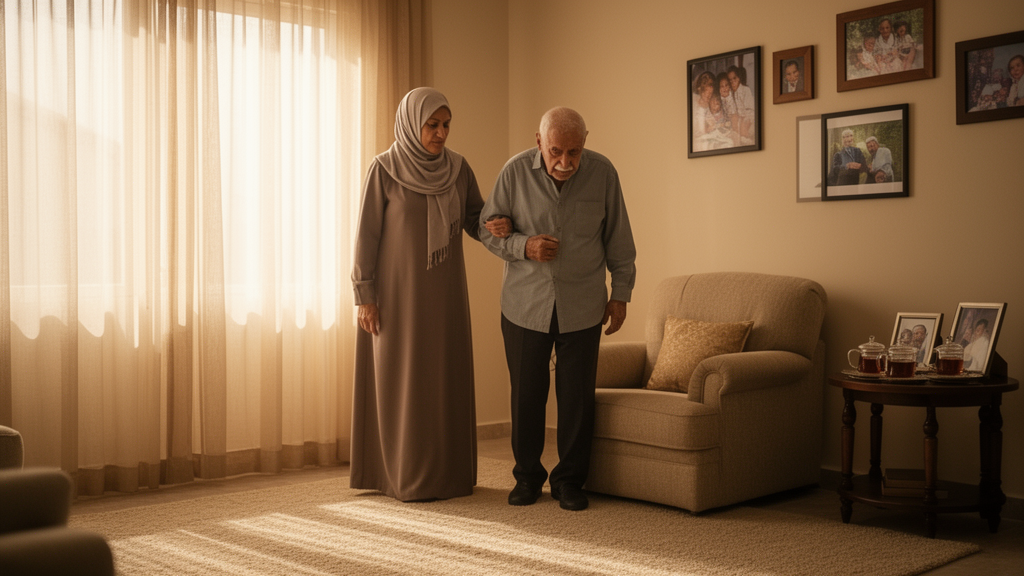
Dementia is quietly becoming one of the defining public health challenges of the twenty-first century. As populations age, the global prevalence of the condition is projected to double roughly every twenty years, straining health systems, families, and the invisible workforce of informal caregivers who sustain patients day after day. A new study from Qatar, published in Frontiers in Dementia, offers a rare quantitative window into just how heavy that invisible load can be, even when patients receive professional nursing support at home.
The research, led by a team from Hamad Medical Corporation’s Private Nursing Services (PNS) program in Doha, set out to measure the burden experienced by caregivers of dementia patients receiving home-based private nursing care. While PNS currently provides professional nursing for 146 dementia patients across Qatar, the program depends fundamentally on family members, friends, and paid or unpaid caregivers who manage patients’ daily needs. The investigators wanted to know how these individuals fare physically, emotionally, socially, and financially, and whether demographic factors shape the strain they endure.
Methodologically, the team employed a descriptive cross-sectional design that functioned as a census of the entire available caregiver population under PNS. Of 146 caregivers approached during routine home visits, 101 completed the full survey, yielding a response rate of 69.1 percent. The central instrument was the Zarit Burden Interview (ZBI), a validated 22-item multidimensional tool that assesses caregiver strain across emotional, physical, social, and financial domains. Each item is scored on a five-point Likert scale from zero, indicating no burden at all, to four, indicating extreme burden, with total scores ranging from 0 to 88. The ZBI has demonstrated robust internal consistency in dementia caregiving contexts, with reported Cronbach’s alpha values between 0.85 and 0.93, making it one of the most reliable measures available for this purpose. Surveys were self-administered in English via digital tablets in patients’ homes, taking roughly ten to fifteen minutes to complete, and were accompanied by sociodemographic questions covering age, gender, education, relationship to the patient, living arrangements, and daily caregiving hours.
The statistical picture that emerged is sobering. The average ZBI score was 42.8 with a standard deviation of 19.6, a level the researchers classify as moderate to severe caregiving challenge. In total, 36.6 percent of caregivers reported moderate to severe burden, and 18.8 percent faced severe burden outright. Only 14.9 percent fell into the minimal burden category. The caregivers themselves were predominantly female, making up 75.2 percent of the sample, with a mean age of 43.2 years. Most were either Arab or Asian in nationality, and 43.6 percent dedicated between 16 and 24 hours daily to caregiving, with a mean caregiving duration of several years per patient.
Item-level responses reveal where the strain concentrates most acutely. A striking 34 percent of caregivers rated the lack of personal time as severely burdensome, and 35 percent described feeling overtaxed with responsibilities at a moderate level. Roughly a quarter reported a moderate loss of control over their lives, and nearly a third expressed uncertainty about how to care for their relative. Feelings of inadequacy were pervasive: 29 percent said they felt they should do more for their patient, and 32 percent reported extreme burden over whether they could do a better job of caring. Health concerns emerged as a major theme, with 22 percent reporting extreme burden over their own health, while privacy and social relationships were strained, with 21 percent rating the impact on family connections and personal privacy as extreme. Financial worries were also prevalent, with 22 percent expressing moderate to severe fears about not having enough money to sustain care, and a similar proportion doubting their ability to continue caregiving at all.
Perhaps the most poignant finding concerns dependence. When asked how much their loved one depended on them as a caregiver, 37 percent reported extreme burden, the single highest concentration of extreme responses across all ZBI items. This total dependence, the authors suggest, captures the existential weight of dementia caregiving, where the patient’s cognitive and functional decline leaves caregivers feeling that every responsibility falls on them alone. Notably, anger and embarrassment were less prominent, with 45 and 44 percent of caregivers respectively reporting no burden from these emotions, hinting that the burden in this population is rooted more in exhaustion, anxiety, and loss of self than in shame or resentment.
Two demographic variables stood out as statistically significant predictors of burden. Education level showed a clear protective gradient: 73 percent of caregivers with graduate or higher education experienced minimal burden, compared to only 26 percent of those with secondary education. Conversely, 49 percent of caregivers with secondary school education and 42 percent of illiterate caregivers reported moderate to severe burden, a difference that reached statistical significance at p equals 0.019. The researchers interpret this disparity as evidence that higher education equips caregivers with better problem-solving skills, emotional resilience, and access to support networks, consistent with prior international literature showing that educated caregivers navigate challenges more effectively and are more likely to access formal support services.
Relationship to the patient also mattered profoundly, with spouses bearing the heaviest toll. Among the 13 spousal caregivers in the sample, 37 percent reported severe burden, compared to just 11 percent of siblings and 16 percent of other relatives, a difference significant at p equals 0.011. No spousal caregiver fell into the minimal burden category. This pattern echoes meta-analytic evidence that spousal caregivers face unique challenges, including the loss of companionship, heightened role strain, and the emotional weight of watching a life partner decline. In Gulf societies, where spousal and family caregiving is often framed as a moral and religious duty, cultural expectations may further intensify this strain, leaving spouses with little psychological permission to step back or seek relief.
Interestingly, several variables that might intuitively seem important did not reach statistical significance. Age, gender, nationality, living arrangements, daily caregiving hours, and years of caregiving all failed to show significant differences in ZBI scores across their levels, although the trend data suggest that caregivers dedicating 16 to 24 hours daily reported numerically higher burden. The authors caution that the relatively small sample size, the cross-sectional design, and the self-report format limit causal inference and generalizability. The English-language survey requirement may also have introduced selection bias, and the study did not adjust for dementia severity, behavioral symptoms, or patient functional status, all of which are established drivers of caregiver strain.
The findings arrive at a moment of regional reckoning. Comparable studies in Saudi Arabia, Kuwait, and the United Arab Emirates report similarly high emotional and financial strain among dementia caregivers, suggesting that caregiver burden is a shared challenge across Gulf countries demanding coordinated policy responses. Qatar has already taken proactive steps through its National Dementia Plan and initiatives led by the Qatar Alzheimer’s Society, which aim to position dementia as a national priority and provide robust support mechanisms for caregivers. The authors argue that these efforts should now be expanded with targeted interventions, including structured caregiver education and training programs, accessible respite care services, counseling and peer support groups, and financial assistance such as subsidies and financial planning support. They also point to emerging global evidence that psychosocial interventions and mobile health tools can effectively reduce caregiver stress, approaches that could be adapted to the Qatari context.
Ultimately, the study underscores a truth that dementia research has been converging on for years: the wellbeing of the patient and the wellbeing of the caregiver are inseparable. When caregivers collapse under the weight of exhaustion, isolation, and financial instability, the quality of care patients receive inevitably suffers. By integrating caregiver-focused services into Qatar’s healthcare infrastructure and aligning them with the National Dementia Plan, policymakers can ensure culturally appropriate and sustainable support. The researchers call for future studies to examine shared caregiving responsibilities and strategies to address the logistical challenges of caregiving, hoping that a more complete understanding of caregiver experiences will translate into better lives for both those who give care and those who receive it.
Subject of Research: The burden among caregivers who are caring for patients with dementia admitted under private nursing services
Article Title: The burden among caregivers who are caring for patients with dementia admitted under private nursing services
Article References: Abdo, A. A. M., Manalo, E. L. C., Santander, L., Samaco, J., Aler, M., Benny, M., Okemmuo, D., Bacal, M. K., Swedan, S., & Singh, K. (2026). The burden among caregivers who are caring for patients with dementia admitted under private nursing services. Frontiers in Dementia, 5, Article 1873575. https://doi.org/10.3389/frdem.2026.1873575
Image Credits: AI Generated
DOI: 10.3389/frdem.2026.1873575
Keywords: burden, caregivers, caring, patients, dementia, admitted, under, private, nursing, services, scientific research
Cite Scienmag News
Cassandra Pierce. (October 15, 2026). Spouses and lower-educated caregivers bear the heaviest dementia burden in Qatar. Scienmag. https://scienmag.com/spouses-and-lower-educated-caregivers-bear-the-heaviest-dementia-burden-in-qatar/
Cassandra Pierce. "Spouses and lower-educated caregivers bear the heaviest dementia burden in Qatar." Scienmag, 15 October 2026, https://scienmag.com/spouses-and-lower-educated-caregivers-bear-the-heaviest-dementia-burden-in-qatar/. Accessed 15 October 2026.
Cassandra Pierce. "Spouses and lower-educated caregivers bear the heaviest dementia burden in Qatar." Scienmag. October 15, 2026. https://scienmag.com/spouses-and-lower-educated-caregivers-bear-the-heaviest-dementia-burden-in-qatar/


