


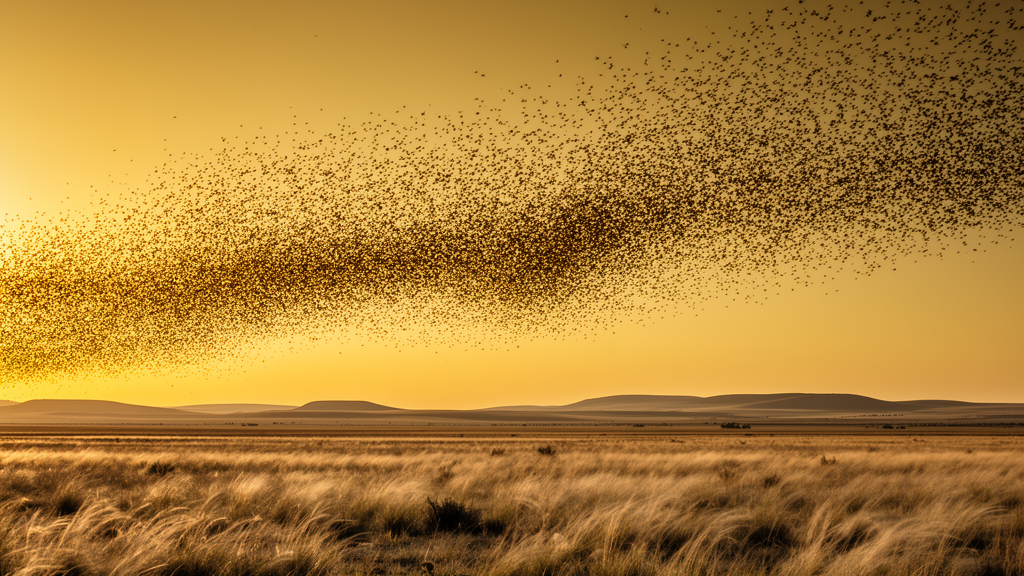
After nearly six decades of quiet, the South American locust, Schistocerca cancellata, erupted back onto the agricultural landscape in 2015, forming dense nymphal bands and flying swarms across Argentina, Paraguay, and Bolivia. A new analysis of the 2015–2025 upsurges, published in the Journal of Orthoptera Research, reveals that these outbreaks were not isolated events but the visible surface of a regional migratory circuit that shuttles locust populations back and forth between Argentina and its northern neighbors. The findings reshape how scientists and pest managers understand one of the hemisphere’s most destructive insect pests.
During the first half of the twentieth century, the South American locust was a scourge of staggering scale. Swarms invaded territory stretching from Bolivia across to Brazil and south into central Argentina, devastating pastures and crops. Historical plagues began with localized breeding in a traditional outbreak area centered on the provinces of Catamarca and La Rioja in northwest Argentina. Following the model of preventive programs developed in Africa in the 1940s, Argentina implemented a similar management strategy in the 1950s, combining regular monitoring with targeted treatments of bands and swarms. Often covering only a few thousand hectares, these operations kept the pest at low to moderate numbers for decades, and plagues became a memory rather than a recurring threat.
That stability eroded. When locust numbers remain low for long periods, monitoring programs face mounting budget pressure, a pattern documented in Argentina during the 1980s. Researchers suggest that continuing reductions in surveillance and control may have contributed to the failure to predict the swarms that suddenly appeared in Santiago del Estero in July 2015. What followed was a sustained population explosion, with widespread nymphal bands and adult swarms occupying much of the species’ historical recession area. The new study set out to reconstruct the sequence of breeding generations before and since that upsurge, asking whether lapses in monitoring or other factors drove the expansion.
To answer that question, the researchers analyzed locust occurrence records from the plant protection agencies of Argentina, Paraguay, and Bolivia, drawing on data about locust stage and behavior, including marching nymphal bands, flying adult swarms, oviposition, and migration. The locust season runs from August to July, with adults in diapause through the winter months. Once diapause ends, adults remain immature until green vegetation, triggered by the first rains of the season, allows maturation and egg laying. The team modeled the timing of egg, nymph, and adult development using temperature-dependent rates from earlier and recent studies, combining them with rainfall records from sixteen regularly reporting weather stations: ten in Argentina, three in Bolivia, and three in Paraguay. Where nymphs appeared, localized breeding had followed rainfall, egg laying, and hatching, allowing the researchers to map the seasonal rhythm of each upsurge.
The data reveal a striking pattern of alternation. Between 2015 and 2020, locusts were sometimes in Argentina, sometimes in Paraguay and Bolivia, and sometimes in both. On several occasions, including mid-2017, mid-2019, early 2020, and mid-2020, a decline in one region coincided with an immediate increase in the other, signaling a regular exchange of populations between the two areas. The 2015–2020 upsurge finally collapsed under a severe drought, but when rains returned in 2022–23, a second upsurge began in early 2024 with breeding in both regions and continued into 2025. Two distinct upsurges, one mechanism.
The seasonal detail is revealing. In the 2016–17 season, more than 600 survey transects in Argentina yielded only five swarms, a result initially credited to successful control. But in early 2017, large numbers of swarms appeared in Paraguay and Bolivia, at least partly the product of locusts migrating north from Argentina at the end of the previous season. Bolivia treated 16,000 hectares after January 2017 reports, and Paraguay declared a state of emergency as thousands of hectares were treated against nymphs. The following winter, swarms from Paraguay invaded northern Argentina in late June 2017, spreading through Formosa, Chaco, and Santiago del Estero, with additional invasions from Bolivia into Jujuy and Salta. A similar sequence repeated in 2019 and 2020, when swarms pushed as far east as Corrientes and Entre Ríos, prompting Brazil to declare a phytosanitary emergency and Uruguay to go on maximum alert.
Perhaps the most intriguing finding concerns the return journey. Southward migrations into Argentina were well documented, but northward movements went largely undetected. The evidence is indirect but compelling: after intense treatment campaigns against nymphs in 2016 and 2018, very few swarms materialized, yet reports of isolated adults remained abundant for weeks. The researchers conclude that adult locusts begin migrating out of Argentina within a week or two of reaching adulthood, much like the desert locust and the Australian plague locust. Because the spring generation develops asynchronously, with egg laying stretched over a month or more, fledging and departure are so protracted that the migrants escape notice both when leaving Argentina and when arriving in Paraguay and Bolivia. Some flights may also have occurred at night; swarms were observed flying after dark near the Bolivian border in late 2016 and near the Paraguayan border in March 2020. The Monte de Sierras y Bolsones ecoregion, a corridor of shrub-steppe valleys running parallel to the Andes, may have provided an ecological highway for these northward movements.
Why has the geography of outbreaks changed so dramatically? The study points to the extensive clearing of the Grand Chaco forest. Satellite imagery comparing 2000 and 2019 shows substantial deforestation across Santiago del Estero, Salta, and the Paraguayan borderlands. Of the 83.3 million hectares of Grand Chaco forest present in 1985 across Argentina, Paraguay, and Bolivia, 14.4 million have been cleared for agriculture. The result is a continuous belt of open plain suitable for locust breeding and egg laying stretching more than 1,000 kilometers from the traditional outbreak areas of La Rioja and Catamarca into northern Argentina and beyond. Breeding that was once confined to a compact outbreak zone now occurs across a vastly larger landscape, and different areas become suitable at different times of year, sustaining population growth even when the traditional zones are unfavorable.
Climate adds a further accelerant. Maximum temperatures during the September-to-March period, when adults mature and lay eggs, have risen sharply in northwest Argentina. Between 1974–75 and 1984–85, mean maximum temperatures averaged 0.65°C below the 1981–2010 baseline; between 2014–15 and 2024–25, they averaged 1.63°C above it, a total increase of 2.28°C. Warmer conditions speed up egg and nymphal development, compressing generation times and allowing more breeding cycles within a single season. The study also found that the 2015 upsurge did not follow the historical pattern of winter rain in Catamarca and La Rioja; instead, it appears to have originated with widespread rains on the cleared plains of Bolivia and Paraguay, while the 2024 upsurge built from breeding across both regions simultaneously.
The implications for management are profound. Upsurges are now a regular feature of the region; the only respite during 2015–2025 came during the severe drought of 2021 and 2022 and the year or so of population rebuilding afterward. Monitoring and control must therefore operate at a coordinated, cross-border scale, a shift already underway through the South American Locust Regional Management Plan. The authors argue for integrated data sharing, drone and remote sensing technologies, and GIS-based forecasting models that incorporate temperature-driven development rates to time surveys and treatments. Without such regional coordination, the migratory circuit will continue to deliver swarms from one country to the next faster than any single nation can respond.
Subject of Research: Population dynamics and regional migratory circuit of the South American locust during the 2015–2025 upsurges
Article Title: Analysis of the 2015–2025 upsurges of the South American Locust, Schistocerca cancellata : Evidence of a regional migratory circuit between Argentina and Paraguay/Bolivia
Article References: Hunter, D., Medina, H., Zagaglia, G., & Spessa, A. (2026). Analysis of the 2015–2025 upsurges of the South American Locust, Schistocerca cancellata: Evidence of a regional migratory circuit between Argentina and Paraguay/Bolivia. Journal of Orthoptera Research, 35(2), 319-328. https://doi.org/10.3897/jor.35.207122
Image Credits: AI Generated
Keywords: South American locust, Schistocerca cancellata, locust swarms, migratory circuit, Argentina, Paraguay, Bolivia, Grand Chaco deforestation, locust management, temperature increase, upsurge dynamics, preventive control
Cite Scienmag News
Gavin Prescott. (October 15, 2026). Locust Swarms Ride a Hidden Migratory Circuit Across South America. Scienmag. https://scienmag.com/locust-swarms-ride-a-hidden-migratory-circuit-across-south-america/
Gavin Prescott. "Locust Swarms Ride a Hidden Migratory Circuit Across South America." Scienmag, 15 October 2026, https://scienmag.com/locust-swarms-ride-a-hidden-migratory-circuit-across-south-america/. Accessed 15 October 2026.
Gavin Prescott. "Locust Swarms Ride a Hidden Migratory Circuit Across South America." Scienmag. October 15, 2026. https://scienmag.com/locust-swarms-ride-a-hidden-migratory-circuit-across-south-america/


