


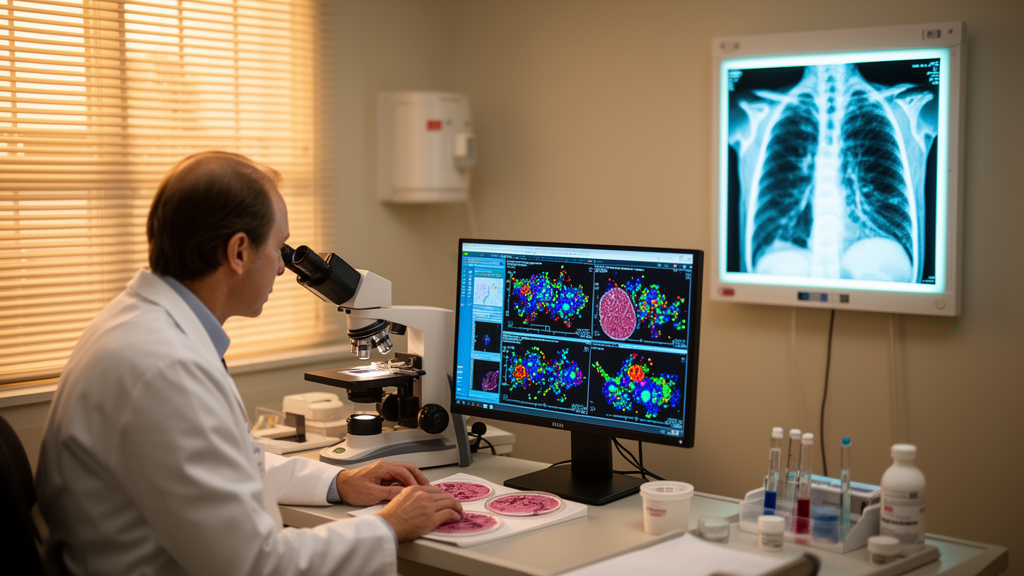
Non-small cell lung cancer (NSCLC) has become the leading example of how molecular biomarkers can transform cancer care. A recent editorial published in Frontiers in Oncology by Prashanth Ashok Kumar, Sora Ely, and Alina Basnet highlights the remarkable progress made in integrating biomarkers into every stage of NSCLC management, from early resectable adenocarcinoma to widely metastatic disease. The authors argue that the field has reached a point where more than a dozen biomarkers now guide targeted therapy decisions, and that future advances depend on embracing modern technologies such as artificial intelligence, radiomics, and multi-omics profiling.
The editorial emphasizes that biomarker integration impacts all stages of NSCLC. In surgically resectable disease, Epidermal Growth Factor Receptor (EGFR) and Anaplastic Lymphoma Kinase (ALK) have fundamentally changed both adjuvant and neoadjuvant management through targeted agents like Osimertinib and Alectinib respectively. In 2026, Selpercatinib demonstrated meaningful benefit when used adjuvantly in Rearranged During Transfection (RET) fusion-positive NSCLC, adding yet another actionable molecular alteration to the early-stage treatment algorithm. These developments represent a fundamental shift from a one-size-fits-all approach to a precision medicine paradigm where the molecular profile of each tumor dictates the therapeutic strategy.
In the metastatic setting, the National Comprehensive Cancer Network (NCCN) guidelines now list 13 molecular markers beside PD-L1, HER2, and MET immunohistochemistry (IHC) on which treatment decisions are based. This extensive panel reflects how deeply molecular profiling has penetrated standard clinical practice. However, the authors caution that even within a particular mutation group like EGFR, there can be variations such as EGFR exon 20 insertions that carry poor outcomes and suboptimal response to existing targeted agents. This level of molecular granularity demonstrates that biomarker classification is not merely binary but requires appreciation of specific alteration types and their distinct clinical implications.
Beyond the guideline-recommended biomarkers, treatment decisions in real-life situations also factor in novel markers with established translational science. These include combinations of Tumor Mutational Burden (TMB) and PD-L1, Tumor Infiltrating Lymphocytes (TILs), STK11, KEAP1, and other markers that predict immune-checkpoint inhibitor (ICI) resistance. Artificial intelligence (AI) tools that analyze the tumor microenvironment are also emerging as valuable adjuncts. The authors note that these novel markers, while not yet formally incorporated into guidelines, increasingly influence clinical decisions when comprehensive translational evidence supports their use.
The editorial also highlights biomarkers that help understand tumor biology as pivotal to advancing the field. CCDC58, for instance, when upregulated, resulted in increased cell proliferation. Indoleamine 2,3-dioxygenase-1 (IDO1) expression in both tumor and immune cells may have a prognostic role correlating with survival. Novel genes such as F2, GPX3, KMO, and KYNU have demonstrated prognostic significance, with all three besides F2 being downregulated in lung adenocarcinomas. Their expression may impact sensitivity to chemotherapeutic agents like cisplatin and gemcitabine, suggesting that biomarker discovery continues to reveal new therapeutic vulnerabilities.
Traditional markers like carcinoembryonic antigen (CEA) may have limited utility in the modern era of NSCLC management despite some analyses demonstrating that increasing levels correlate with worse outcomes. The authors argue that biomarkers helping appreciate the biology of the tumor microenvironment must be integrated into staging, prognostication, and eventually treatment decisions. Resistance to treatments and disease recurrence is orchestrated by an interplay of multiple pathologic, immunologic, and molecular characteristics that may be inherent to the tumor or develop over time. A simple anatomic staging based on tumor size, lymph node status, or distant spread alone may not capture this complexity.
While the importance of the tumor microenvironment is increasingly being recognized, the editorial suggests that equal importance should be given to the lymph node immune microenvironment. The authors highlight that germinal center lymphocyte processing of tumor antigens in the lymph nodes may play an important role in lung cancer progression. In fact, the lymphocyte microenvironment may provide valuable information even if the lymph node is not involved with cancer. This hypothesis is supported by other studies showing that lymph nodes draining the tumor have an immunosuppressive environment with significantly higher numbers of regulatory T cells compared to cytotoxic ones, potentially contributing to ICI resistance.
Several biomarkers detecting various arms of the immune response, such as VEGF, MMP9, PD-L1, CD11, and CD66, are available, but their utility and practical use remain uncertain. A standalone marker is usually limited in its ability to discern the complex interplay of various biologic factors. The authors propose that 21st-century technologies and AI-powered tools could potentially simplify this complexity. Single-cell and multimodal transcriptomics, sequencing-based spatial transcriptomics, and imaging-based or high-plex proteomics are examples of such tools that may help refine tumor classification beyond histology, IHC, and individual mutations. These technologies are analogous to Google Earth, as they map out and magnify detailed molecular and immunologic activity down to a very minute level in every physical coordinate of a tissue sample.
Multi-omics data can define molecular subtypes of NSCLC and identify potential novel targets like domain-negative anillin protein (dnANLN), the expression of which has shown susceptibility to docetaxel in vitro. Radiomics is another tool that converts clinical images such as CT and PET scans into high-fidelity quantifiable data, enabling correlation with molecular markers, histopathologic correlates, and other clinically relevant parameters. Through this approach, clinical images can serve as surrogates for markers such as EGFR, TMB, cancer invasiveness, distinguishing benign versus aggressive lesions, and occult metastasis. Radiomics tools such as Computer-Aided Nodule Assessment and Risk Yield (CANARY) have utilized images to predict mutations in TP53, KRAS, and EGFR, offering a non-invasive window into tumor molecular characteristics.
In clinical practice, oncologists frequently encounter scenarios where sufficient tissue, tumor cells, or DNA are not available to perform comprehensive sequencing and all the necessary IHCs listed in the guidelines for NSCLC. Blood-based circulating tumor DNA (ctDNA) is not always sensitive, particularly for fusions where RNA-based analysis on tissue is needed. Patients may not always be willing to undergo repeat tissue biopsy for the sake of sequencing. Radiomics may have a role in such niche clinical situations. A recent study demonstrated that radiomics could identify NSCLC patients at risk for recurrence after neoadjuvant chemotherapy with ICI. Radiomics can therefore serve as a non-invasive, cost-efficient adjunct tool in the prognostication of NSCLC. The authors conclude that improving outcomes in NSCLC is closely tied to advances in biomarker recognition and targeting, and that future studies should embrace modern technology while providing clarity to clinicians on how to utilize these tools in clinical practice.
,
Subject of Research: Editorial: Advancing non-small cell lung cancer management through biomarker integration
Article Title: Editorial: Advancing non-small cell lung cancer management through biomarker integration
Article References: Ashok Kumar, P., Ely, S., & Basnet, A. (2026). Editorial: Advancing non-small cell lung cancer management through biomarker integration. Frontiers in Oncology, 16, Article 2005040. https://doi.org/10.3389/fonc.2026.2005040
Image Credits: AI Generated
DOI: 10.3389/fonc.2026.2005040
Keywords: Editorial, Advancing, non-small, cell, lung, cancer, management, biomarker, integration, scientific research
Cite Scienmag News
Nathaniel Bowman. (October 15, 2026). How Biomarker Integration Is Advancing Non-Small Cell Lung Cancer Management. Scienmag. https://scienmag.com/how-biomarker-integration-is-advancing-non-small-cell-lung-cancer-management/
Nathaniel Bowman. "How Biomarker Integration Is Advancing Non-Small Cell Lung Cancer Management." Scienmag, 15 October 2026, https://scienmag.com/how-biomarker-integration-is-advancing-non-small-cell-lung-cancer-management/. Accessed 15 October 2026.
Nathaniel Bowman. "How Biomarker Integration Is Advancing Non-Small Cell Lung Cancer Management." Scienmag. October 15, 2026. https://scienmag.com/how-biomarker-integration-is-advancing-non-small-cell-lung-cancer-management/


