


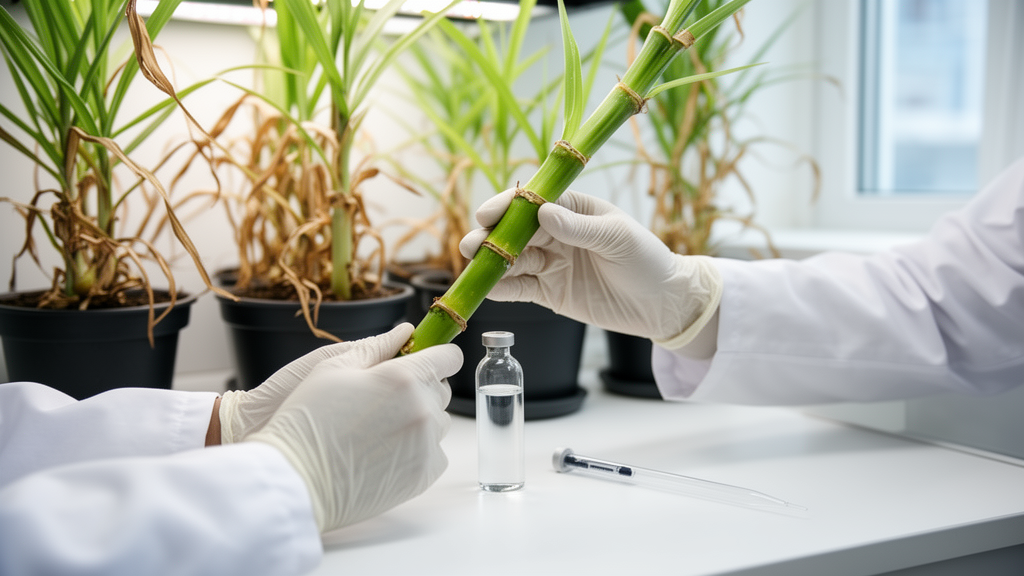
Drought is one of the most punishing forces in global agriculture, and few crops feel its bite more acutely than sugarcane, a giant grass whose towering stalks are packed with water and whose sugar yields collapse under prolonged water deficit. Now, a team of researchers at the ICAR-Sugarcane Breeding Institute in Coimbatore, India, has pulled back the curtain on the molecular machinery that allows certain sugarcane genotypes to endure dry spells that would devastate others. Writing in Molecular Biology Reports, Lakshmi Kasirajan and colleagues describe how they used a classic but powerful technique called suppression subtractive hybridization to catalog the genes that switch on when water becomes scarce, revealing distinct drought-fighting strategies in two different interspecific hybrids.
The significance of the work lies in the genetic raw material the team chose to study. Modern sugarcane cultivars are complex hybrids descended from three founding ancestral genomes, and one of the most important contributors is Saccharum spontaneum, a wild relative that thrives in harsh environments where domesticated varieties struggle. Interspecific hybrids carrying S. spontaneum heritage combine agronomically desirable traits, such as high sugar content and robust growth, with an inherent tolerance to abiotic stresses including drought, waterlogging, and salinity. Understanding which genes underpin that resilience has been a long-standing goal for breeders hoping to develop climate-proof varieties for a world where rainfall is becoming increasingly erratic.
Suppression subtractive hybridization, first described in 1996, is an elegant method for isolating transcripts that are present in one condition but absent or rare in another. The technique works by comparing cDNA populations from stressed and unstressed plants, hybridizing them against each other, and amplifying only the sequences unique to the stressed sample. In this study, the researchers applied the method to two sugarcane genotypes, AS 04-1687 and TS-GS 2024, both derived from S. spontaneum ancestry and both known for their drought tolerance. For AS 04-1687, the subtraction libraries yielded amplicons ranging from 200 base pairs to 1.6 kilobases, while for TS-GS 2024 the range was 250 base pairs to 1.1 kilobases, indicating rich and diverse pools of drought-induced transcripts in both varieties.
After sequencing the raw reads, processing them, assembling the fragments, and functionally annotating the resulting sequences, the team identified 452 differentially expressed drought-induced transcripts in AS 04-1687 and 625 in TS-GS 2024. These numbers represent the molecular vocabulary each genotype deploys when water deficit strikes, and the sheer scale of the response underscores how multifaceted drought adaptation really is. A substantial portion of the identified transcripts in both genotypes was associated with protein modification, a finding that aligns with growing evidence that post-translational adjustments, including ubiquitin-mediated protein degradation and glycosylation changes, are central to how plants retool their cellular machinery under stress.
Perhaps the most striking result is that the two genotypes appear to weather drought through fundamentally different biochemical routes. In AS 04-1687, drought tolerance was linked to coumarin-mediated stress responses. Coumarins are plant secondary metabolites with well-documented roles in antioxidant defense and growth regulation, and their involvement here suggests this hybrid leans on phenylpropanoid chemistry to buffer the oxidative damage that accompanies dehydration. In TS-GS 2024, by contrast, the drought response was governed by an abscisic acid-mediated signaling cascade and the ascorbate biosynthetic pathway. Abscisic acid, or ABA, is the master hormonal regulator of water-stress responses in plants, triggering stomatal closure, osmotic adjustment, and the activation of hundreds of stress-responsive genes, while ascorbate serves as a frontline antioxidant in the cellular battle against reactive oxygen species.
Running through both genotypes, however, was a common cast of transcription factors acting as the conductors of the drought response orchestra. Transcripts belonging to the MYB, NAC, bZIP, SPL, and WRKY families were identified as key regulators of drought stress in both varieties. These gene families are celebrated in plant biology for good reason: MYB factors control phenylpropanoid and flavonoid biosynthesis, NAC factors orchestrate stress-triggered developmental remodeling, bZIP proteins mediate ABA signaling, SPL factors integrate developmental and environmental cues, and WRKY factors sit at the crossroads of stress and defense responses. Their shared involvement across both genotypes points to a conserved regulatory core that any drought-tolerant sugarcane is likely to possess.
TS-GS 2024 added one more layer of complexity that its counterpart did not show. In this genotype, transcriptional regulation via the JAZ family, proteins that repress jasmonate signaling, contributed to coordinating plant defense through ABA signaling, osmotic adjustment, and physiological remodeling. The interplay between jasmonate and ABA pathways is an area of intense interest because it determines how plants balance growth against defense when resources are limited. The presence of JAZ-mediated regulation in TS-GS 2024 suggests that this hybrid fine-tunes its stress response with an additional hormonal dial, potentially explaining why it activated a larger number of drought-induced transcripts overall.
The team did not stop at cataloging transcripts; they validated their findings with physiological measurements and molecular expression analysis, including quantitative real-time PCR using the established 2-delta-delta-CT method. This combination of subtraction-based discovery, functional annotation, and expression validation gives the results a robustness that pure sequencing surveys sometimes lack. It also demonstrates that suppression subtractive hybridization remains a cost-effective and targeted alternative to whole-transcriptome sequencing, particularly valuable for crops like sugarcane whose genome is one of the most complex in the plant kingdom, with a mosaic monoploid reference sequence only recently assembled and an enormous, polyploid genome that complicates routine genomic analyses.
The practical implications for agriculture are considerable. Sugarcane supports sugar industries and emerging bioeconomies across the tropics, and India, the world’s largest sugar producer, faces recurring droughts that slash yields and threaten farmer livelihoods. By pinpointing candidate genes, the coumarin pathway components in AS 04-1687, the ABA and ascorbate machinery in TS-GS 2024, and the shared transcription factor regulators, breeders now have a molecular shortlist for marker-assisted selection or genetic engineering. Genes from these pathways could be introduced into elite cultivars or used as DNA markers to track drought tolerance through breeding populations, accelerating the development of varieties that maintain productivity on less water.
Beyond the immediate breeding applications, the study adds to a growing body of evidence that wild crop relatives are treasure troves of stress-adaptive genetics waiting to be mined. The research was supported by the Indian Council of Agricultural Research, and the authors emphasize that their findings offer valuable insights for identifying novel genes that enhance drought resistance in sugarcane. As climate change tightens its grip on global water supplies, the humble wild grasses that once grew untamed along riverbanks may hold the keys to keeping humanity’s most important sugar and energy crop alive and thriving. What this study shows, in essence, is that the difference between a wilting field and a surviving one can come down to a few hundred carefully orchestrated transcripts, and that we now know, with unprecedented precision, exactly which ones to look for.
Subject of Research: Drought-induced molecular pathways and stress-responsive transcripts in sugarcane interspecific hybrids identified by suppression subtractive hybridization
Article Title: Identification and functional annotation of drought-induced molecular pathways in sugarcane using suppression subtractive hybridization
Article References: Kasirajan, L., Vargheese, R. L., Sankararaj, I. Y., Sebastiar, S., Angannan, S., Ayyadurai, A., Valiyaparambth, R., & Venkatachalam, A. D. (2026). Identification and functional annotation of drought-induced molecular pathways in sugarcane using suppression subtractive hybridization. Molecular Biology Reports, 53(1), Article 1606. https://doi.org/10.1007/s11033-026-12780-0
Image Credits: AI Generated
DOI: 10.1007/s11033-026-12780-0
Keywords: sugarcane, drought stress, suppression subtractive hybridization, Saccharum spontaneum, abscisic acid, coumarin, ascorbate, transcription factors, MYB, NAC, bZIP, JAZ
Cite Scienmag News
Juliet Wilcox. (October 15, 2026). Sugarcane’s Drought Secrets Revealed Through Subtractive Hybridization. Scienmag. https://scienmag.com/sugarcanes-drought-secrets-revealed-through-subtractive-hybridization/
Juliet Wilcox. "Sugarcane’s Drought Secrets Revealed Through Subtractive Hybridization." Scienmag, 15 October 2026, https://scienmag.com/sugarcanes-drought-secrets-revealed-through-subtractive-hybridization/. Accessed 15 October 2026.
Juliet Wilcox. "Sugarcane’s Drought Secrets Revealed Through Subtractive Hybridization." Scienmag. October 15, 2026. https://scienmag.com/sugarcanes-drought-secrets-revealed-through-subtractive-hybridization/


