


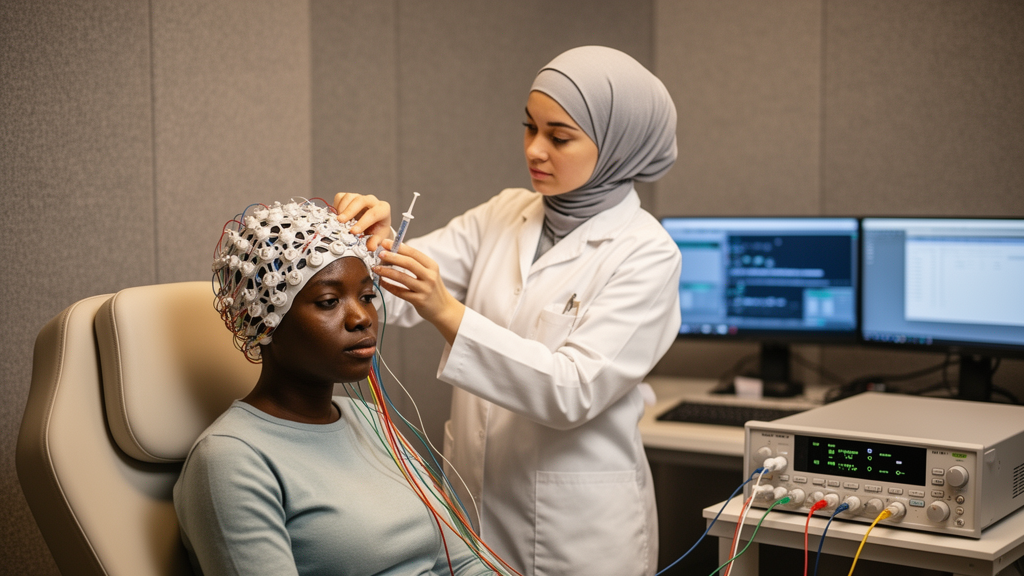
Every year, thousands of electroencephalography (EEG) studies measure the brain’s electrical activity by pressing electrodes against a participant’s scalp. The technique has underpinned a century of cognitive neuroscience and clinical research, from decoding attention to diagnosing epilepsy. Yet a new open-access tutorial in Behavior Research Methods argues that the method itself has quietly filtered out entire communities—most visibly Black participants with afro-textured hair and Muslim women who wear the hijab—producing datasets that are overwhelmingly White and, in turn, findings that may not generalize beyond that narrow base.
The paper, led by Damian Cruse of the University of Birmingham’s School of Psychology and Centre for Human Brain Health, is unusual in both its subject and its authorship. It was co-produced with paid working groups of six Hijabi undergraduate students and six Black undergraduate students, who identified the barriers to EEG participation from their own lived experience and then designed the solutions. The result is a practical manual covering everything from recruitment adverts to electrode fitting, complete with co-produced text, photographs, and open-access videos intended for reuse by labs worldwide.
The scale of the problem is stark. Because EEG electrodes must contact the scalp directly, standard practice involves a stretchy headcap lined with electrodes, held in place with conductive gel or saline. When hair is dense, curly, or coily—a texture typical among Black participants, sometimes called afro-textured hair—researchers often cannot achieve good electrode contact. Rather than adapt, many labs simply exclude such participants in advance, a phenomenon the literature calls phenotype bias. The Birmingham team found a striking illustration: reviewing 76 EEG studies advertised on their university’s participation database, 42—55 percent—explicitly listed hair texture as an exclusion criterion, with wording such as “No afro/thick hair.”
That exclusion carries scientific consequences beyond fairness. The authors note that differences in signal quality between participants with different hair phenotypes can generate apparent, yet spurious, racial differences in brain activity—differences that then feed harmful views of race as biological rather than socially constructed. In clinical contexts the stakes are higher still: the paper draws a parallel with pulse oximetry, where devices calibrated on light skin were shown to overestimate oxygen saturation in Black patients, a bias with documented clinical harm. Claims about EEG biomarkers, the authors argue, carry the greatest moral responsibility for inclusivity.
For Muslim women who wear hijab, the barrier is different but equally systematic. Hijabis do not remove their head-covering in front of men, and the hijab reflects personal boundaries about physical contact with the head and hair—precisely what EEG application requires. Because much EEG data collection is carried out by postgraduate students and postdocs, roughly half of whom are men, a Hijabi woman can contribute to far fewer studies than a non-Hijabi peer. The authors also frame this as a racialized experience: only about 6 percent of British Muslims are White, compared with roughly 80 percent of British academics and PhD students, meaning the researchers designing the protocols rarely share the participants’ experiences.
To quantify these barriers, the team ran an online survey of the university’s student cohort, gathering usable responses from 200 people, about 19 percent of whom reported wearing a hijab and about 14 percent of whom described themselves as Black, African, or Caribbean. The numbers were telling: 48 percent of White respondents had participated in EEG research, compared with just 21 percent of Black respondents. Among Hijabis, 54 percent reported having participated, though the authors caution this may reflect sampling bias, since recruitment targeted people with prior EEG experience in that community.
The free-text survey responses and working-group discussions converged on distinct themes. For Hijabis, the central issue was hesitancy—not knowing whether the researcher would be a man, or whether the hijab would “get in the way.” One respondent wrote that they were “not sure if [they] could approach the researchers and ask if [they] were able to participate.” The recommended remedies centered on accommodations and transparency: “Having female researchers present, preferably if they were Muslim too, would increase participation in my demographic,” one respondent suggested. For Black participants, the themes were hair and past experiences: “I know they’d likely reject me because of my braids so I don’t bother trying,” one wrote, while another stated flatly, “I was rejected because of my race.”
The Hijabi-focused technical solution is a two-part protocol. First, research centres should employ a paid female EEG “operator,” trained in both standard data collection and Hijabi-friendly procedures, who fits the cap and monitors signal quality while respecting the participant’s needs. Second, once the cap is fitted, the participant can loosely wrap a hijab over it, covering any visible hair so that—with consent—the male researcher can enter the room to deliver task instructions consistently. The team recommends labs keep a supply of light-fabric hijabs, such as cotton jersey, since gel-based systems can soil the fabric, and notes that a hijab over the cap also provides reassurance during unanticipated events like building evacuations. Clear privacy signage, camera systems switched off or angled away, and two-room lab layouts with a control room complete the protocol.
For Black participants, the authors argue that adapting existing procedures is more practical than waiting for new hardware, since bespoke electrodes for afro-textured hair would be hard to combine with conventional systems in a single experiment. Net-based EEG systems, in which electrodes sit in a mesh with gaps between them, allow researchers to move hair around each electrode or even pass braids, twists, and locs through the gaps—though care is needed for participant comfort. Saline-based nets also compare reasonably with gel systems on signal quality, although the authors flag that the key comparison study did not report participants’ hair types, and limited evidence suggests afro-textured hair absorbs water less readily, potentially weakening saline contact. Protective hairstyles—cornrows radiating from the crown of the head, for example—can provide excellent scalp access under a standard cap. Rather than demanding participants restyle their hair in advance, which the authors call a significant burden given a documented history of racialized hair discrimination, they recommend clear communication that participants can return whenever their hair is in a compatible style, plus hair-washing facilities stocked with products for the full range of hair textures.
Recruitment is the other half of the fix. The team co-designed participant-facing videos, scripted and presented by the working groups themselves, that explain the procedures from a Hijabi or Black perspective and state explicitly who designed them. They also provide adaptable recruitment wording that separates hair texture from hairstyle—acknowledging that textures are natural characteristics while braids and weaves are choices—explains that setup time varies with hair amount and style, promises reimbursement for that time, and invites participants to ask in advance whether their current hairstyle will work. The authors close with a broader argument: inclusive practices are a moral imperative, overgeneralization from narrow samples risks trapping cognitive EEG research in local minima, and the most effective route to lasting change is a more diverse generation of EEG researchers—one that co-production, open resources, and welcoming labs can help bring into being.
Subject of Research: Inclusive electroencephalography research practices for Black and Muslim participants
Article Title: Inclusive electroencephalography practices for Black and Muslim participation in a White non-Muslim-majority country: A co-produced tutorial
Article References: Inclusive electroencephalography practices for Black and Muslim participation in a White non-Muslim-majority country: A co-produced tutorial. (n.d.). https://doi.org/10.3758/s13428-026-03203-w
Image Credits: AI Generated
DOI: 10.3758/s13428-026-03203-w
Keywords: electroencephalography, EEG, inclusivity, hijab, afro-textured hair, co-production, neuroscience methods, phenotype bias, research participation, Behavior Research Methods, diversity in science, signal quality
Cite Scienmag News
Glenn Wilkins. (October 15, 2026). How EEG Labs Are Finally Learning to Work for Black and Muslim Participants. Scienmag. https://scienmag.com/how-eeg-labs-are-finally-learning-to-work-for-black-and-muslim-participants/
Glenn Wilkins. "How EEG Labs Are Finally Learning to Work for Black and Muslim Participants." Scienmag, 15 October 2026, https://scienmag.com/how-eeg-labs-are-finally-learning-to-work-for-black-and-muslim-participants/. Accessed 15 October 2026.
Glenn Wilkins. "How EEG Labs Are Finally Learning to Work for Black and Muslim Participants." Scienmag. October 15, 2026. https://scienmag.com/how-eeg-labs-are-finally-learning-to-work-for-black-and-muslim-participants/


