


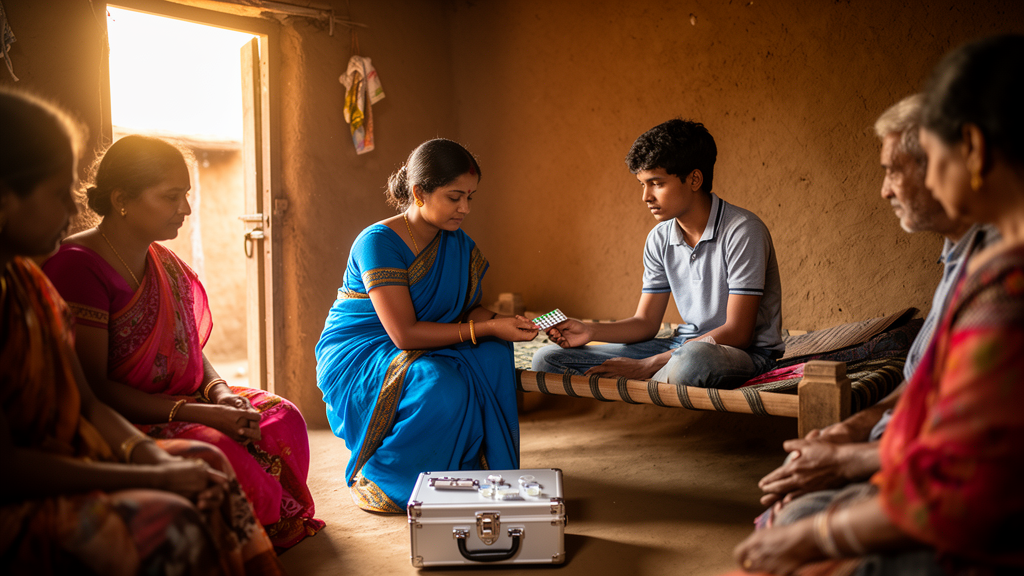
India has set itself one of the most ambitious public health deadlines in the world: eliminating tuberculosis by 2025, five years ahead of the global Sustainable Development Goal target. A crucial pillar of that effort is tuberculosis preventive treatment, the practice of giving antibiotics to people who are infected with the TB bacterium but not yet sick, in order to stop the infection from ever progressing to active disease. In July 2021, the Government of India issued national guidelines laying out how this strategy should be rolled out, with a particular focus on household contacts of people diagnosed with active TB, who face the highest risk of recent infection. Yet a new qualitative study from Pune district suggests that, on the ground, the machinery for delivering preventive treatment is running far below capacity, and that the gap between policy and practice is wide enough to threaten the national timeline.
The study, published in PLOS One by Prakash Prabhakarrao Doke of Dr. D. Y. Patil Medical College and colleagues, set out to identify the factors influencing the implementation and acceptance of tuberculosis preventive treatment in India. Rather than counting cases or measuring drug adherence numerically, the researchers took an implementation-science approach, asking the people who run and receive the program why it works or fails in their experience. Between April and August 2024, the team conducted focus group discussions with medical officers, the physicians who staff public health centers, and with adult contacts of TB patients, alongside in-depth interviews with senior health officers responsible for district-level oversight. The transcripts were transcribed, translated and analyzed thematically using MAXQDA software, with a hybrid inductive-abductive approach that allowed themes to emerge from the data while also being mapped against established implementation frameworks.
The scale of the qualitative evidence base was considerable. Eighty-six health and medical officers took part in eight focus group discussions, while six further discussions were held with adult contacts of index TB cases, and senior health officers were interviewed individually in depth. This dual perspective, capturing both the providers and the intended recipients of preventive care, is what gives the study its diagnostic power. Implementation failures are rarely caused by a single broken link; they arise when the perceptions, knowledge and constraints of health workers and communities misalign in compounding ways. The Pune findings illustrate that dynamic with unusual clarity, revealing a program in which the guidelines exist on paper but the operational details have not penetrated the front lines.
Knowledge emerged as the first and most fundamental fault line. Many health officers had received training in tuberculosis in general, but not specifically in preventive treatment, leaving them uncertain about who should be screened, for how long drugs should be taken, and which regimens were available. Medical officers knew only the isoniazid regimen, one of the older options for latent TB infection, and interferon-gamma release assays, modern blood tests that can help confirm infection, were either unknown to them or simply unavailable in their facilities. This knowledge deficit cascaded directly to patients: medical officers minimally briefed the adult contacts of TB cases about preventive treatment, so families often left the health system without understanding that a preventive option existed at all, let alone what it involved or why the duration of therapy mattered.
The consequences of that communication gap were visible in the uptake of diagnostic services. Very few of the adult contacts underwent blood tests, chest X-rays or sputum examination, and even fewer actually received preventive treatment, with the durations of therapy varying widely, a sign that standardization had broken down. In a program whose entire logic depends on systematically screening every household contact of an infectious case and offering them a complete course of preventive drugs, each missed briefing and each skipped test represents a chain of transmission left unbroken. The mathematics of TB control is unforgiving in this respect: untreated latent infection in a high-burden household is a reservoir that can seed the next generation of active cases, undermining the treatment of the index patient itself.
Beyond knowledge and logistics, the study identified three social and structural forces that shaped screening and treatment decisions. Stigma appeared mainly from the perspective of contacts, who were reluctant to be identified as TB-exposed, a fear that discourages them from presenting for screening or adhering to treatment. Migration emerged as a concern from the health personnel’s perspective, since mobile populations are difficult to follow through a months-long course of preventive therapy, and losing contact with a patient mid-regimen defeats the purpose of treatment. Lack of awareness was cited by both groups, a shared blind spot that left communities uninformed and health workers under-mobilized. These are precisely the kinds of barriers that biomedical interventions alone cannot fix, and they explain why the researchers frame their findings in terms of implementation science rather than clinical medicine.
The supply side of the program showed equally serious strain. The study documented a shortage of trained human resources, meaning that even motivated officers lacked the staffing to conduct systematic contact tracing and counseling. The supply of diagnostic kits and medicines was disrupted at times, interrupting the continuity that preventive therapy demands. When drugs or test kits run out, patients who have already overcome stigma and traveled to a facility may never return, and each such interruption erodes community trust in the program. The researchers also noted that health personnel and contacts alike recommended non-pharmacological measures such as mask use, cleanliness and good nutrition, reflecting an intuitive but incomplete understanding of prevention that underscores the need for clearer communication about what drug-based prevention can and cannot do.
Perhaps the most sobering finding concerns expectations within the health system itself. All of the officers interviewed perceived that TB elimination in India may linger until 2030 rather than being achieved by the national 2025 deadline. That internal skepticism matters, because implementation science has long shown that frontline belief in a program’s feasibility shapes the energy with which it is pursued. If the people running contact screening believe the target is out of reach, the daily urgency of briefing every contact and completing every course diminishes. The officers themselves, however, did not simply diagnose problems; they proposed remedies, including structured training, patient counselling, community awareness campaigns and multi-sectoral collaboration that would bring other government departments into the TB response alongside health services.
The study’s conclusions translate into a concrete agenda. Health personnel capacity building must move beyond general TB training to cover preventive treatment regimens, screening protocols and modern diagnostic tools such as interferon-gamma release assays. Infrastructure and logistics need strengthening so that diagnostic kits and drug supplies remain uninterrupted and staffing levels match the workload of systematic contact management. Stigma mitigation requires multiple strategies, from community engagement to confidentiality protections, because fear of exposure is a direct deterrent to screening uptake. And multi-sectoral collaboration, extending the response beyond the health department, addresses the migration and awareness problems that no clinic can solve alone. Each of these levers maps onto a specific failure mode documented in the Pune data, which is what makes the study actionable rather than merely descriptive.
For a country that accounts for roughly a quarter of the world’s tuberculosis burden, the stakes of getting preventive treatment right could hardly be higher. The Pune study does not question the science of preventive therapy, which is well established; it questions the delivery system, and finds it under-informed, under-staffed and under-communicated at the critical interface between health workers and households. The hybrid inductive-abductive thematic method, anchored in an implementation framework, gives the findings a structure that policymakers can act on, identifying not just that the program underperforms but where in the cascade of screening, briefing, testing and treating it loses people. If India’s 2025 elimination goal is to be salvaged, or its 2030 fallback realized, the evidence from Pune suggests the fastest returns will come not from new drugs or new diagnostics, but from training the workforce, steadying the supply lines, calming the fears of exposed families and coordinating the many arms of government that shape whether a TB contact ever receives the preventive care the guidelines promise.
Subject of Research: Barriers to implementing tuberculosis preventive treatment among health workers and patient contacts in India
Article Title: Factors influencing tuberculosis preventive treatment implementation in India: A hybrid inductive-abductive thematic analysis using implementation framework
Article References: Doke, P. P., Chutke, A. P., Gothankar, J. S., Patil, S. V., Bargaje, M. D., Mitragotri, B., & Pakhale, D. (2026). Factors influencing tuberculosis preventive treatment implementation in India: A hybrid inductive-abductive thematic analysis using implementation framework. PLOS One, 21(10), e0359171. https://doi.org/10.1371/journal.pone.0359171
Image Credits: AI Generated
DOI: 10.1371/journal.pone.0359171
Keywords: tuberculosis, preventive treatment, India, implementation science, contact screening, stigma, public health, PLOS One, latent TB infection, health workforce, Pune, TB elimination
Cite Scienmag News
Kristina Jarvis. (October 15, 2026). Why India’s Push to Wipe Out Tuberculosis Stumbles at the Preventive Stage. Scienmag. https://scienmag.com/why-indias-push-to-wipe-out-tuberculosis-stumbles-at-the-preventive-stage/
Kristina Jarvis. "Why India’s Push to Wipe Out Tuberculosis Stumbles at the Preventive Stage." Scienmag, 15 October 2026, https://scienmag.com/why-indias-push-to-wipe-out-tuberculosis-stumbles-at-the-preventive-stage/. Accessed 15 October 2026.
Kristina Jarvis. "Why India’s Push to Wipe Out Tuberculosis Stumbles at the Preventive Stage." Scienmag. October 15, 2026. https://scienmag.com/why-indias-push-to-wipe-out-tuberculosis-stumbles-at-the-preventive-stage/


