


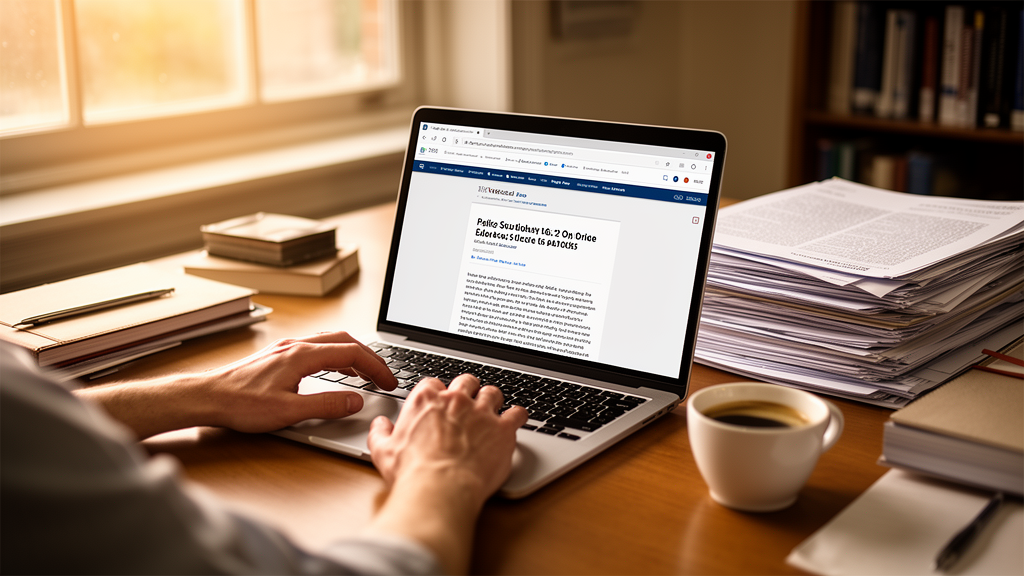
In the fast-moving world of biomedical science, the gap between a manuscript’s formal acceptance and its appearance in a polished, paginated journal issue has long been a source of frustration for researchers, journalists, and clinicians alike. A paper describing a new drug candidate or a toxicological safety finding can sit in a publisher’s production queue for weeks or even months before the final typeset version becomes publicly available. To close that gap, Springer Nature and the journals it publishes, including BMC Pharmacology and Toxicology, operate an early-access mechanism known as the Article in Press. Once a manuscript has been formally accepted after peer review, it is published online in this preliminary form, complete with a permanent Digital Object Identifier, or DOI, that allows the work to be viewed, shared, and cited immediately. The approach reflects a broader shift in scholarly communication toward speed and transparency, and it carries important implications for how new pharmacological and toxicological findings reach the scientific community.
The Article in Press model rests on a simple but consequential premise: the intellectual content of a paper has already been validated by peer review, so the remaining work is largely technical. Copyediting, typesetting, reference linking, and author proofing are production tasks rather than scientific ones. By releasing the accepted manuscript before those tasks are complete, publishers ensure that a discovery enters the public record at the earliest defensible moment. Each Article in Press receives its DOI at this early stage, and that identifier is permanent. When the final Version of Record is later published, it replaces the early-access version while retaining the same DOI, so every citation made in the interim remains valid. This continuity of identifier is what makes the system workable, because citation stability is the backbone of the scholarly record.
For pharmacology and toxicology, where findings can influence drug development pipelines, regulatory submissions, and clinical practice, the speed advantage is more than a matter of convenience. A study reporting an unexpected adverse effect, a novel mechanism of drug action, or a promising preclinical result may be relevant to other laboratories within days of acceptance. Under a traditional publication schedule, that relevance could be delayed by production timelines measured in months. Early access compresses the interval between acceptance and visibility, allowing competing teams to replicate findings, clinicians to weigh emerging evidence, and systematic reviewers to incorporate the most current data. In fields where replication and rapid synthesis of evidence are essential, the difference between weeks and months can shape the trajectory of an entire research area.
The system is not without caveats, and publishers are careful to flag them. An Article in Press is clearly labelled online to indicate that it is not the final Version of Record. The reason is practical rather than cosmetic: errors affecting the content may still be discovered during the final production process. Typesetting can introduce mistakes, references can be mislinked, figures can be rendered incorrectly, and authors themselves frequently catch residual problems during the proofing stage. Corrections made during author proofing are applied to the final Version of Record, not retroactively propagated to every copy of the early-access file that may have been downloaded or cached. Readers who rely on an Article in Press are therefore consulting a version that is scientifically vetted but editorially provisional, a distinction that matters most for numerical data, author lists, and funding statements.
Because of that provisionality, the Article in Press stage also interacts with the correction machinery of scholarly publishing. If a substantive error is identified after acceptance but before final publication, it can be corrected without the formal apparatus of a post-publication correction notice, since the Version of Record has not yet been issued. This gives authors and production teams a built-in window for quality control that did not exist under older print-driven workflows. Once the final version appears, the same DOI persists, and any subsequent corrections follow the journal’s standard correction policies. In effect, the early-access period functions as an extended proofing phase conducted in public view, with the safeguard that the labelled status of the document tells readers exactly how much editorial refinement has taken place.
Open access journals have embraced this model most fully. Springer Nature notes that fully open access journals provide the Article in Press service on every accepted manuscript, meaning that no accepted paper waits behind a production backlog before becoming citable. The alignment between open access and early access is natural: both philosophies prioritize the rapid, unrestricted dissemination of research findings. For authors, this means that the moment of acceptance effectively becomes the moment of publication in the eyes of many indexing services and institutional reporting systems. For funders who mandate immediate open availability of supported research, the early-access DOI provides a concrete, citable artifact that satisfies compliance requirements without waiting for issue assignment.
The mechanics of citation during the early-access period deserve particular attention, because they illustrate how the scholarly record maintains coherence across versions. When a researcher cites an Article in Press, the citation points to the DOI rather than to a volume, issue, or page number, none of which exist yet. Reference managers and bibliographic databases handle these citations by resolving the DOI, which always leads to the current authoritative version of the document. Once the Version of Record replaces the early-access file, the same resolution path delivers the final, typeset article. This design eliminates the broken citations and duplicate records that plagued early attempts at online-first publishing in the late 1990s and early 2000s, when provisional articles sometimes accumulated parallel citation histories that diverged from their final versions.
There is also a communications dimension to the model. Springer Nature encourages authors who wish to organize a press release for their Article in Press to contact their production editor as early as possible in the process. Early coordination matters because science journalists often work on tight timelines, and embargoes, interviews, and multimedia assets are easier to arrange when the publication date is known well in advance. For high-profile pharmacological findings, such as a new compound with therapeutic potential or a safety signal with public health relevance, the ability to plan coverage around an early-access date rather than a distant issue date can determine whether a study captures public attention or slips past unnoticed. The production editor serves as the coordination point, aligning the technical publication schedule with the communications plan.
From the reader’s perspective, the practical guidance is straightforward. An Article in Press can be read, shared, and cited with confidence in its scientific conclusions, because peer review has already been completed. However, users should note the label, quote figures and author affiliations with the awareness that minor corrections may still occur, and revisit the DOI if absolute certainty about wording or data presentation is required. Legal disclaimers applying to the journal apply equally to the early-access version, so the usual cautions about interpreting preliminary findings, particularly in pharmacology and toxicology where translational implications are often drawn cautiously, remain in force. The early-access label is not a warning against use; it is an honest description of the document’s position within the production pipeline.
Taken together, the Article in Press system represents a pragmatic compromise between two competing ideals of scientific publishing: the desire for absolute editorial polish and the desire for immediate dissemination of validated knowledge. By assigning a permanent DOI at acceptance, labelling the provisional status of the document, correcting errors during proofing, and replacing the early version with a final Version of Record under the same identifier, publishers have built a pipeline that preserves the integrity of the citation record while dramatically shortening the wait for new findings. For researchers in pharmacology and toxicology, and for the journalists and clinicians who translate their work, the model means that the most current evidence is increasingly available at the moment it is scientifically ready, not merely when the printing schedule allows. As open access continues to expand across the biomedical literature, the expectation that acceptance and public availability should coincide is likely to become the norm rather than the exception.
Subject of Research: Early-access publication of accepted peer-reviewed manuscripts as Articles in Press with permanent DOIs
Article Title: Articles in Press
Article References: Articles in Press. (n.d.). Original publication
Image Credits: AI Generated
DOI: Not provided
Keywords: Articles in Press, early access publishing, peer review, Digital Object Identifier, open access, Springer Nature, BMC Pharmacology and Toxicology, Version of Record, scholarly publishing, citation stability, author proofing, scientific communication
Cite Scienmag News
Ophelia Keating. (October 15, 2026). Accepted but Not Final: How Articles in Press Are Reshaping Scientific Publishing. Scienmag. https://scienmag.com/accepted-but-not-final-how-articles-in-press-are-reshaping-scientific-publishing-2/
Ophelia Keating. "Accepted but Not Final: How Articles in Press Are Reshaping Scientific Publishing." Scienmag, 15 October 2026, https://scienmag.com/accepted-but-not-final-how-articles-in-press-are-reshaping-scientific-publishing-2/. Accessed 15 October 2026.
Ophelia Keating. "Accepted but Not Final: How Articles in Press Are Reshaping Scientific Publishing." Scienmag. October 15, 2026. https://scienmag.com/accepted-but-not-final-how-articles-in-press-are-reshaping-scientific-publishing-2/


