


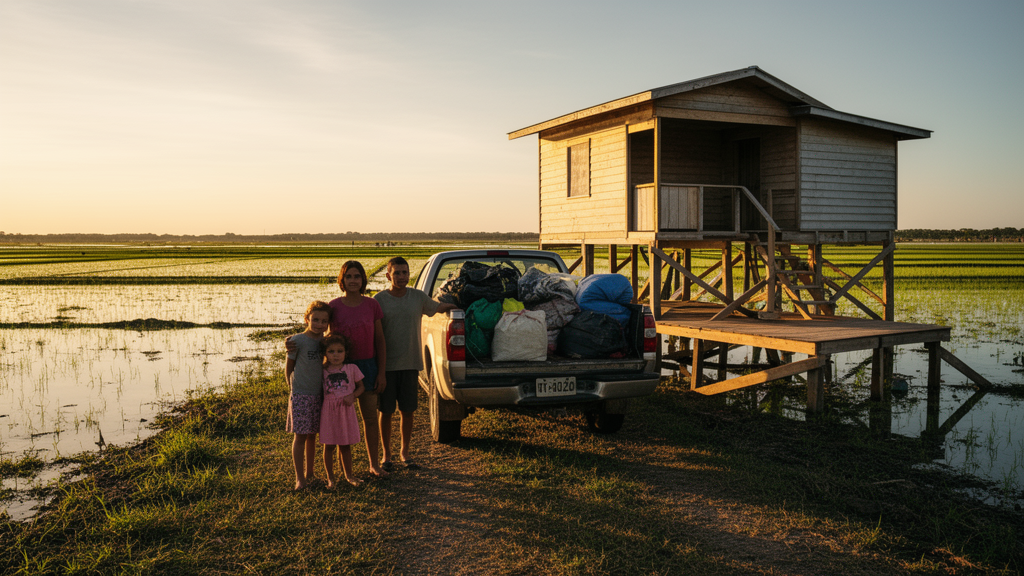
In the flood-prone floodplains and drought-exposed farmlands of Zambia’s Western Province, the decision to leave home and the decision to stay and adapt are often treated by researchers and policymakers as opposite poles of a single choice. A new study challenges that framing. Drawing on survey data from 460 respondents in smallholder households, geographers Eliška Masná and Jiří Hasman of Charles University in Prague found that people’s intentions to migrate in response to environmental change and their intentions to adapt where they live are positively correlated. In other words, the same individuals often hold strong intentions toward both strategies at once, suggesting that mobility and immobility are not mutually exclusive responses to environmental stress but intertwined elements of a household’s broader repertoire of coping options.
The research, published in Humanities and Social Sciences Communications, is among the first to combine Protection Motivation Theory, a well-established psychological framework for understanding how people respond to threats, with the growing mobility–immobility scholarship that examines why some people move while others remain in place under similar pressures. Protection Motivation Theory proposes that a person’s response to a threat depends on how severe and likely they judge that threat to be, how vulnerable they feel, how effective they believe the recommended response would be, how capable they feel of carrying it out, and how costly that response would be. By measuring these cognitive components alongside structural conditions such as remoteness, wealth and social networks, the authors were able to test which factors actually travel with adaptation intentions in a real-world setting.
Western Province offers a compelling laboratory for such questions. The region, home to the Lozi people and their distinctive flood-based agro-pastoral system along the Zambezi River, experiences recurrent droughts, erratic rainfall and seasonal flooding that undermine smallholder livelihoods built around rain-fed agriculture and livestock. Households there have long practiced a form of mobility, including seasonal labor migration, as part of their livelihood strategies, which makes the province an ideal place to ask whether environmental stress pushes people toward leaving or toward transforming how they live at home. The survey, conducted in June 2022 with trained enumerators using electronic structured interviews, captured respondents’ experiences with past environmental events, their perceptions of future risks, and their intentions to either migrate or invest in in-situ adaptation.
To analyze the data, the researchers employed structural equation modelling, a statistical technique that allows researchers to test how multiple hypothesized relationships between latent constructs, such as perceived severity or self-efficacy, and observed outcomes fit the observed data simultaneously. This approach is particularly valuable when the constructs of interest, like a person’s belief in their own capacity to respond to a threat, cannot be directly measured but must be inferred from multiple survey items. The modelling revealed a pattern that cuts against the common assumption of a migration-adaptation trade-off: the correlation between migration intentions and in-situ adaptation intentions was positive, meaning that respondents who felt more inclined to adapt at home were not less inclined to consider migration, and vice versa.
Among the psychological constructs drawn from Protection Motivation Theory, one stood out with striking clarity. Perceived self-efficacy, the belief in one’s own ability to successfully execute a response, showed the clearest positive association with both migration and in-situ adaptation intentions. People who felt capable of acting were more inclined to act, whether that action meant moving or transforming their livelihoods in place. This finding carries a hopeful implication: building people’s sense of agency, through skills, resources and support, may strengthen the whole spectrum of adaptive responses rather than pushing people toward any single strategy. It also echoes a consistent result in the psychology of climate response, where self-efficacy repeatedly emerges as a stronger predictor of intention than fear-based appraisals of the threat itself.
By contrast, most of the other cognitive components of the theory showed only limited associations with the outcomes. Perceptions of the severity of environmental threats, their likelihood, and the perceived costs and effectiveness of specific responses did not translate as strongly into intentions as the classical framework might predict. This is a meaningful result for the field, because it suggests that in contexts of chronic, slow-onset environmental stress, simply informing people about how bad conditions are or will become may do little to change what they intend to do. What matters more, the study implies, is whether people believe they have any real capacity to respond at all, and whether the structural conditions of their lives make response feasible.
Those structural conditions proved consequential in their own right. The researchers found that village remoteness from the provincial capital, socioeconomic status, and the presence of migration networks were all associated with adaptation intentions. Remoteness shapes access to markets, information, services and alternative livelihoods, and thus the practical menu of options a household can realistically consider. Migration networks, the ties that connect a village to relatives and acquaintances who have already moved, can lower the informational and financial barriers to leaving, making migration a more imaginable and attainable strategy. Socioeconomic status, meanwhile, determines whether a household has the resources to invest in either adaptation measures or the costs of moving. The findings underscore that adaptation intentions are not formed in individual minds alone but within geographies of opportunity and constraint.
Perhaps the most counterintuitive result concerns the past. The researchers found that easier coping with past environmental events was negatively associated with both migration and in-situ adaptation intentions. Households that had managed to get through previous droughts or floods without major hardship expressed weaker intentions to either move or adapt. This pattern suggests a kind of experiential complacency: if past events were manageable, the perceived need for deliberate, forward-looking response diminishes. Yet in a changing climate, past manageability may be a poor guide to future stress, and this lag between experience and intention could leave households poorly positioned as conditions worsen. The result also illustrates why experiential and structural factors deserve equal analytical weight alongside psychological ones when researchers try to anticipate how communities will respond to environmental change.
The study’s conceptual contribution lies in demonstrating the value of pairing a psychological model with a broader mobility–immobility perspective. Protection Motivation Theory, on its own, tends to frame responses as individual cognitive calculations, while mobility scholarship emphasizes that staying can be as active and intentional a choice as leaving, shaped by attachment to place, family obligations, and structural immobility as much as by lack of alternatives. By holding both frameworks together, the authors show that migration and in-situ adaptation are best understood as complementary options within a single decision space, both animated by a common sense of capacity to act. For the many people in Western Province and similar settings worldwide, the question is not simply whether to go or stay, but how to secure a livelihood under conditions that are becoming less predictable.
For policy, the implications are equally significant. Programs that aim to enhance climate resilience often focus either on reducing distress-driven migration or on promoting on-farm adaptation, implicitly treating the two as substitutes. This study suggests such a framing may be mistaken. Interventions that strengthen perceived self-efficacy, improve access to information and services in remote villages, support socioeconomic resources, and work with existing migration networks could simultaneously expand the full range of adaptive options available to households. And because households that found past events easy to cope with show weaker adaptation intentions, outreach efforts may need to target precisely those communities that feel least at risk, before accumulating environmental change outpaces their experience-based confidence. As climate pressures intensify across the drylands of southern Africa, understanding the psychology and geography of the decision to stay, as much as the decision to go, may prove essential to helping people navigate what comes next.
Subject of Research: Psychological and structural drivers of migration and in-situ adaptation intentions among smallholder households facing environmental change in Western Zambia
Article Title: Between migration and in-situ adaptation: environmental change and adaptation intentions in Western Zambia
Article References: Between migration and in-situ adaptation: environmental change and adaptation intentions in Western Zambia. (n.d.). https://doi.org/10.1038/s41599-026-09335-w
Image Credits: AI Generated
DOI: 10.1038/s41599-026-09335-w
Keywords: climate adaptation, migration intentions, Zambia, Western Province, Protection Motivation Theory, self-efficacy, smallholder households, environmental change, mobility and immobility, structural equation modelling, human geography, climate resilience
Cite Scienmag News
Sloane Callahan. (October 15, 2026). When Climate Stress Hits, Staying and Leaving May Be Two Sides of the Same Plan. Scienmag. https://scienmag.com/when-climate-stress-hits-staying-and-leaving-may-be-two-sides-of-the-same-plan/
Sloane Callahan. "When Climate Stress Hits, Staying and Leaving May Be Two Sides of the Same Plan." Scienmag, 15 October 2026, https://scienmag.com/when-climate-stress-hits-staying-and-leaving-may-be-two-sides-of-the-same-plan/. Accessed 15 October 2026.
Sloane Callahan. "When Climate Stress Hits, Staying and Leaving May Be Two Sides of the Same Plan." Scienmag. October 15, 2026. https://scienmag.com/when-climate-stress-hits-staying-and-leaving-may-be-two-sides-of-the-same-plan/


